 Eustis Estate
Gallery 1 Highlight : Crispus Attucks
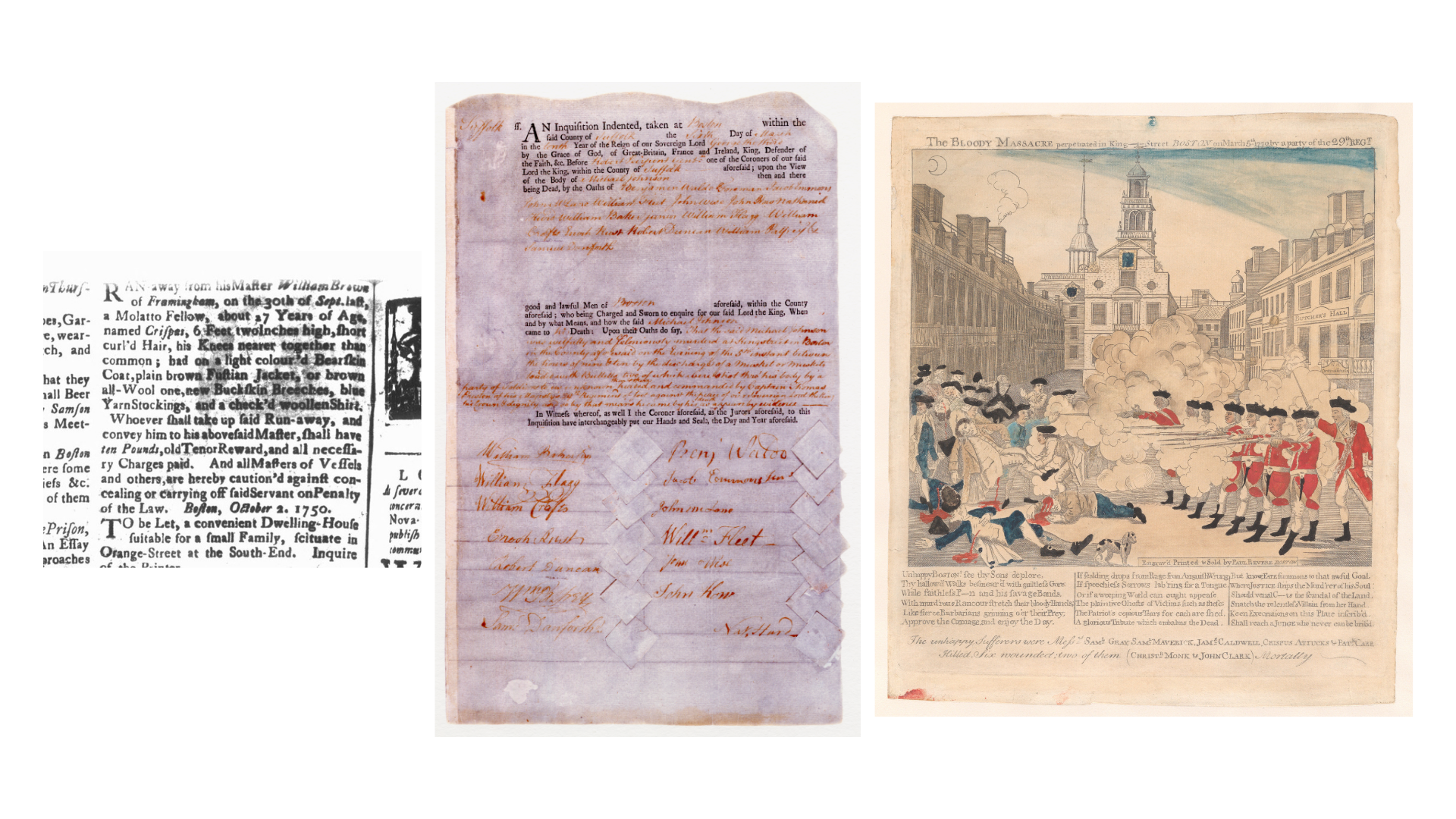
From left to right:
(1) Advertisement, Boston Gazette, October 2, 1750. MyHeritage, Boston Public Library.
In 1750, Deacon William Brown placed a runaway ad in the Boston Gazette for “a Molatto Fellow, about 27 years of Age, named Crispas, 6 Feet two Inches high, short curl’d Hair, his Knees nearer together than common.”
(2) Coroner’s Report, 1770. Courtesy of Revolutionary Spaces.
Crispus Attucks was identified as “Michael Johnson” in this coroner’s report, a name he possibly used to keep from being discovered by his enslavers. Newspapers soon after published his real identity.
(3) The Boston Massacre, Paul Revere, Boston, 1770. Metropolitan Museum of Art.
Paul Revere included Crispus Attucks in his iconic engraving of the Boston Massacre, immortalizing his role in the American Revolution.
One of the most important and intriguing objects in Historic New England’s collection is a pewter teapot with a broken base and a replaced handle. Unremarkable from the perspective of a connoisseur or collector, its true value comes from its association with Crispus Attucks (1723-1770), the first casualty of the Boston Massacre on March 5, 1770.
According to historical accounts, this teapot and accompanying pewter cup belonged to Attucks. Preserved by the family of his former enslavers, these objects transformed from humble household goods to relics of the American Revolution over the course of 250 years, mirroring the evolution of Crispus Attucks from slain protestor to martyr to symbol.
Born to an African father and Natick mother, Attucks was enslaved by the Brown family of Framingham, Massachusetts. In 1750, Deacon William Brown placed a runaway ad in the Boston Gazette for “a Molatto Fellow, about 27 years of Age, named Crispas, 6 Feet two Inches high, short curl’d Hair, his Knees nearer together than common.” Whether or not Attucks was captured remains unverified, but he spent most of his adult life traveling between colonial ports in America and the Caribbean.
Attucks was among the group of colonists who clashed with armed British soldiers on that fateful day in 1770. One witness testified Attucks “made a blow” at the soldiers, whose retaliatory fire killed him and four others. Immediately following the event, the Sons of Liberty condemned the attack on American colonists, galvanizing support for revolutionary cause. John Adams hailed Attucks as “the hero of the night,” though he later blamed Attucks for “the dreadful carnage” during his defense of Captain Preston and the officers on trial for murder. Paul Revere included Attucks in his iconic engraving of the Boston Massacre, immortalizing his role in the American Revolution.
After his death, Attucks would have remained a footnote in history were it not for William Cooper Nell, a Black abolitionist. Nell revived the memory of Attucks as part of a broader anti-slavery campaign in New England, reframing him as a martyr and a symbol of African American liberation. Nell and his fellow abolitionists established Crispus Attucks Day to commemorate his sacrifice for liberty.
During this time, descendants of former enslaver William Brown approached Nell with the teapot and cup now in our collection, claiming Attucks as their original owner. According to a letter from descendant James W. Brown, a state representative from Framingham, Attucks was recaptured in 1750. He remained enslaved until his death and was permitted to buy and sell cattle and take part in seafaring voyages. In his retelling, Brown described his ancestors as benevolent enslavers and Attucks “faithful to his master.” This story bolstered the provenance of the teapot and cup: Why else would a distinguished New England family hold onto humble, broken household objects with no monetary value? These items were displayed alongside other Revolutionary-era relics during commemorative events. The two pierced holes in the pewter cup may be for hanging it during such festivities.
In 1888, a monument to the Boston Massacre installed in Boston Common depicted Attucks as among “those who first gave their lives to that struggle which led to our birth as a nation,” according to Governor Oliver Ames. Of Attucks’ inclusion on the bronze plaque depicting the five men slain during the conflict, Frederick Douglass wrote: “I am happy in the thought that the Commonwealth of Massachusetts is about to commemorate an act of heroism on the part of one of a race seldom credited with heroic qualities.”
In 1918, Miss S. E. Kimball, a descendant of the Brown family, presented this teapot to the Bostonian Society. In her letter accompanying the donation, Kimball described the teapot as “of no value other than Historic,” and felt its place should be “among the antiques” of the Society. The next year, the Bostonian Society transferred the teapot to the Society for the Preservation of New England Antiquities (today, Historic New England). Founder William Sumner Appleton invited Kimball to see her donation “placed on exhibition, duly labelled. . . among our other pewter household articles.” Though prized by Appleton not only for its rich historical associations but also as a work of colonial craftsmanship, subsequent curators focused solely on its provenance: one mid-century label read, “Formerly owned by Crispus Attucks of Boston Massacre fame” and another, “This battered is starred as it was supposedly once owned by the Mulato slave Crispus Attucks, slain at the so-called Boston Massacre of March 5.1770.” The cup was donated to Historic New England in 1993 as part of a bequest from Eleanor Fayerweather.