 Eustis Estate
“There was the Destruction of the Tee they supposed there to be about 340 Chests destroyed All thrown into the Dock in one Nite etc.”
– Samuel Pierce, December 15, 1773
Resistance took many forms in the years leading up to the American Revolution. Colonists, from farmers and artisans to dockworkers and ministers, made their voices heard amid the brewing conflict with England.
New Englanders resisted taxation laws passed by British Parliament by boycotting imported goods like tea and silk, holding public protests, and forming a Provincial Congress to oppose the Crown-appointed government.
Some colonists documented their thoughts in diaries and sermons while the deeds of others are associated with objects they left behind or made for their commemoration.
This gallery highlights such belongings, preserved by later generations as memorials to large and small acts of rebellion during the American Revolution.
Timeline of Events
February 10, 1763 – The Treaty of Paris
The Seven Years War is concluded. The French concede their territories west of the Mississippi, excluding New Orleans, to the British. The expense of the war leads to a massive English national debt, which Parliament seeks to recoup through taxation of its colonies.
March 22, 1765 – The Stamp Act
The British Government passes an act authorizing a tax on paper goods, such as newspapers and legal documents. The tax faces violent opposition from colonists, spurring groups like the Sons of Liberty to form in 1765. These protests will have ripple effects, leading to the events of the Revolutionary War.
October 19, 1765 – The Resolutions of the Stamp Act Congress
The Massachusetts legislature invites the colonies to send delegates to New York to discuss the Stamp Act, on the motion of James Otis. Only nine colonies send representatives, and six representatives sign the petition addressed to the King of England and British Parliament requesting the act be repealed.
March 5, 1770 – The Boston Massacre
Violence between colonists and occupying British troops break out in Boston as tensions reach an all-time high. A few civilians, including Crispus Attucks, are killed instantly while other members of the mob are injured. The violence of the event will be seized on by figures such as Samuel Adams and Paul Revere to fuel momentum towards the impending revolution.
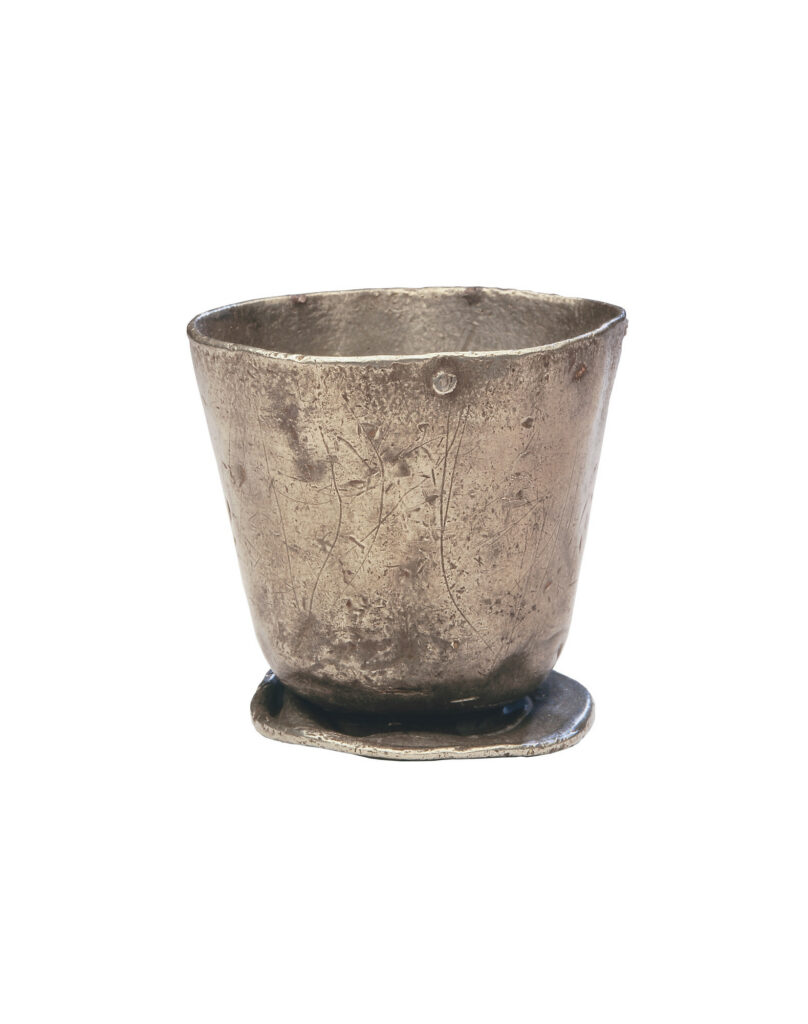
Coroner’s Report
Coroner’s Report, 1770
Courtesy of Revolutionary Spaces
Graphic reproduced for illustration purposes.
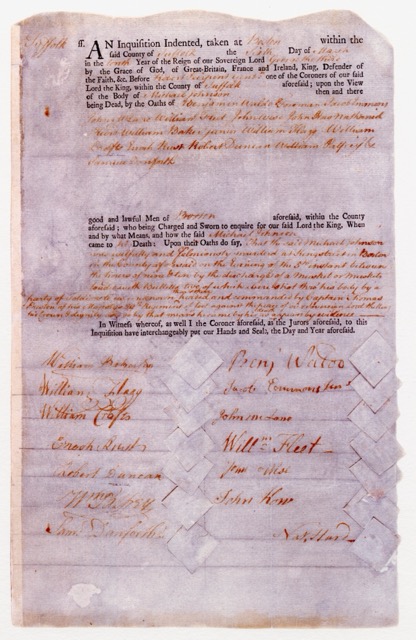
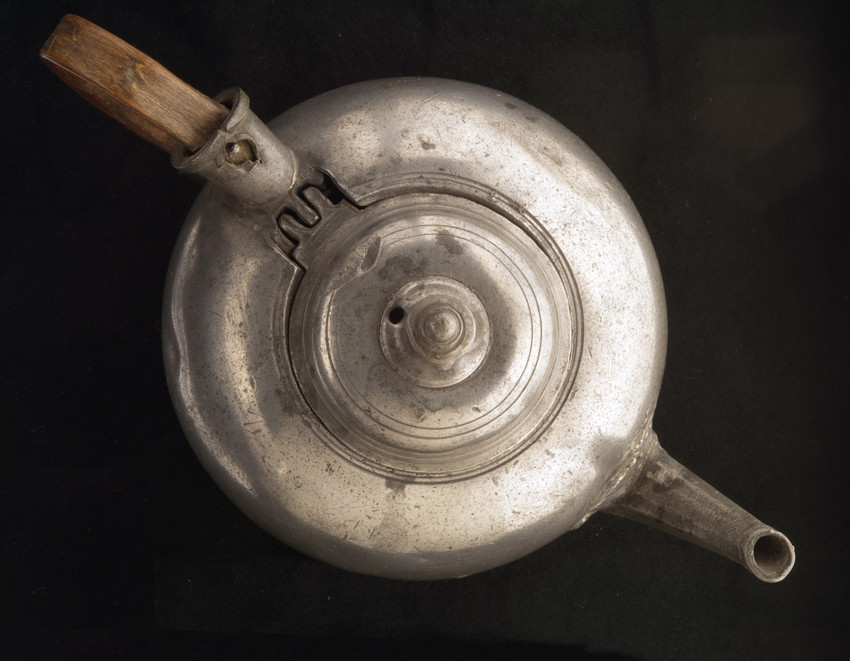
Teapot
Boston, 1750-70
Pewter, wood
Gift of Miss S. E. Kimball
By its history, this pewter teapot and cup belonged to Crispus Attucks (1723-1770), a sailor of African and Indigenous ancestry. Attucks was among the group of colonists who clashed with British soldiers on March 5, 1770, a conflict later called the Boston Massacre. Eyewitnesses described Attucks as the first to die, “killed instantly” by British musket fire. Immediately following the event, the Sons of Liberty condemned the attack, galvanizing support for the revolutionary cause.
Originally donated to the Bostonian Society (now Revolutionary Spaces) by a descendant of the family who had once enslaved Attucks, the teapot was later given to Historic New England. The cup was separately donated by another member of the same family.
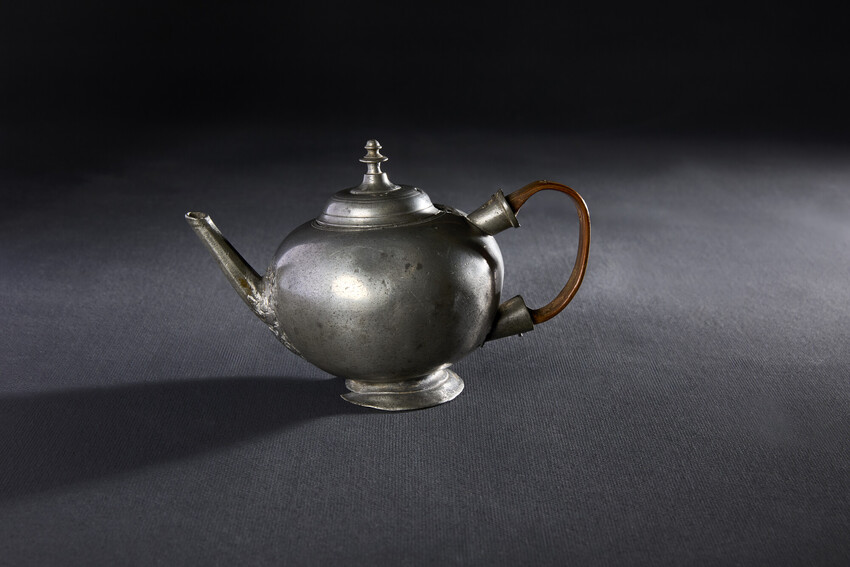
Cup
Boston, ca. 1770
Pewter
Bequest of Eleanor Fayerweather
The Many Lives of Crispus Attucks
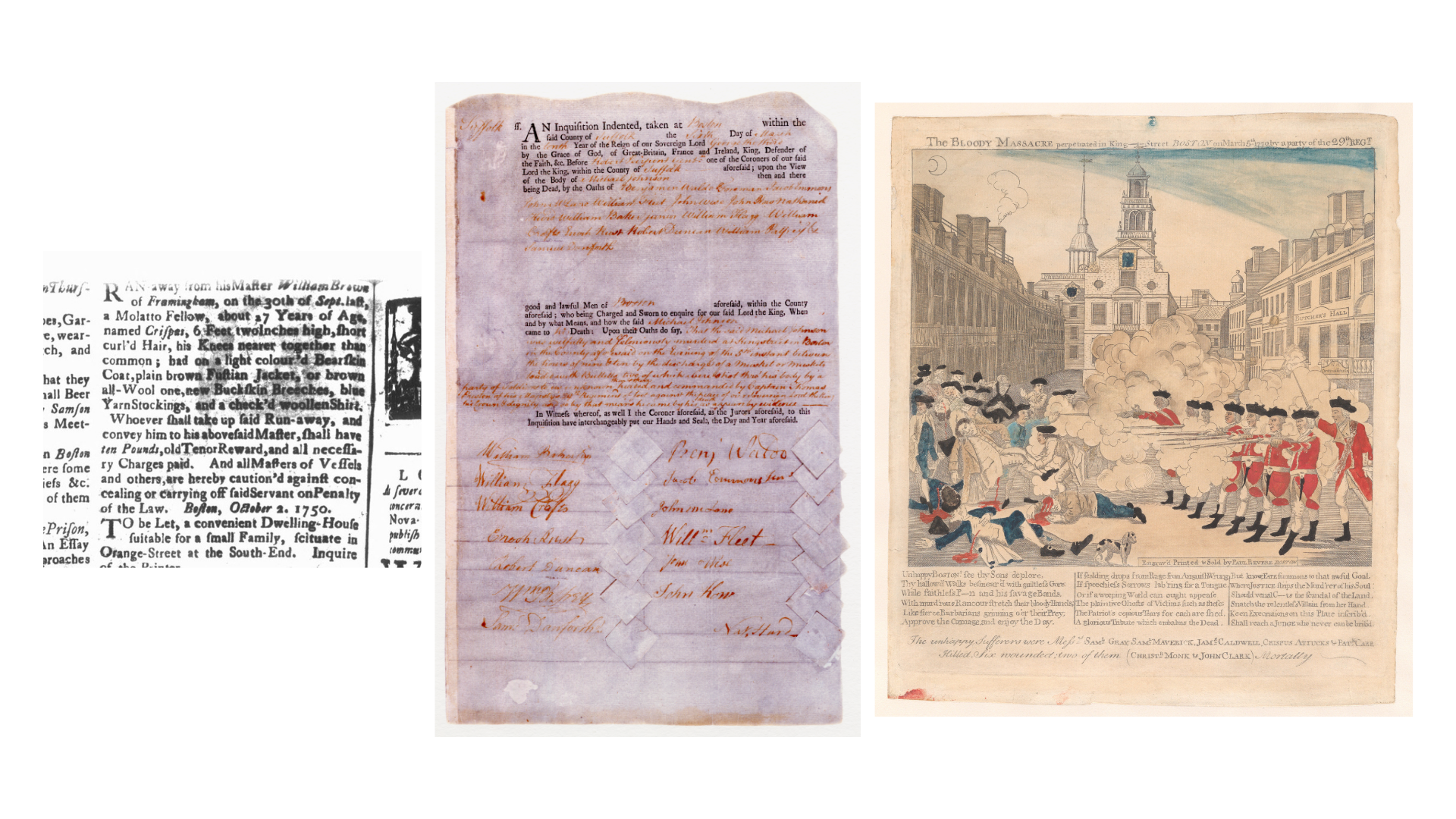
From left to right:
(1) Advertisement, Boston Gazette, October 2, 1750. MyHeritage, Boston Public Library.
In 1750, Deacon William Brown placed a runaway ad in the Boston Gazette for “a Molatto Fellow, about 27 years of Age, named Crispas, 6 Feet two Inches high, short curl’d Hair, his Knees nearer together than common.”
(2) Coroner’s Report, 1770. Courtesy of Revolutionary Spaces.
Crispus Attucks was identified as “Michael Johnson” in this coroner’s report, a name he possibly used to keep from being discovered by his enslavers. Newspapers soon after published his real identity.
(3) The Boston Massacre, Paul Revere, Boston, 1770. Metropolitan Museum of Art.
Paul Revere included Crispus Attucks in his iconic engraving of the Boston Massacre, immortalizing his role in the American Revolution.
One of the most important and intriguing objects in Historic New England’s collection is a pewter teapot with a broken base and a replaced handle. Unremarkable from the perspective of a connoisseur or collector, its true value comes from its association with Crispus Attucks (1723-1770), the first casualty of the Boston Massacre on March 5, 1770.
According to historical accounts, this teapot and accompanying pewter cup belonged to Attucks. Preserved by the family of his former enslavers, these objects transformed from humble household goods to relics of the American Revolution over the course of 250 years, mirroring the evolution of Crispus Attucks from slain protestor to martyr to symbol.
Born to an African father and Natick mother, Attucks was enslaved by the Brown family of Framingham, Massachusetts. In 1750, Deacon William Brown placed a runaway ad in the Boston Gazette for “a Molatto Fellow, about 27 years of Age, named Crispas, 6 Feet two Inches high, short curl’d Hair, his Knees nearer together than common.” Whether or not Attucks was captured remains unverified, but he spent most of his adult life traveling between colonial ports in America and the Caribbean.
Attucks was among the group of colonists who clashed with armed British soldiers on that fateful day in 1770. One witness testified Attucks “made a blow” at the soldiers, whose retaliatory fire killed him and four others. Immediately following the event, the Sons of Liberty condemned the attack on American colonists, galvanizing support for revolutionary cause. John Adams hailed Attucks as “the hero of the night,” though he later blamed Attucks for “the dreadful carnage” during his defense of Captain Preston and the officers on trial for murder. Paul Revere included Attucks in his iconic engraving of the Boston Massacre, immortalizing his role in the American Revolution.
After his death, Attucks would have remained a footnote in history were it not for William Cooper Nell, a Black abolitionist. Nell revived the memory of Attucks as part of a broader anti-slavery campaign in New England, reframing him as a martyr and a symbol of African American liberation. Nell and his fellow abolitionists established Crispus Attucks Day to commemorate his sacrifice for liberty.
During this time, descendants of former enslaver William Brown approached Nell with the teapot and cup now in our collection, claiming Attucks as their original owner. According to a letter from descendant James W. Brown, a state representative from Framingham, Attucks was recaptured in 1750. He remained enslaved until his death and was permitted to buy and sell cattle and take part in seafaring voyages. In his retelling, Brown described his ancestors as benevolent enslavers and Attucks “faithful to his master.” This story bolstered the provenance of the teapot and cup: Why else would a distinguished New England family hold onto humble, broken household objects with no monetary value? These items were displayed alongside other Revolutionary-era relics during commemorative events. The two pierced holes in the pewter cup may be for hanging it during such festivities.
In 1888, a monument to the Boston Massacre installed in Boston Common depicted Attucks as among “those who first gave their lives to that struggle which led to our birth as a nation,” according to Governor Oliver Ames. Of Attucks’ inclusion on the bronze plaque depicting the five men slain during the conflict, Frederick Douglass wrote: “I am happy in the thought that the Commonwealth of Massachusetts is about to commemorate an act of heroism on the part of one of a race seldom credited with heroic qualities.”
In 1918, Miss S. E. Kimball, a descendant of the Brown family, presented this teapot to the Bostonian Society. In her letter accompanying the donation, Kimball described the teapot as “of no value other than Historic,” and felt its place should be “among the antiques” of the Society. The next year, the Bostonian Society transferred the teapot to the Society for the Preservation of New England Antiquities (today, Historic New England). Founder William Sumner Appleton invited Kimball to see her donation “placed on exhibition, duly labelled. . . among our other pewter household articles.” Though prized by Appleton not only for its rich historical associations but also as a work of colonial craftsmanship, subsequent curators focused solely on its provenance: one mid-century label read, “Formerly owned by Crispus Attucks of Boston Massacre fame” and another, “This battered is starred as it was supposedly once owned by the Mulato slave Crispus Attucks, slain at the so-called Boston Massacre of March 5.1770.” The cup was donated to Historic New England in 1993 as part of a bequest from Eleanor Fayerweather.
Samuel Pierce
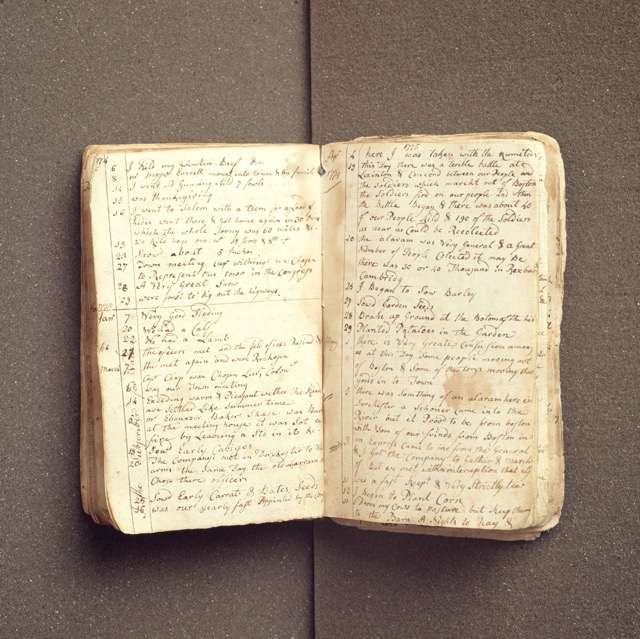
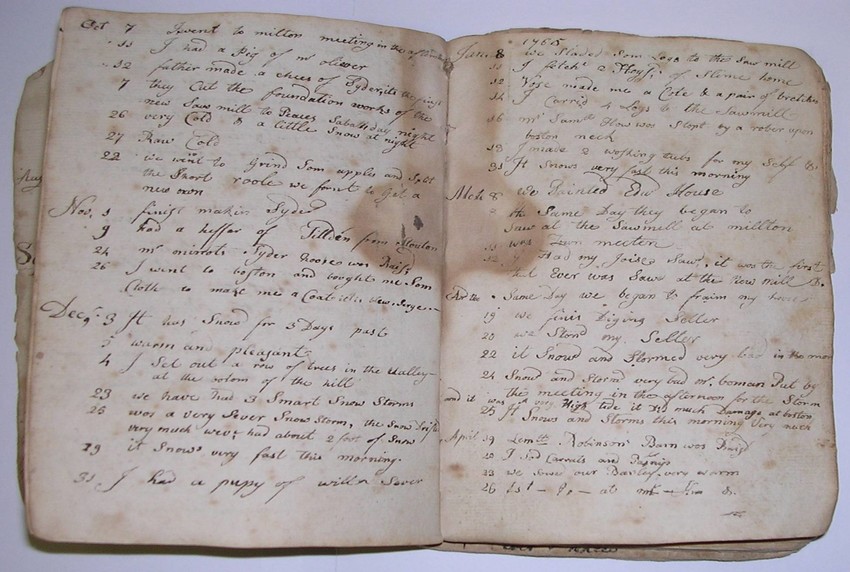
Recording the RevolutionSamuel Pierce used his journal from 1762 to 1797 to keep track of the daily activities of his family, farm, and community in Dorchester, Massachusetts. Between harvests and house raisings, Pierce recorded events like the Boston Massacre, the Boston Tea Party, the Siege of Boston, and the Battle of Bunker Hill. As a colonel in the Massachusetts militia, Pierce took part in the fortification of Dorchester Heights, a strategic military operation that led to the evacuation of the British from Boston in 1776.
Preserved in family hands for more than 200 years, Samuel Pierce’s journal provides a glimpse into the lives of everyday New Englanders who witnessed and participated in the American Revolution.
Click the thumbnail to flip through the Journal.
Journal
Samuel Pierce (1739 – 1815)
Dorchester, Massachusetts
Paper, ink
Pierce Family Papers,
Library and Archives Purchase
Samuel Pierce used this journal from 1762 to 1797 to keep track of the daily activities of his family, farm, and community in Dorchester, Massachusetts. Between harvests and house raisings, Pierce recorded events like the Boston Massacre, the Boston Tea Party, the Siege of Boston, and the Battle of Bunker Hill. As a colonel in the Massachusetts militia, Pierce took part in the fortification of Dorchester Heights, a strategic military operation that led to the evacuation of the British from Boston in 1776.
Preserved in family hands for more than 200 years, Samuel Pierce’s journal provides a glimpse into the lives of everyday New Englanders who witnessed and participated in the American Revolution.
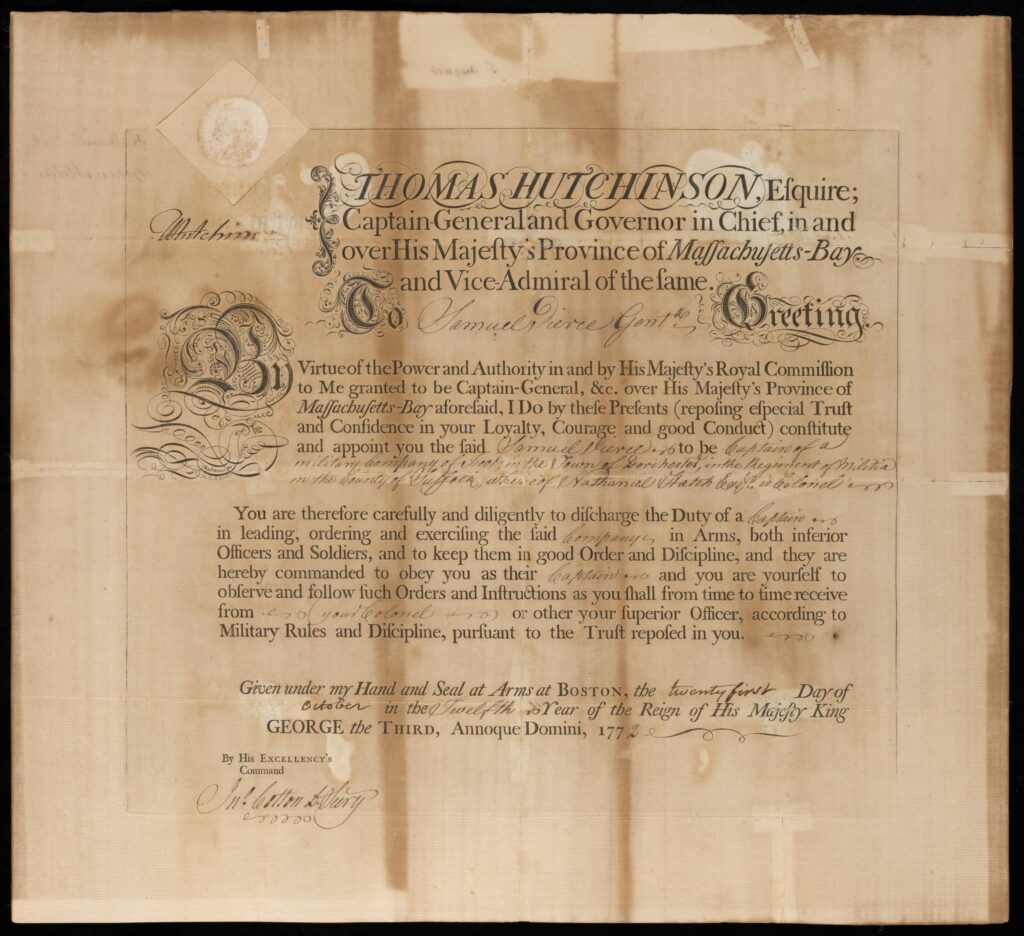
Commission
Captain Samuel Pierce (1739-1815), Dorchester militia, signed by Governor Thomas Hutchinson (1711-1780), October 21, 1772. Pierce Family Papers, Library and Archives Purchase
In 1772, Samuel Pierce accepted a royal commission to become Captain of the Dorchester militia, a position he later resigned in favor of a new commission under the Continental Congress.
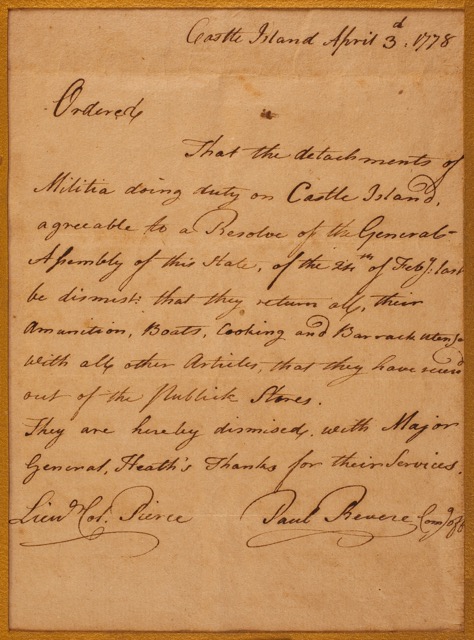
Orders from Paul Revere to Samuel Pierce
Castle Island, April 3, 1778. Pierce Family Papers, Library and Archives Purchase
Samuel Pierce was stationed at Castle Island off Boston Harbor to guard captured British General John Burgoyne. In this letter, commanding officer Paul Revere discharges Pierce and his men and thanks the company for their service.
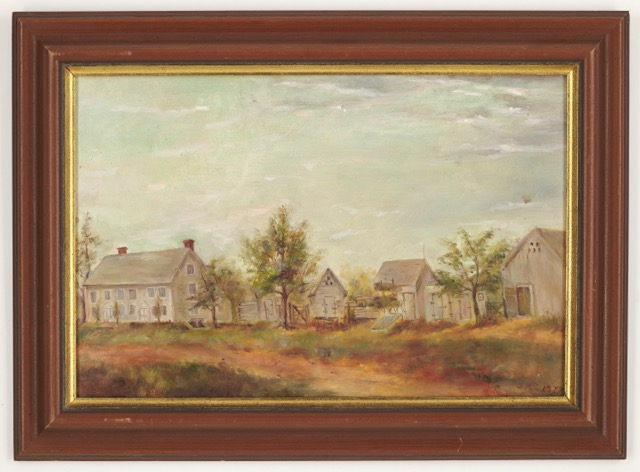
Pierce Farm
Pierce Farm, Courtesy of Judy Pierce
From the Townspeople
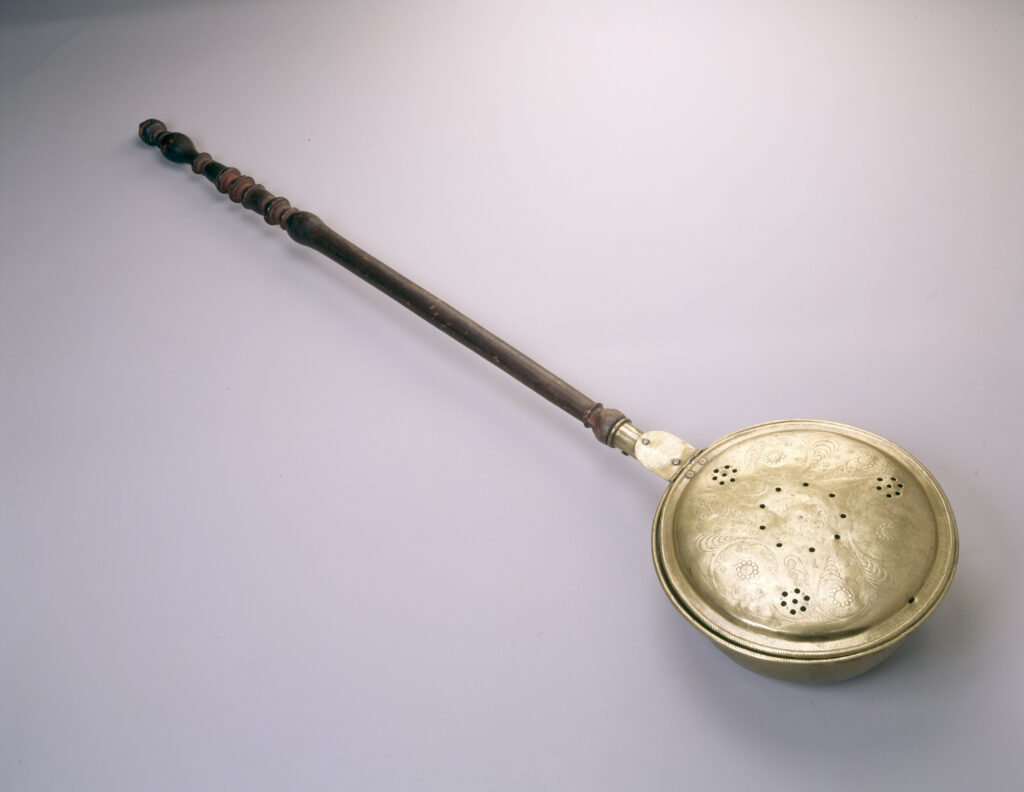
Warming Pan
This warming pan was commissioned by the townspeople of Danvers, Massachusetts, to honor Francis Symonds (1719-1775). The brass lid and pan are engraved with the inscription:
“Francis Symonds Esq.
Innkeeper and Poet
Patriot and Friend
of Gen. Washington
From the Townspeople”
Francis Symonds owned the Bell Tavern, a popular meeting place in South Danvers (now Peabody), Massachusetts, and a site of revolutionary activity.
In 1770, the Sons of Liberty brought an accused seller of boycotted tea to the tavern and made him sign a confession and apology. The morning of April 19, 1775, local militia companies gathered at the Bell Tavern before marching to Menotomy (now Arlington) to intercept British Regulars returning to Boston. Symonds himself took part in the Battle of Menotomy, the bloodiest engagement of the day.
Noted collector and scholar Nina Fletcher Little acquired the warming pan from a dealer in the 1960s. By its history, the pan was made in the 1780s and presented to Symonds in recognition of his deeds for the town. However, an obituary in the Essex Gazette confirms Symonds died of sickness in September 1775. The warming pan was therefore likely made around 1835 when the town of Danvers celebrated the sixtieth anniversary of the Battle of Lexington and Concord by erecting a monument in front of Bell Tavern. The inscription bolstered the legacy of Symonds as a prominent local citizen.
Boston, early 1800s
Brass, wood
Gift of Bertram K. and Nina Fletcher Little
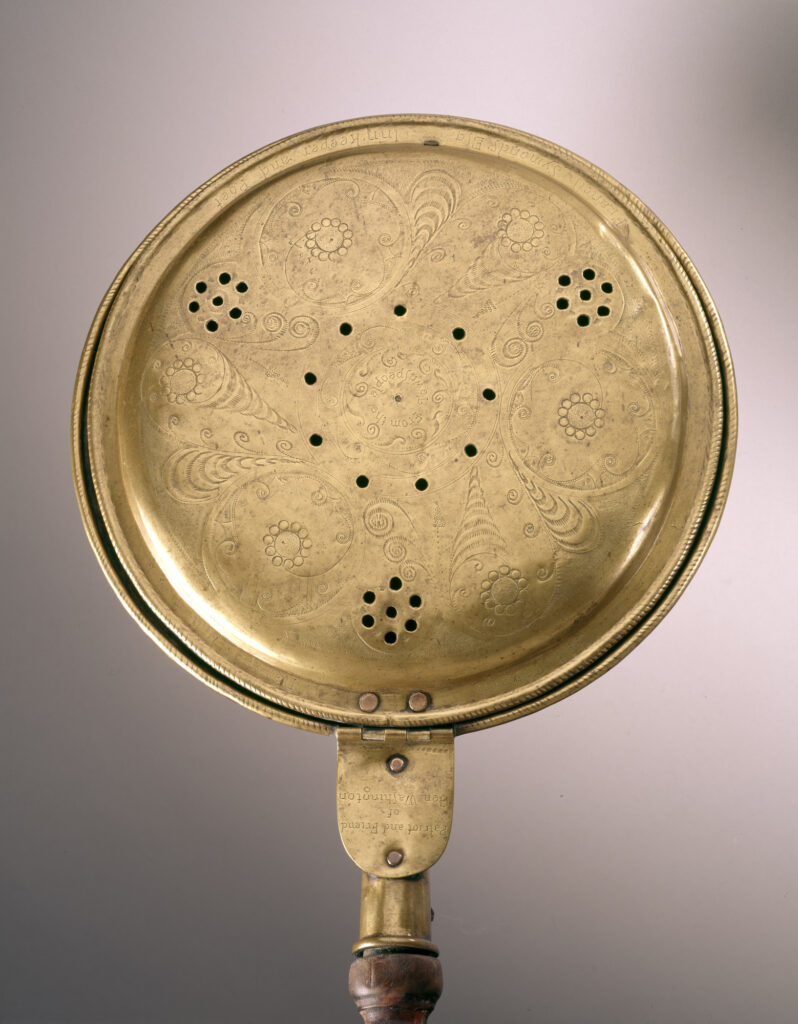
Detail of the Engraving on the Warming Pan
The brass lid and pan are engraved with the inscription:
“Francis Symonds Esq.
Innkeeper and Poet
Patriot and Friend
of Gen. Washington
From the Townspeople”
Behind the Exhibition
Francis Symonds' Warming PanTucked away in the parlor at Historic New England’s Cogswell’s Grant in Essex, Massachusetts, is a warming pan with a turned wooden handle and a brass container pierced with holes and engraved with scrolling vines and flowerheads. Also referred to as bed warmers, warming pans were a common household tool in colonial and post-revolutionary America, filled with embers and placed under the sheets of a bed to warm it before use.
This particular warming pan had more than just decorative motifs adorning its metallic surface. Engraved on its lid are the words: From the Townspeople / Patriot and Friend of Gen. Washington / Bell Tavern, Danvers, Massachusetts / Francis Symonds Esq. Innkeeper and Poet. On the pan’s sides, inside the incised outline of a bell: I’ll toll you / if you have need / and feed you well/ and bid you speed. On the other side: Francis Symonds / makes and sells / the best of chocolate / also shells.
Tea Boxes
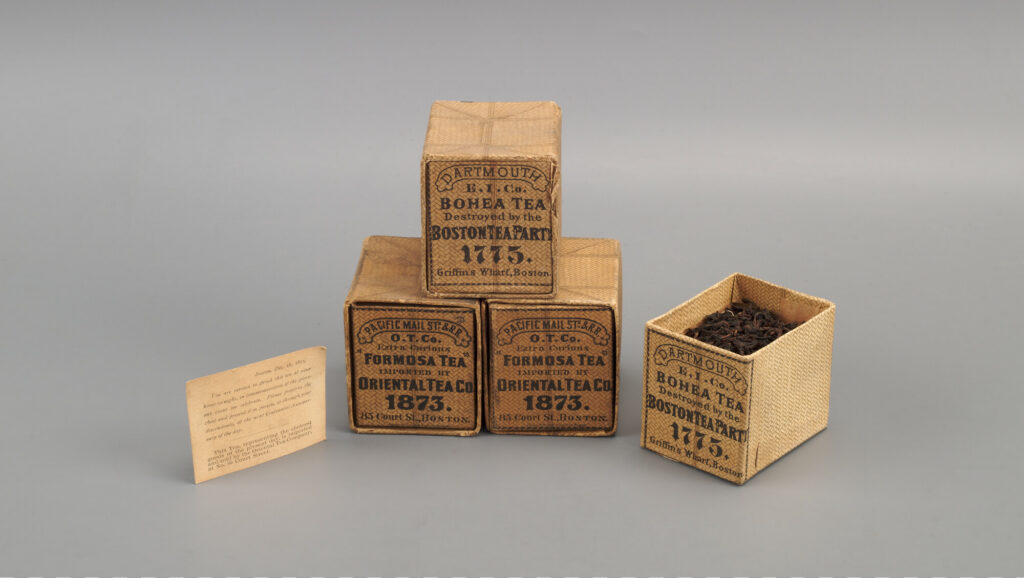
Tea Boxes
Boston, 1873
Paper, tea
Gift of Miss Anne F. Caryl
Estate of Miss Frances Greely Stevenson
Gift of Miss Mary Eustis
At the centennial celebration of the Boston Tea Party in 1873, Boston’s Oriental Tea Company sold souvenir boxes of tea. The company urged purchasers to preserve the box and “present it in person, or through your descendants, at the next Centennial Anniversary of the day.” Historic New England received multiple donations of these boxes over the next several decades.
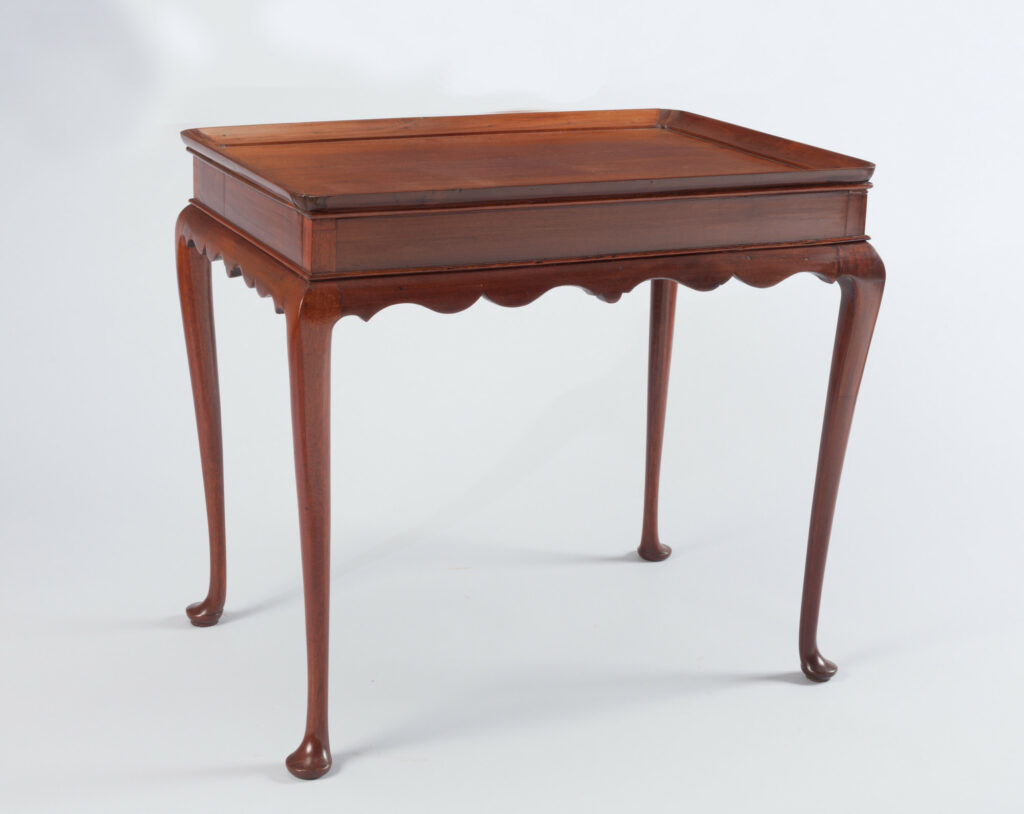
Tea Table
Table
Boston, 1755-65
Pine, maple
Bequest of Caroline Barr Wade
From their home in New Ipswich, New Hampshire, Charles Barrett (1740-1809) and his wife, Rebecca Minott (1744-1838), used this elegant table to participate in the genteel ritual of taking tea. As revolutionary sentiments spread across the state, Barrett was among a handful of prominent townspeople accused of being a Loyalist. He marched to Concord, Massachusetts, with the New Ipswich militia on April 20, 1775, but he only spent one day in service.
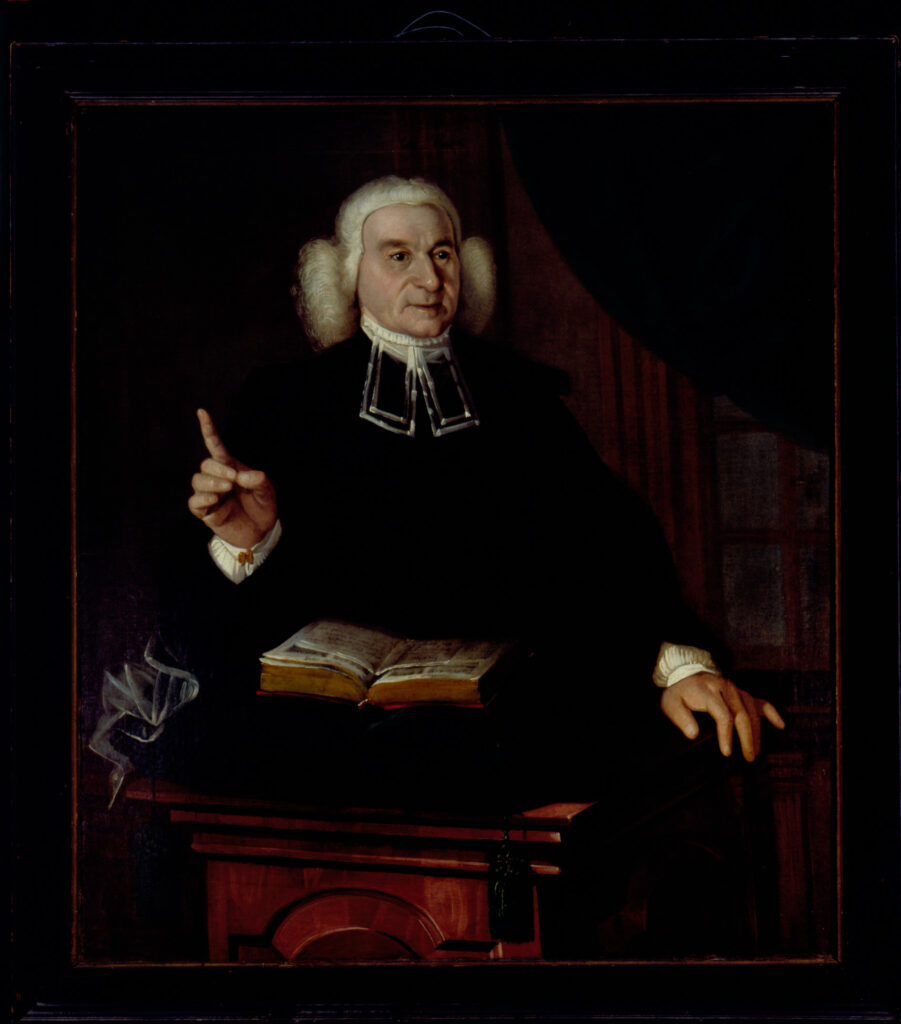
Eli Forbes
Reverend Eli Forbes
Christian Gullager (1759-1826)
Massachusetts, 1785-87
Oil on canvas
Gift of Bertram K. and Nina Fletcher Little
Eli Forbes (1726-1804) served as minister for Brookfield, Massachusetts. In a controversial sermon delivered in 1771, Forbes condemned tyranny but defended the British military occupation of Boston as “necessary to the preservation of the public peace.” Facing harassment from his fellow colonists, Forbes and his family left their parish in 1775. Christian Gullager painted this portrait of Eli Forbes after he fled to Gloucester, Massachusetts, and became minister of its First Church.
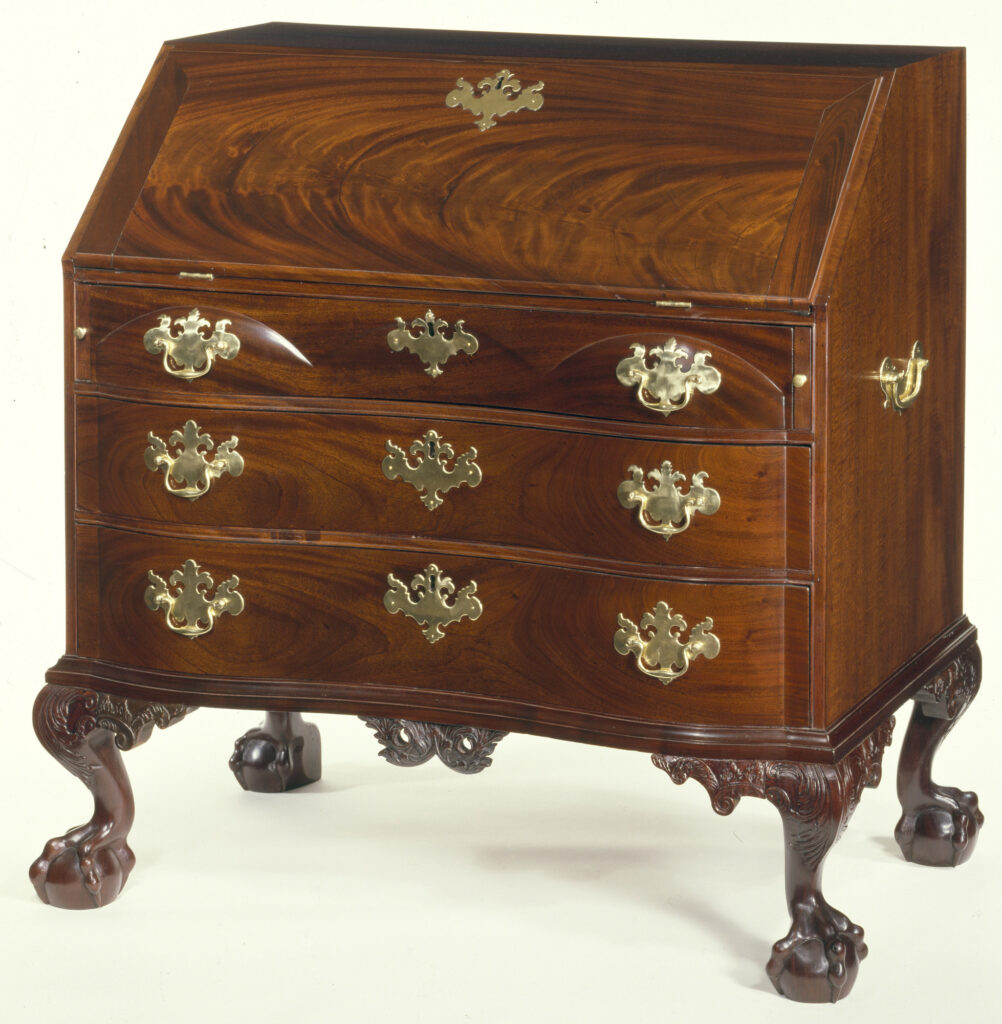
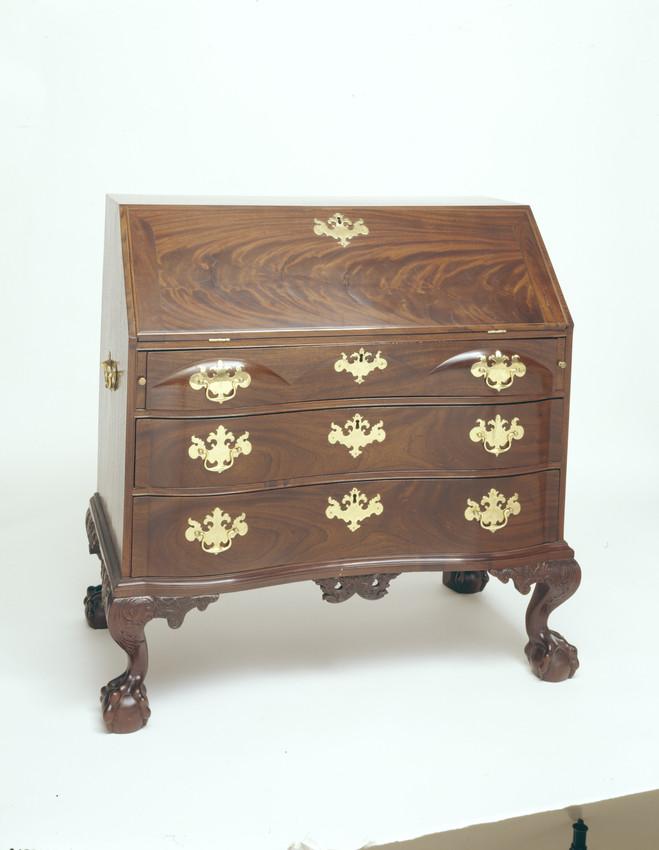
John Austin Desk
Desk
John Austin (1722-1798)
Charlestown, Massachusetts, 1780-86
Mahogany, cherry, white pine, brass
Bequest of Eleanor Clarke Bowser
In the weeks leading up to to the Battle of Lexington and Concord on April 19, 1775, John Austin (1722-1798) was in Concord, Massachusetts, preparing stores of military supplies and rolling musket cartridges for the Provincial Congress. A carver by trade, Austin left behind his livelihood to support the revolutionary cause and was later appointed conductor for the Massachusetts artillery regiment. He continued working for the military throughout the war, guaranteeing a source of income for his family.
By 1780, John Austin was back in his Charlestown, Massachusetts, shop. He likely carved the feet, brackets, and drop finial on this desk, which descended in the family of his son, merchant Thomas Austin (1762-1816). The desk remained with Thomas Austin and his wife Martha Frost at Historic New England’s Cooper-Frost-Austin House in Cambridge, Massachusetts.
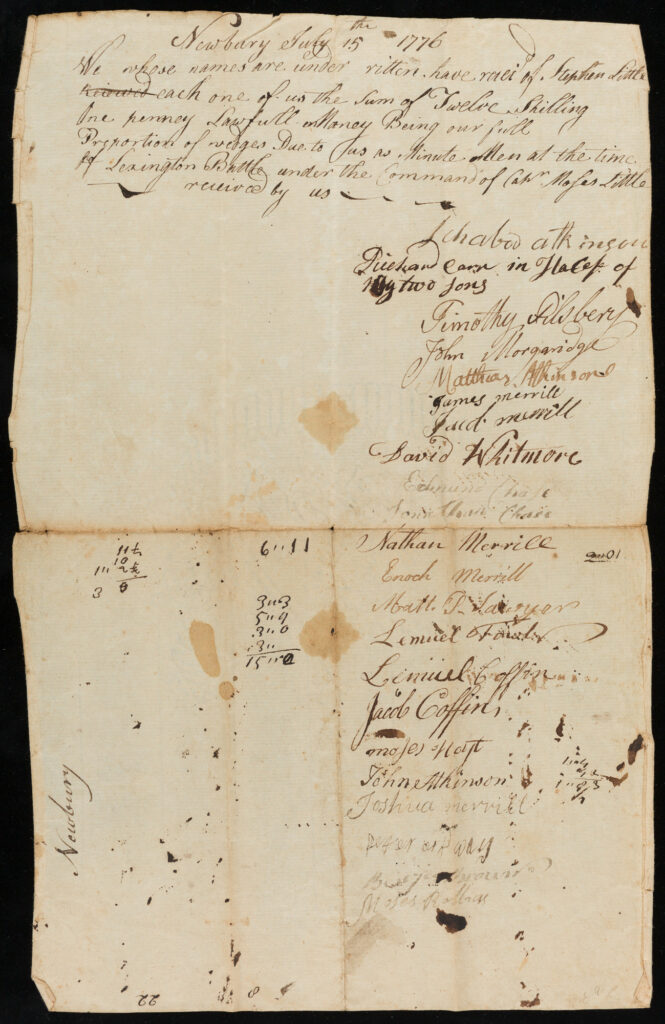
Letter to Stephen Little
Letter to Stephen Little
July 15, 1776
Newbury, Massachusetts
Paper and ink
Little Family Papers,
Bequest of Agnes and Amelia W. Little
On the morning of April 19, 1775, Captain Moses Little (1724-1798) mustered a company of Minutemen and marched from Newbury, Massachusetts, to intercept British Regulars sent to seize a stockpile of military supplies in Concord, Massachusetts. Militia companies kept track of personnel on a list called a muster roll. This letter to Stephen Little (1719-1793), a Newbury town official and brother to Moses Little, is a receipt showing that Stephen Little paid twenty-two of the men on the muster roll the monies owed for their service, with officers receiving more than enlisted men. Even as revolution unfolded across New England, these bureaucratic tasks remained part of everyday life.
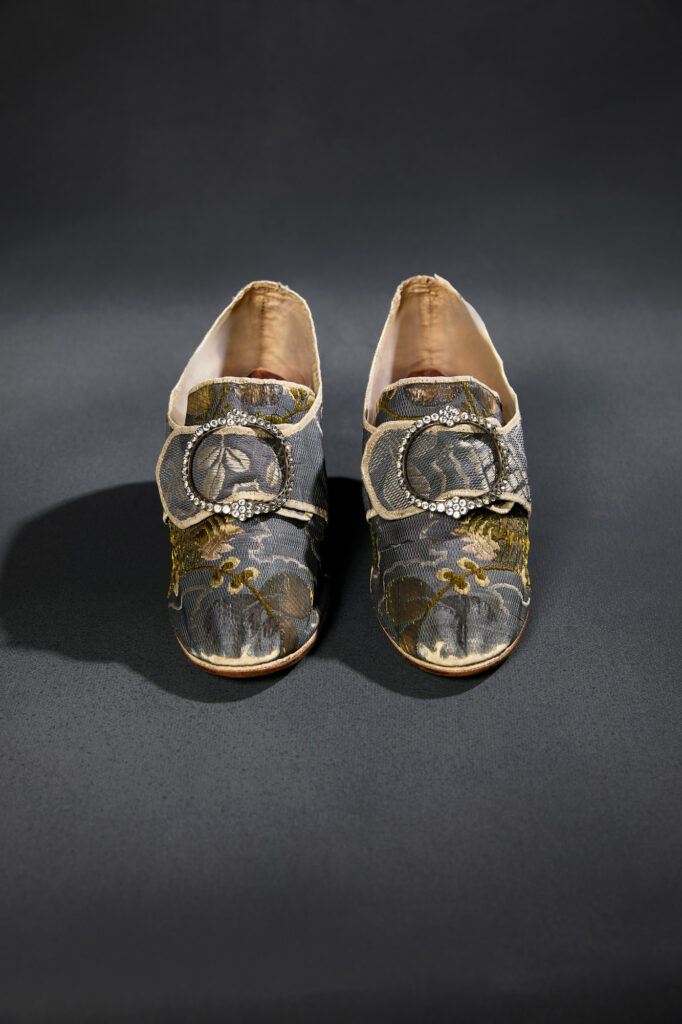
Silk Shoes
Shoes
Winthrop Gray (1740-1782)
Boston, 1765-75
Leather, silk, metallic thread
Gift of the Massachusetts Historical Society
Before the American Revolution, Winthrop Gray (1740-1782) used metallic thread and silk brocade to fashion elegant shoes for Boston’s colonial elite. Gray enlisted in the Continental Army and served from 1776 to 1779. He allegedly resigned his commission after a disagreement with Paul Revere and later opened a tavern in Boston.
Martha Stevens (1715-1785) purchased these shoes after her third marriage to Captain John Stevens (1715-1776), a Boston merchant who commanded a militia company stationed at Fort Ticonderoga, New York, during the war. After his death in 1776, Martha maintained her family inheritance, a vast tract of farmland in Ashford, Connecticut. She bequeathed these shoes to her relative Increase Sumner who donated them to the Massachusetts Historical Society, after which they came to Historic New England.
Photograph courtesy of Joel Benjamin.
Curator's View
Explore More
The next page is Gallery 2.