Eustis Estate
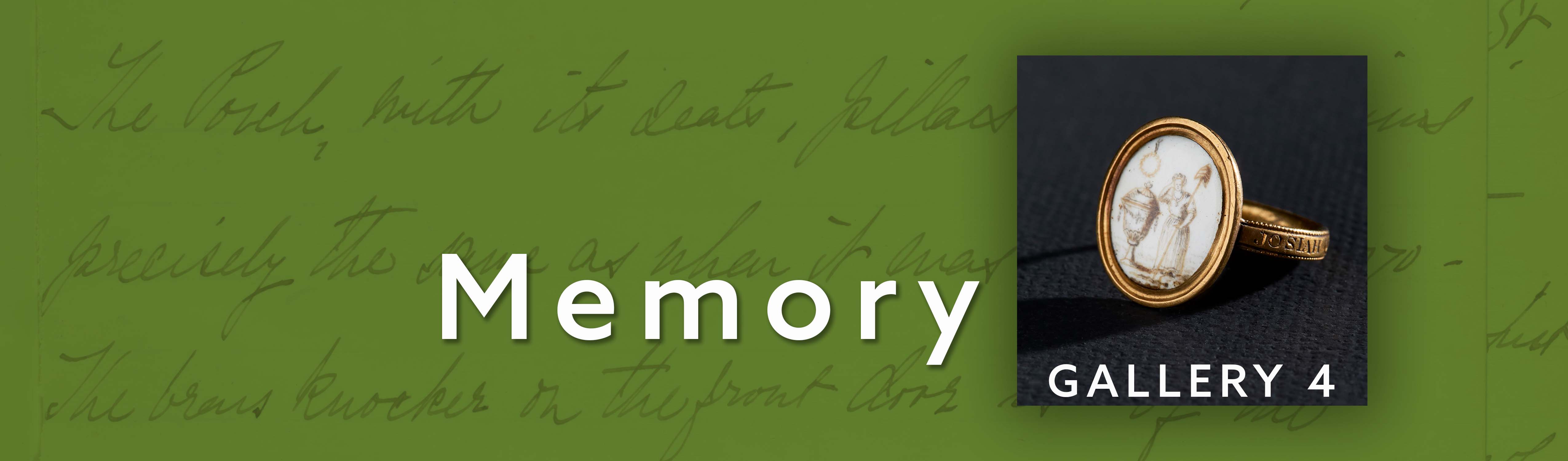
“I…have been thinking more about the past. All the lovely things in the house that have had their stories recorded. I hope someone outside our dear family circle enjoys learning about our family and who we’ve met and what we’ve read.” – Eliza Susan Quincy, July 1866
Even before the War for Independence ended, New Englanders made and preserved objects that commemorated – and sometimes embellished – their memories of the American Revolution. Some of these
objects related to family members who lost their lives, while others documented notable events. Meanwhile, the circulation of consumer goods with patriotic imagery enabled former colonists to demonstrate their new status as American citizens.
Stories of revolution were etched, stitched, painted, and inscribed on objects, which transformed them into powerful artifacts of historical memory.
The objects in this gallery reflect the many ways the American Revolution was crafted and interpreted by its survivors and later generations of Americans. As these objects joined the collection of Historic New England, so did their associated memories become part of the museum’s story.
Timeline of Events
March 1, 1781- Articles of Confederation
Designed as the first constitution, this document is meant to serve Congress during the Revolutionary War. The articles are eventually considered too broad to be of use after independence and are repealed after the Constitutional Convention of 1787, where the Constitution of the United States was eventually ratified.
January, 1782 – Loyalists leave the US
Colonists still loyal to the British evacuate the US to other parts of the Empire, including England, Canada, Africa, and the West Indies. They are compensated for property loss and aided with land grants and professional appointments to help them with relocation.
September 3, 1783 – The Treaty of Paris or The Peace of Paris
The preliminary treaty formally ends the war and ratifies the existence of the United States of America. Great Britain recognizes the US as an independent nation and formalizes its boundaries to the Mississippi River. Canada remains in the possession of the British Empire.
The Quincy Family Remembers
Eliza Susan Quincy (1798-1884) spent her life preserving the memories and belongings of her ancestors at Historic New England’s Quincy House, in Quincy, Massachusetts. She took particular care with those of her grandfather, Josiah Quincy Jr. (1744-1775).
Josiah Quincy Jr. was a gifted orator and author who criticized British Parliament’s unconstitutional oppression of the American colonies. He spent a year in England meeting with authorities to clear up any “gross misrepresentations and falsehoods” spread by former Massachusetts Governor Thomas Hutchinson about the “state of rebellion” among colonists. In 1775, Quincy Jr. set sail for Boston with information that could be delivered only by word of mouth, claiming, “my going now must be of great advantage to the American Cause.” He never made it home, dying of tuberculosis at the age of thirty-one while nearing the coast of Cape Ann, Massachusetts, just days after the events at Lexington and Concord set in motion the battle for American independence.
Quincy Jr.’s contributions to the American cause would, within a few decades, be eclipsed by those of his friends and fellow patriots. Eliza Susan Quincy was zealous in her efforts to keep his legacy alive, working with her father to publish the Memoir of the Life of Josiah Quincy in 1825. She believed, had Quincy Jr. lived, “he would have held the first rank among the statesmen” of the United States.
“I…have been thinking more about the past
All the lovely things in the house that have had their stories
recorded. I hope someone outside our dear family circle enjoys
learning about our family and who we’ve met and what we’ve read.”
– Eliza Susan Quincy, July 1866
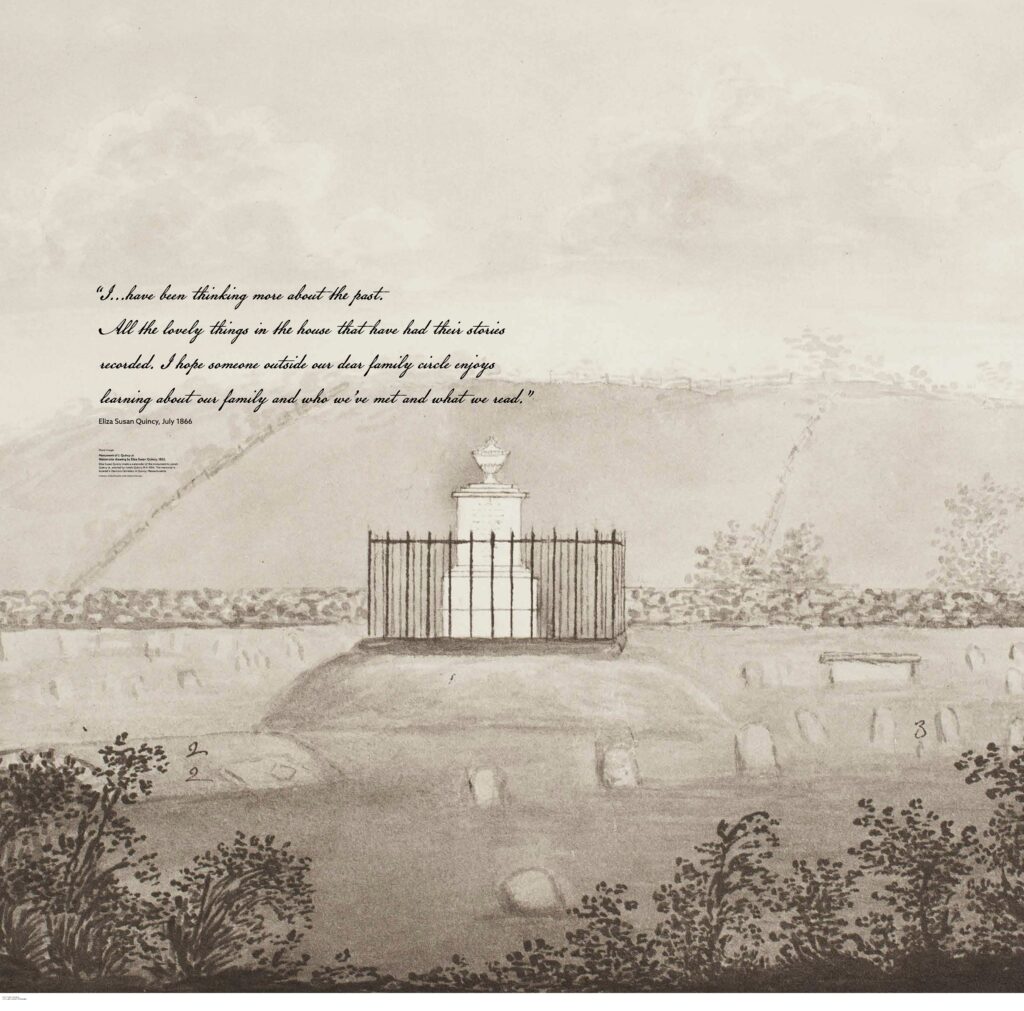
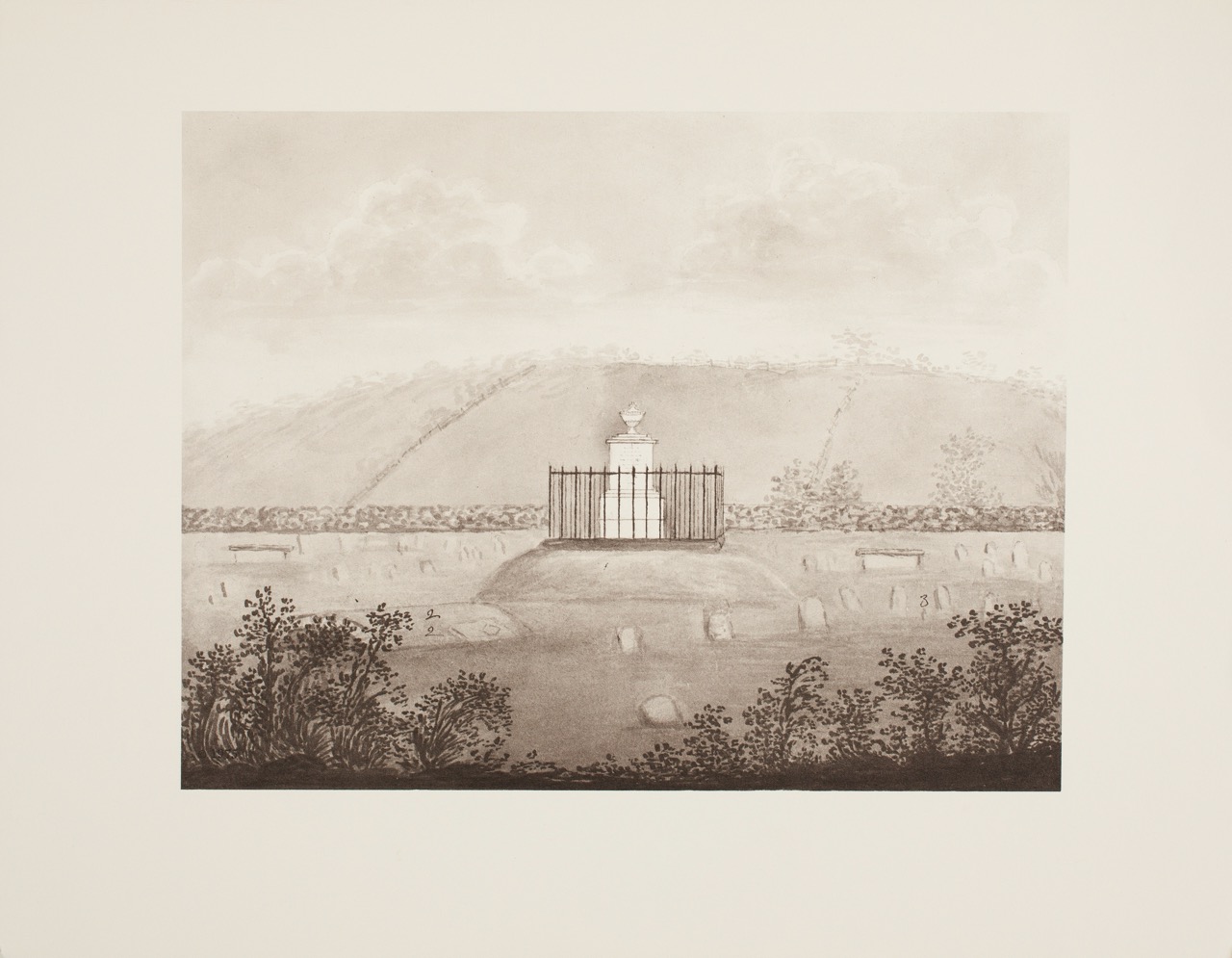
Mural image: Monument of J. Quincy Jr.
Watercolor drawing by Eliza Susan Quincy, 1822.
Elisa Susan Quincy made a watercolor of the monument to Josiah Quincy Jr., erected by Josiah Quincy III in 1804.
The memorial is located in Hancock Cemetery in Quincy, Massachusetts.
Collection of the Massachusetts Historical Society
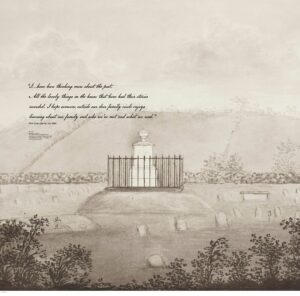
Sword
England, 1770-75
Steel, silver, gilt
Gift of Edmund Quincy
This sword belonged to Josiah Quincy Jr. Quincy was not a soldier and the sword never saw combat. His father, or perhaps his son, had the sword engraved in memory of his spirited defense of American liberties, although, he spent nearly his entire career condemning the use of bloodshed to resolve conflict and frequently invoked the sword in his speeches and writings as a tool to “oppress and enthrall.”
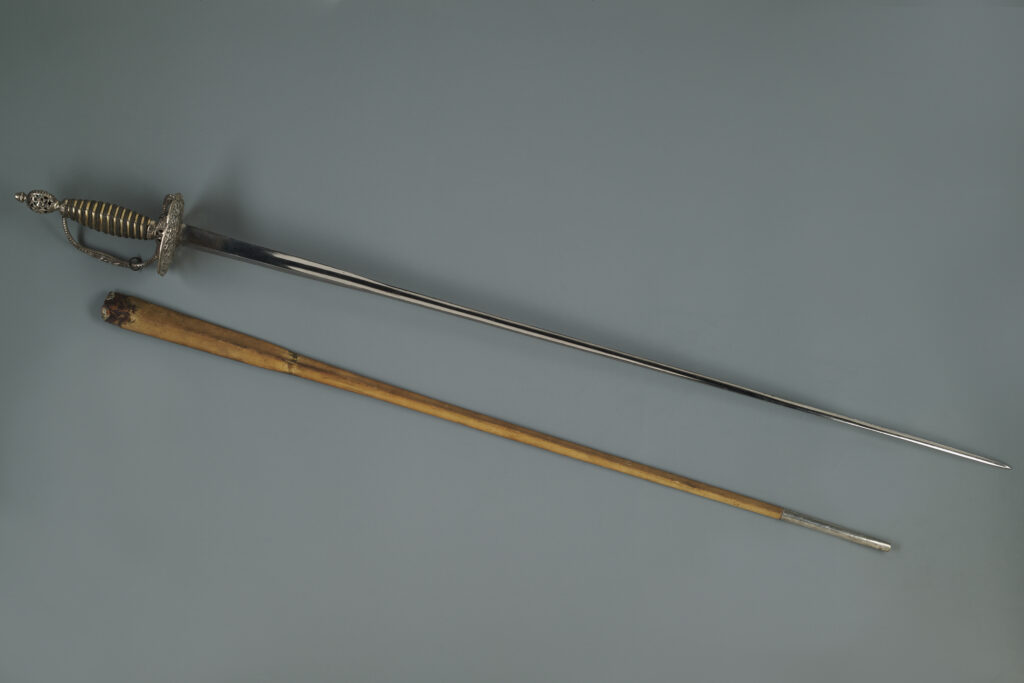
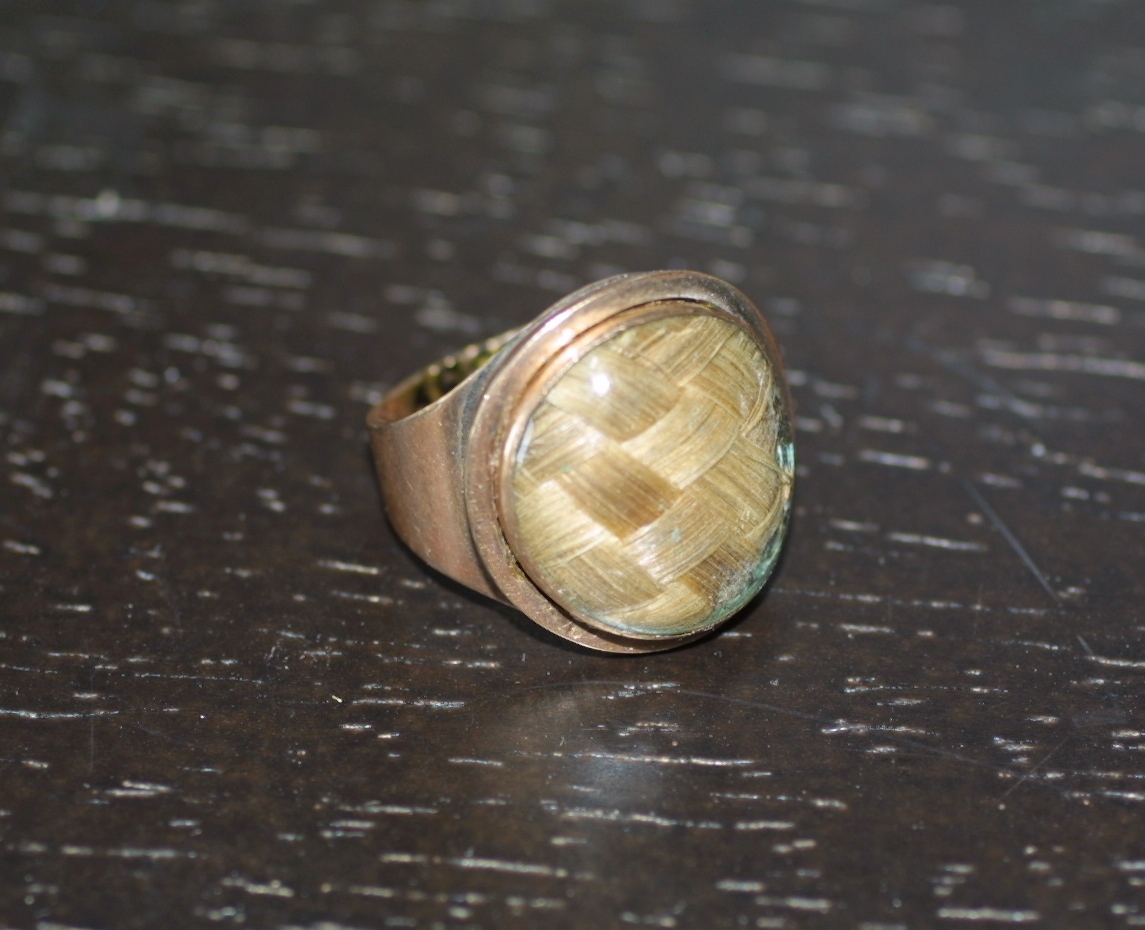
Memorial Ring
Massachusetts, 1775
Gold, ivory
Gift of Edmund Quincy
According to Eliza Susan Quincy, this ring was acquired by Josiah Quincy Jr. in London as a present for his father and given to his wife, Abigail, for safekeeping. Josiah’s tragic death prompted Abigail to engrave the ring in honor of her late husband, bearing the inscription: “Oh, save my country, were his last.” His father Colonel Josiah Quincy wore the ring throughout his life and passed it onto his grandson, “wishing the motto engraved upon it may never be forgotten or neglected by him.”
Photo courtesy of Joel Benjamin.
Pane of Window Glass
Massachusetts, 1700s
Glass
Collection of Edmund Quincy
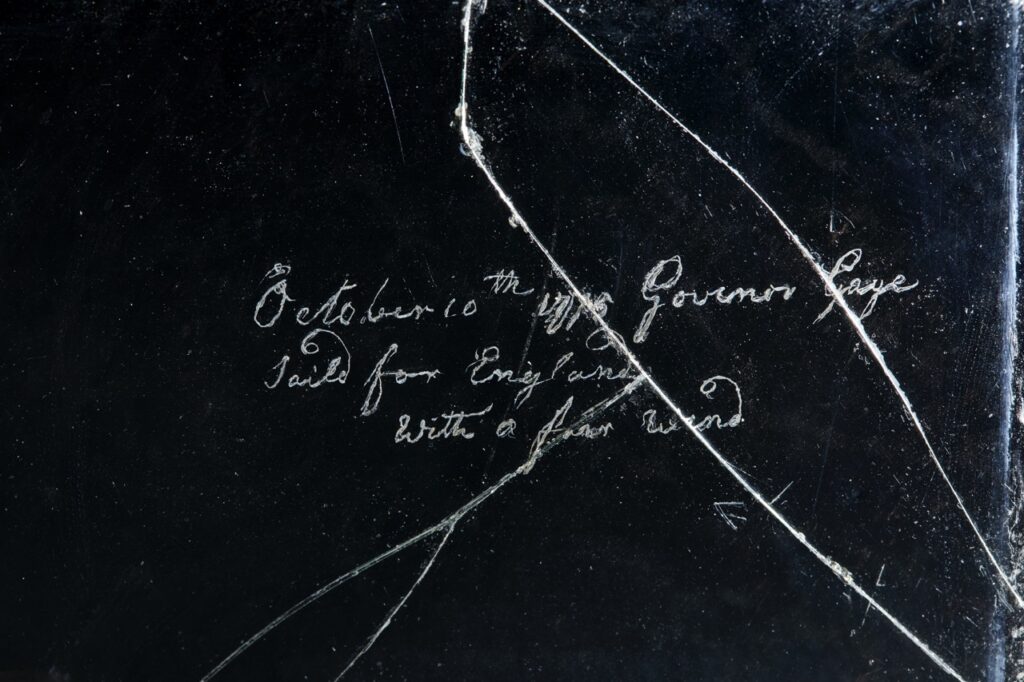
This cracked pane of glass is originally from the monitor at the top of Quincy House, which in the eighteenth century afforded a clear view of Boston Harbor. By its history, Colonel Josiah Quincy spent hours there watching troop movements during the American Revolution. On October 10, 1775, he scratched “Governor Gage sail’d for England with a fair wind” onto the glass, referring to General Thomas Gage’s departure to England after the British defeat at the Battle of Bunker Hill.
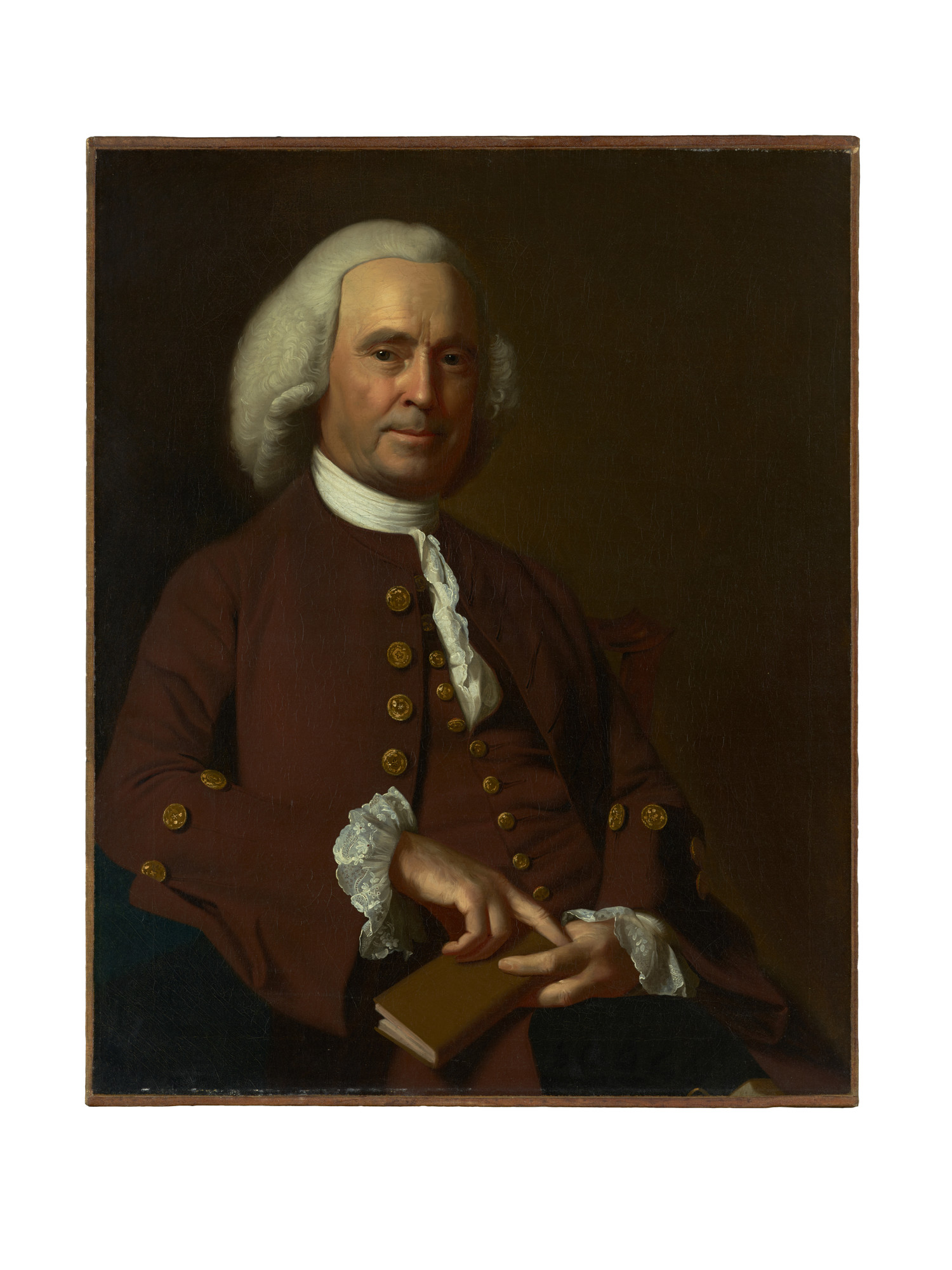
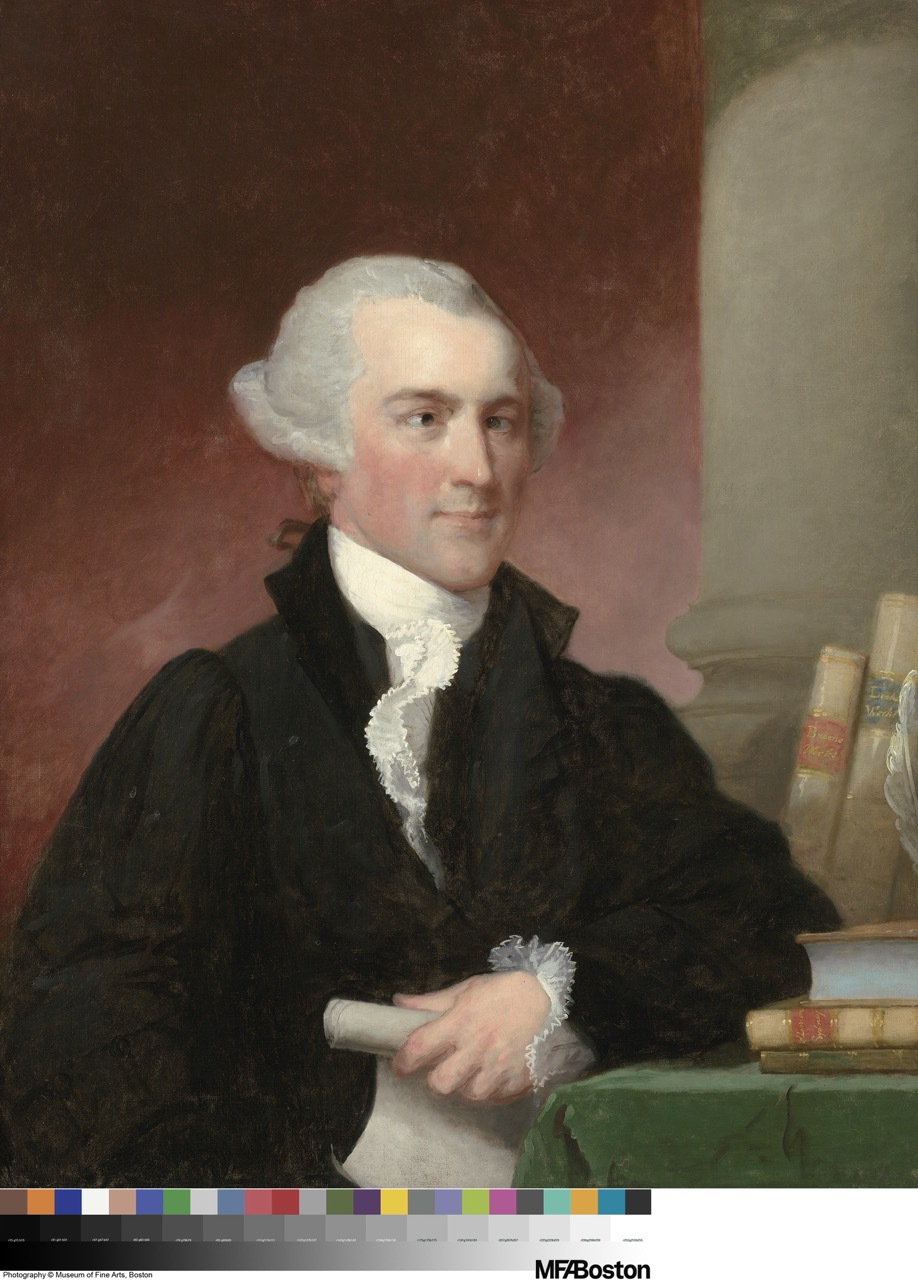
Josiah Quincy
Copley, John Singleton (1738-1815) Portrait of Josiah Quincy c. 1767 Oil on Canvas Massachusetts, Boston Photograph © Dietrich Foundation
Quincy House Interior
Parlor at left of entrance, Josiah Quincy House, Quincy, Mass.
When the Quincy family donated the house to Historic New England in 1937, many of the original furnishings had already been dispersed or sold. To re-create the look of the 1880s photographs, Historic New England augmented Quincy family pieces with other objects from its collections. A reproduction was used for the Copley portrait of Colonel Josiah Quincy.
This desk and bookcase, while it resembles the Foster desk and bookcase on view in Gallery 4, is not the same piece.
A reproduction of the John Singleton Copley portrait of Josiah Quincy.
The sword leaning against the chair in this photograph is on view in Gallery 4.
to learn more
Quilt Top
Quilt Top
New Hampshire, 1780-1840
Wool
Gift of Mrs. William R. Burleigh
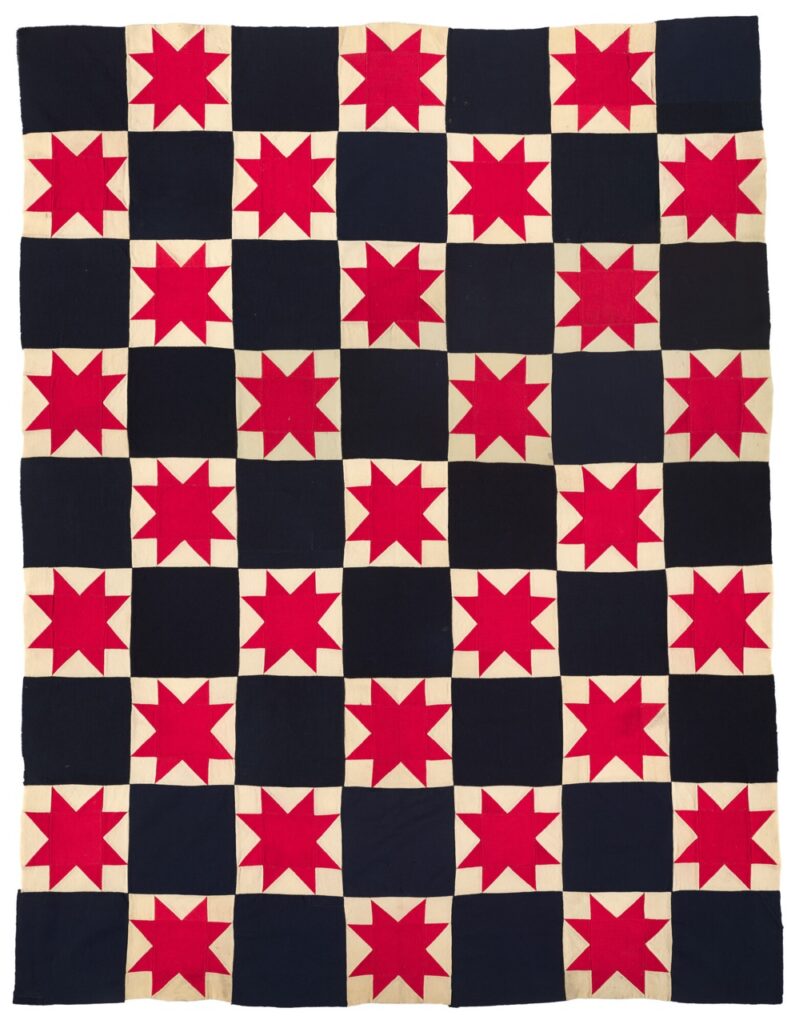
This quilt top came to Historic New England with a letter from the donor claiming it was “made from uniforms of soldiers who fell at the Battle of Bunker Hill in 1775.” The quilt descended in the Riddle family of New Hampshire.
In 1924, Historic New England founder William Sumner Appleton responded to the donor and said his object label would not change much from the account he received: “to put it just as given above is as near the truth as we shall be able to get.”
He ended his letter by assuring the donor that further research would undoubtedly “uncover some member of the family who was at Bunker Hill or close enough to the scene of the fighting to secure the uniforms from which the bedspread is made.”
Indeed, family ancestor John Ferguson (1757-1845) enlisted in the army at the age of 19 and fought at the Battle of Bunker Hill. However, it is unlikely that Ferguson stripped fallen soldiers of their jackets.
The quilt is unlined and unfinished, and the grade of wool is consistent with cloth used in American military uniforms from the eighteenth century until the Civil War. British officers used a different grade of wool in their uniforms. Ferguson and other veterans may have donated their uniforms to the unidentified quilt maker who made this piece as a commemorative souvenir of the American Revolution.
Behind the Exhibition
The Myth of the Bunker Hill Quilt TopWhen I first began to think about this exhibition, I was inspired by one object in the collection: an unlined quilt pieced together with squares of blue, white, and red wool. This quilt top was donated in 1934 by Jennie White Burleigh, who passed along a message from its original owner, William Cheney. According to Cheney’s note to the Burleigh, the quilt descended in his family—a common story for most items that make their way into the collection and archives of Historic New England. However, there was something unusual about Cheney’s history of the object: According to him, the quilt was “made from English Officers’ uniforms, who fell at Bunker Hill. . .. All the quilt is made from uniforms of the soldiers that fought in 1775.” What an extraordinary claim!
The quilt has never been exhibited; after coming to Historic New England, it was catalogued and placed into our rolled textile storage at the Haverhill Center for Preservation and Collections. It wasn’t until I did a cursory search of our collections database for keywords relevant to the American Revolution that I became aware of its existence.
The Legacy of Hancock House
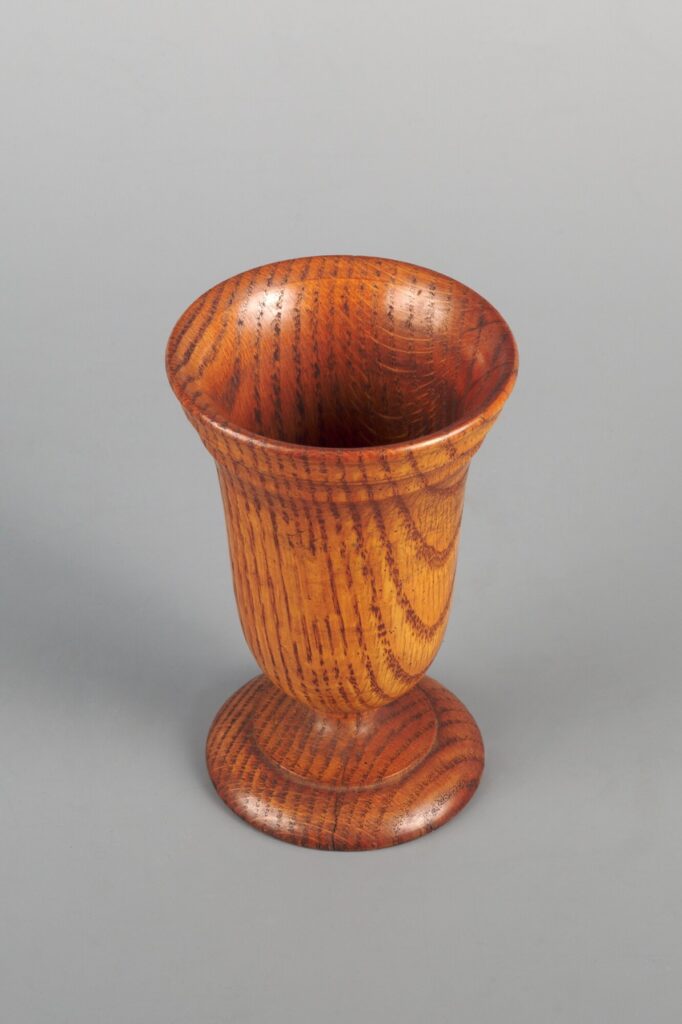
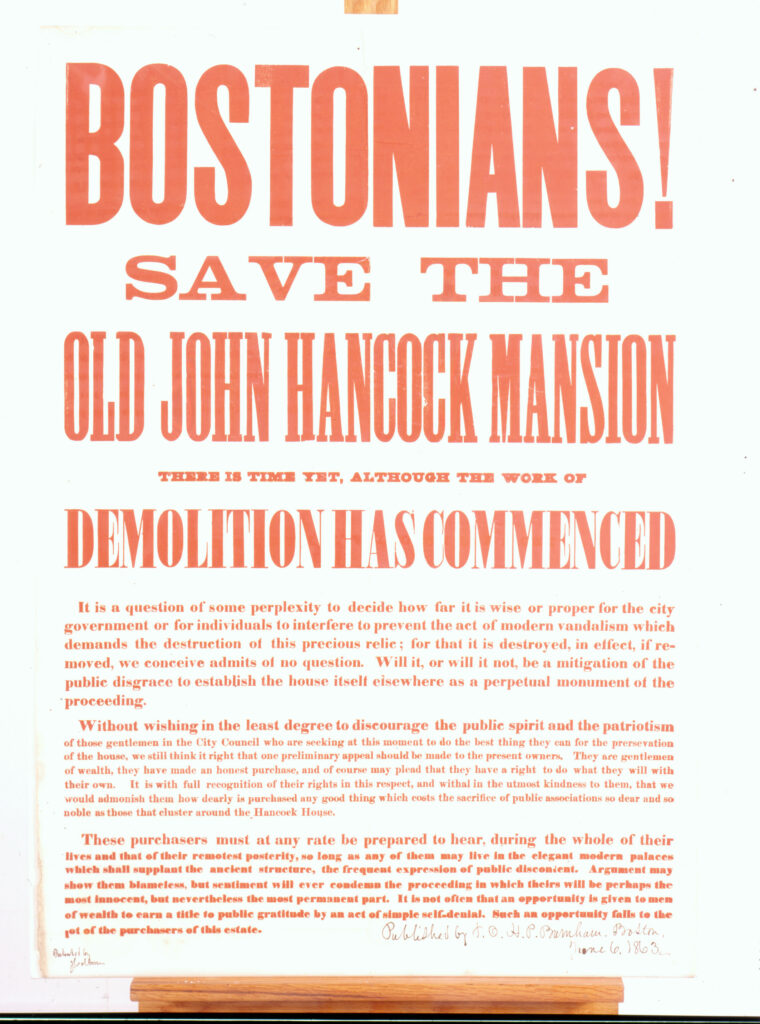
During the nineteenth century, Bostonians revered the John Hancock House partly because of its architecture but also for its historical associations. In 1863, after efforts to sell the house to the Commonwealth for use as a governor’s residence failed, the Hancock family sold the land on which the house stood to a pair of businessmen. They proposed to demolish Hancock House and construct two new townhouses on the site, leading to one of the earliest preservation battles in America.
When efforts to save Hancock House failed, the family held auctions to sell materials from the mansion, including its architectural elements and interior furnishings. From the exterior woodwork, people made highly collectible souvenirs like these two goblets.
William Sumner Appleton (1874-1947) did not witness the destruction of Hancock House, but its memory spurred the creation of Historic New England in 1910. In the first issue of its Bulletin, Appleton described the destruction of Hancock House “as a classic in the annals of vandalism.” Historic New England owns one of the largest artifact and archival collections related to Hancock House.
Painting of Hancock House
John Hancock House
Clement Drew (1806-1889)
Boston, 1859
Oil on board
Historic New England Purchase
This painting depicts Hancock House, built in 1737, which stood atop Beacon Hill in Boston. John Hancock (1737-1793) inherited this stately mansion in 1764 from his uncle Thomas Hancock, a wealthy Boston merchant. Hancock House was a site of colonial resistance leading up to the American Revolution. Hancock celebrated the Stamp Act repeal in 1765 by holding a lavish party at his home. The Boston Gazette reported on “the grand and elegant Entertainment” offered by the host in honor of the Sons of Liberty. During the Siege of Boston, the British military took over this house and Generals Thomas Gage and Hugh Percy used it as their headquarters. After the war, Hancock returned to his mansion and enjoyed a successful political career, including two terms as governor of Massachusetts.
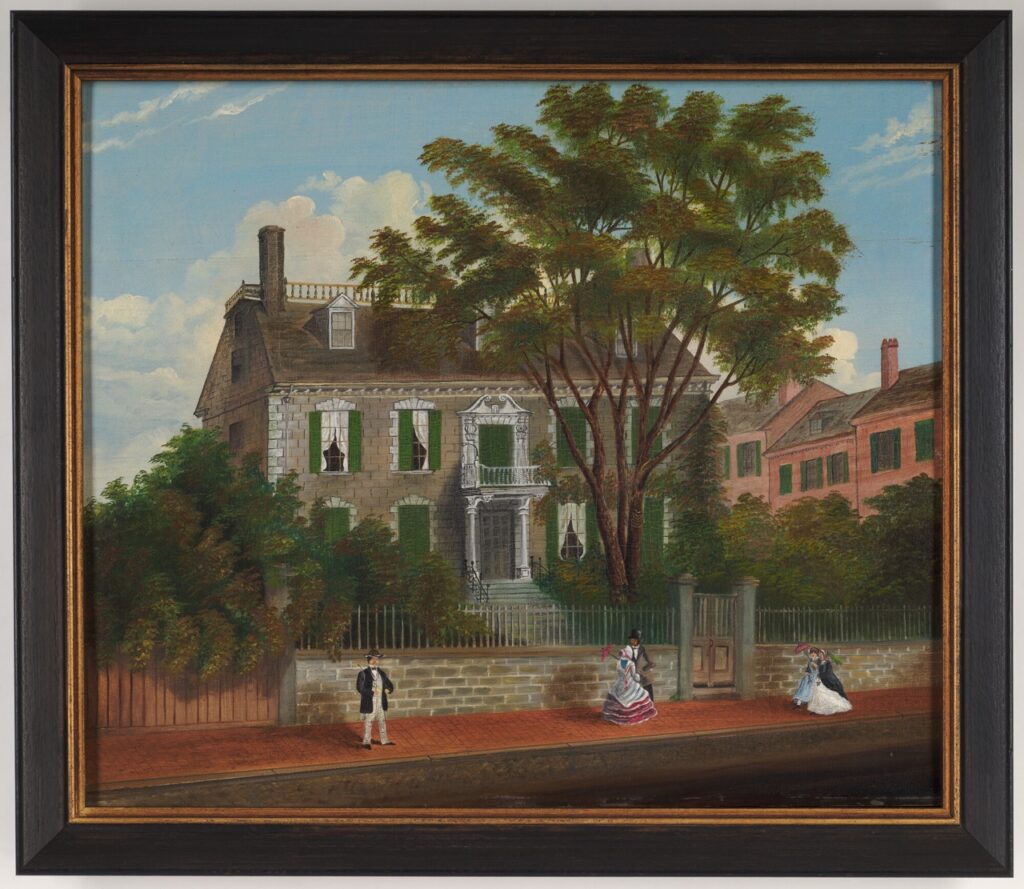
Small Goblet
Goblet
Boston, ca. 1863
Wood
Gift of Alice Badger
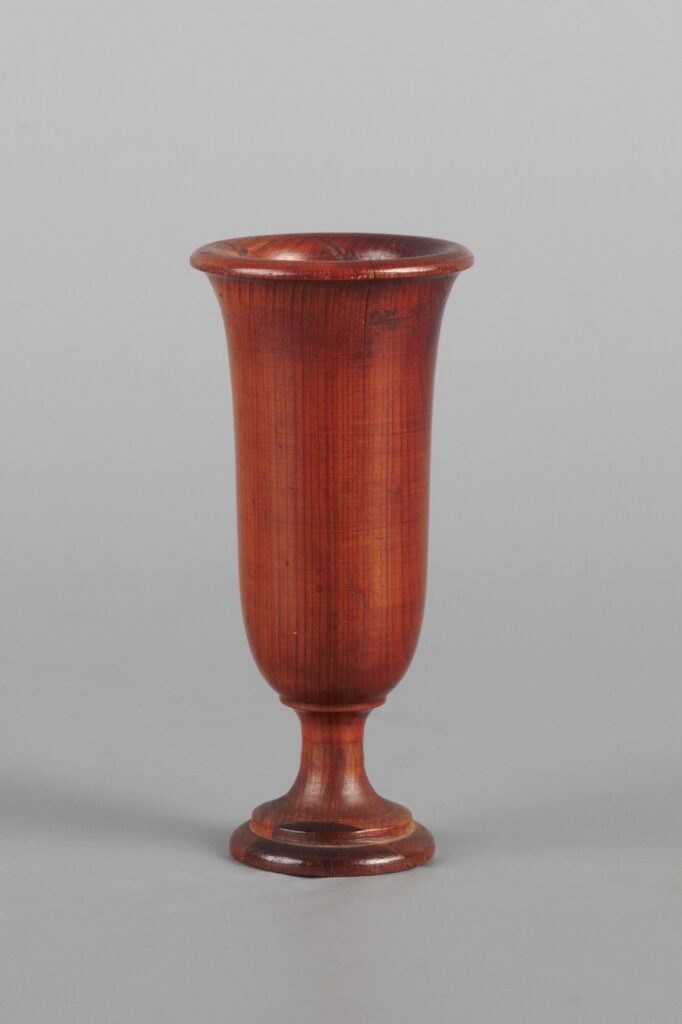
Large Goblet
Goblet
Boston, ca. 1863
Wood
Gift of Charles E. Deane, Ruthven Deane, and Miss Mary Deane Dexter
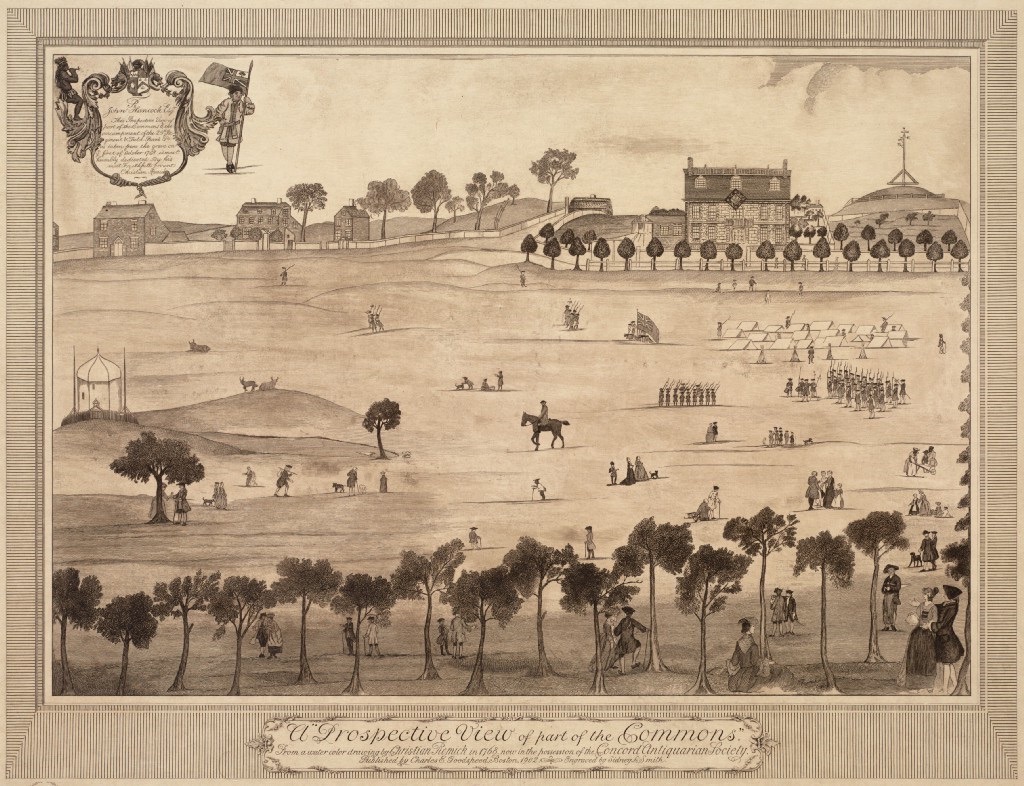
Watercolor of Hancock House
A prospective view of part of the Commons. From a 1768 watercolor drawing by Christian Remick, 1768.
Engraved by Sydney L. Smith, 1902.
This print is based on Christian Remick’s original watercolor drawing showing the occupation of the Boston Common by British Regulars in 1768.
Hancock House is depicted in the background.
Boston Public Library
Hancock Broadside
Broadside, published by T. O. H. P. Burnham,
Boston, June 6, 1863.
Bostonians posted this broadside throughout the city in 1863 to protest the destruction of Hancock House.
Historic New England, Library and Archives
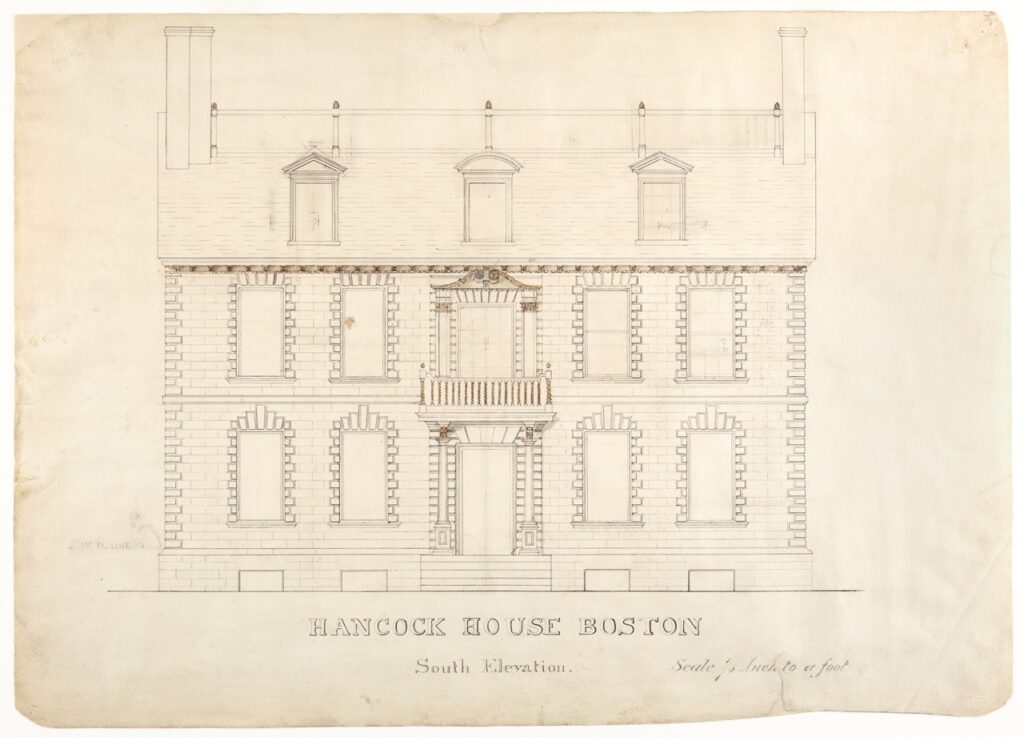
Measured Drawings Hancock House
With Hancock House, architect John Hubbard Sturgis produced the first set of measured drawings of a domestic dwelling in the United States.
Measured Drawing of the John Hancock House by John Hubbard Sturgis, ca. 1863.
Library and Archives Purchase
Decanters
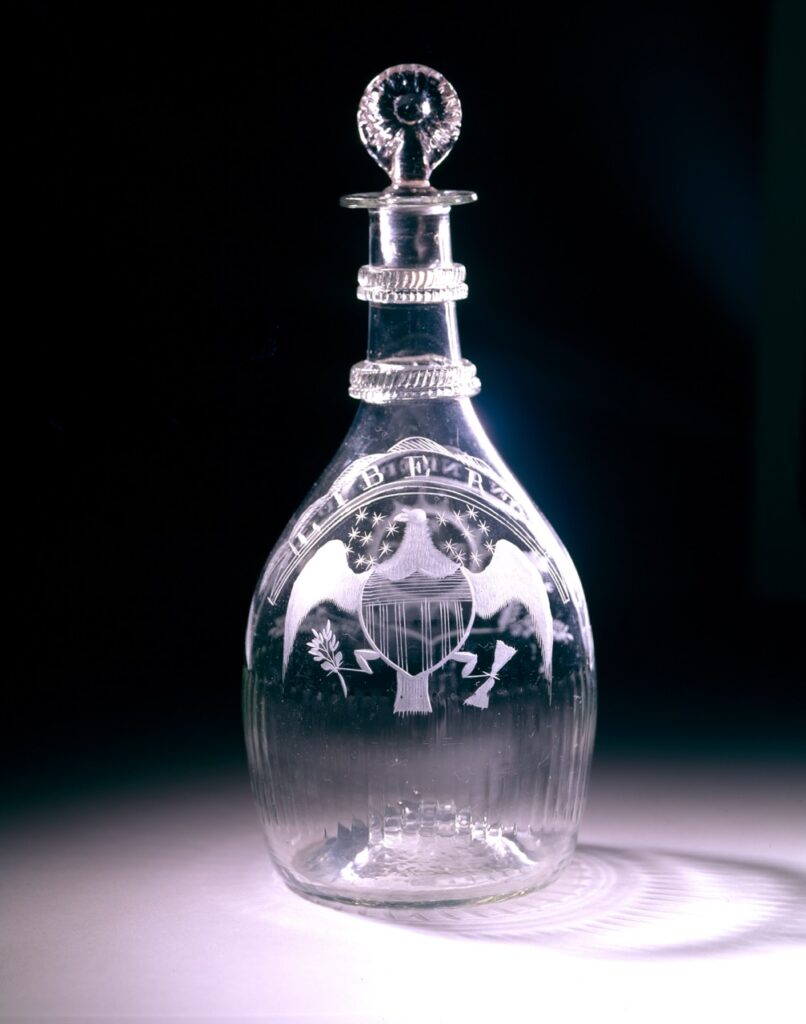
Almost immediately after the American Revolution, English and Irish manufacturers flooded the United States with domestic goods emblazoned with patriotic imagery. The Irish glass decanters are etched on one side with an eagle and the word “LIBERTY” and on the other with the misspelled word “AMERICAN INDEPENDANCE” and the initials “NG.”
The initials belong to Nancy Gay (1791-1873), whose father Eleazar Gay and uncles Charles and Robert Jameson participated in the Boston Tea Party. Their patriotic legacy adorned the fine goods purchased for the family home on Gay’s Island in Cushing, Maine.
Decanters
Ireland, ca. 1815
Glass
Gift of Mrs. Sarah Norton McCullogh
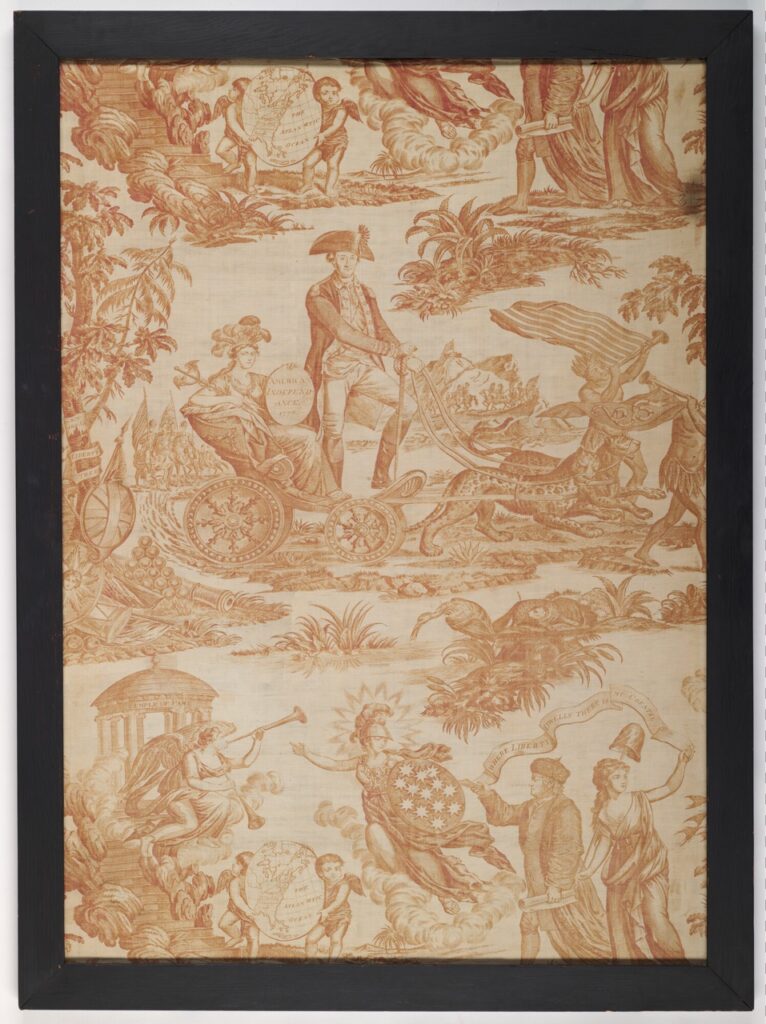
Toile Fragment
Toile Fragment, “The Apotheosis of Washington and Franklin”
England or Ireland, ca. 1785-1800
Cotton
Gift of the Stephen Phillips Memorial Charitable Trust for Historic Preservation
The framed toile fragment belonged to a set of printed bedroom linens owned by Peggy Duncan (1769-1858) of Haverhill, Massachusetts. The design features a scene of George Washington driving a chariot with the allegorical figure of America while Benjamin Franklin accompanies the figure of Liberty. The imagery derived from John Trumbull’s portrait of Washington and Giovanni Battista Nini’s medallion of Franklin. The Duncan family divided what remained of the original set of a bed spread, curtains, and valance. Surviving fragments were later sold to early twentieth-century collectors as “valuable curiosities,” according to a note on the back of the frame.
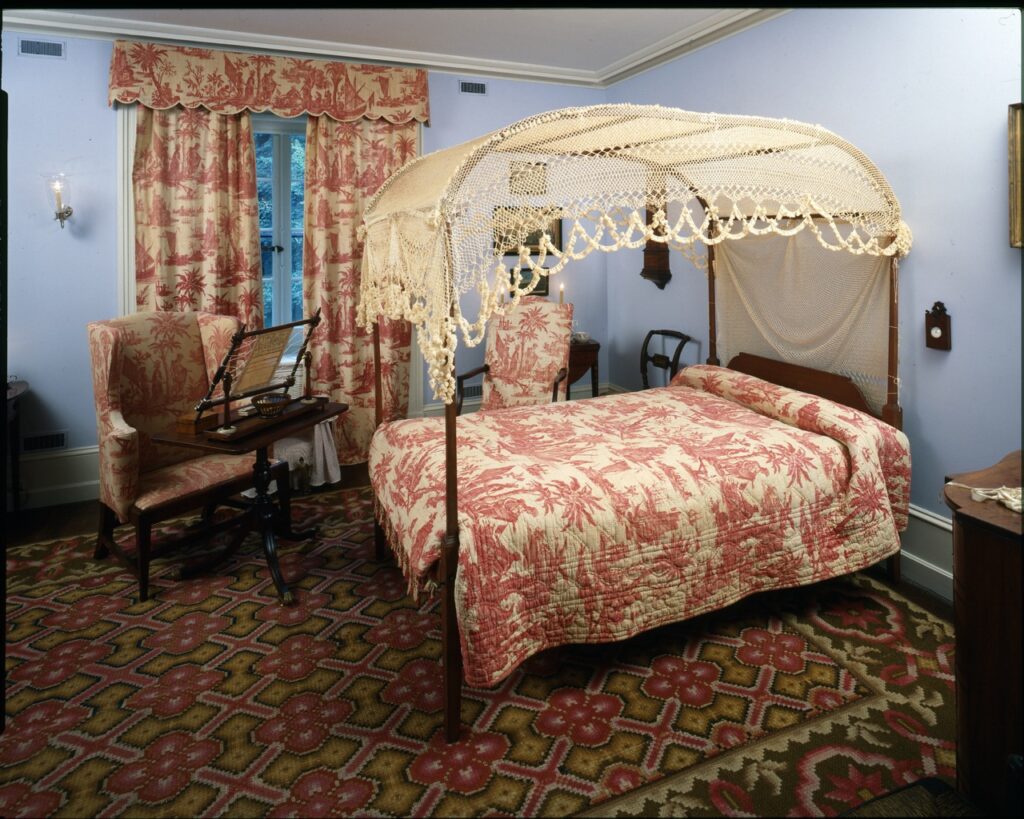
Toile Bedspread
The Apotheosis of Washington and Franklin” was available on furnishing fabrics as early as 1785, produced by British manufacturers for the American market.
Courtesy Winterthur Museum, Garden & Library
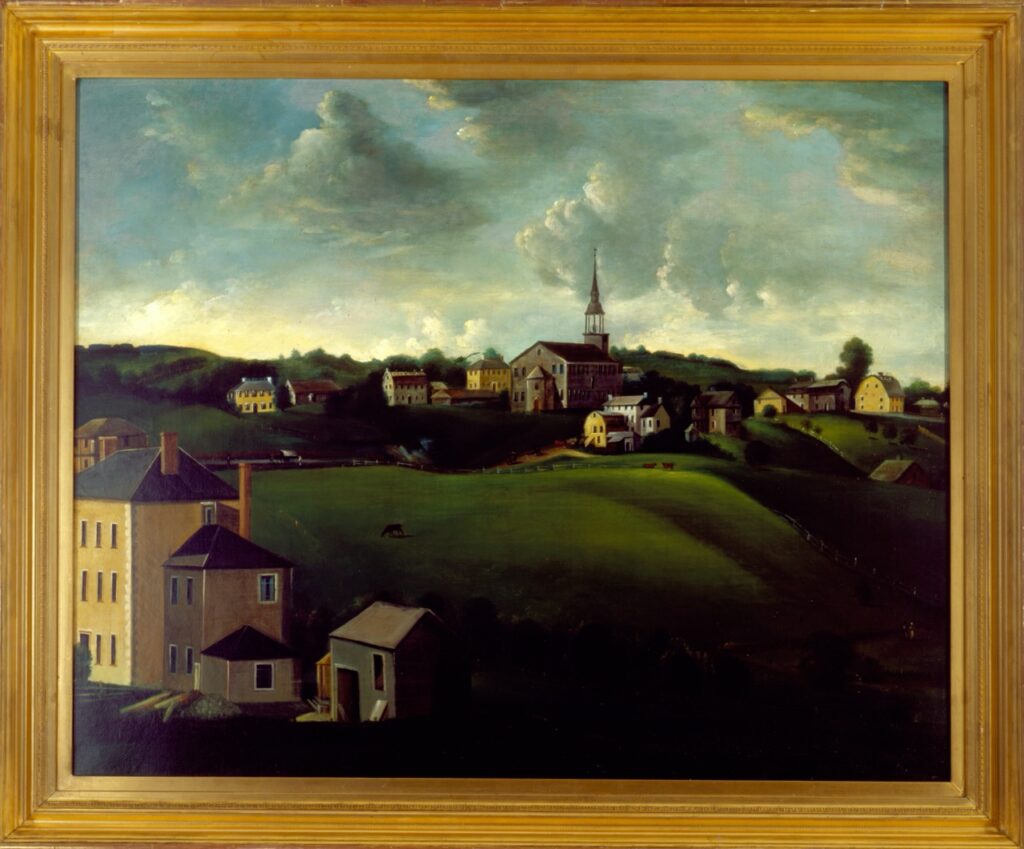
Meetinghouse Hill
Meeting House Hill
Samuel Curtis (1785-1876)
Roxbury, Massachusetts, ca. 1799
Oil on canvas
Gift of Miss Mary E. Haven
In this painting of Meeting House Hill in Roxbury, Massachusetts, artist Samuel Curtis depicted a scene of peaceful urban life. More than twenty years earlier, during the Siege of Boston, the Continental Army occupied this same hill to prevent British supplies from crossing Boston Neck. Their defensive earthworks, fortifications made from dirt, are visible to the right of the church steeple and along the horizon on the far left. The meeting house in the center of the view took heavy cannon fire during the Siege and was rebuilt in 1804, only a few years after the completion of this painting.
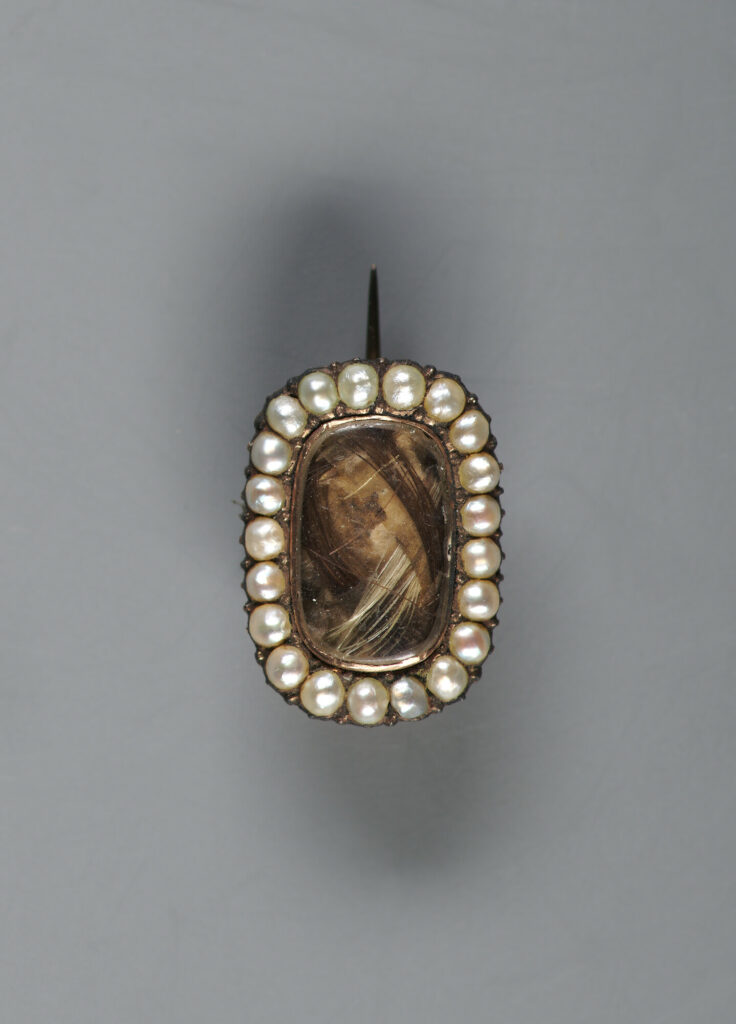
Brooch
Brooch
America, 1800-20
Hair, gold, glass, pearl
Gift of Mrs. Edmund Bridge
This brooch allegedly contains locks of hair from President George Washington and Governor Caleb Strong of Massachusetts (1745-1819). The donor was the great-granddaughter of Josiah Bartlett, a member of the Grand Lodge of Massachusetts.
After Washington died in 1799, Bartlett, along with Paul Revere and John Warren, wrote to Martha Washington requesting a piece of her late husband’s hair for the Grand Lodge as an “invaluable relique of the Hero and Patriot.” Martha Washington granted their request. Perhaps the Bartlett family kept an additional piece as a family heirloom.
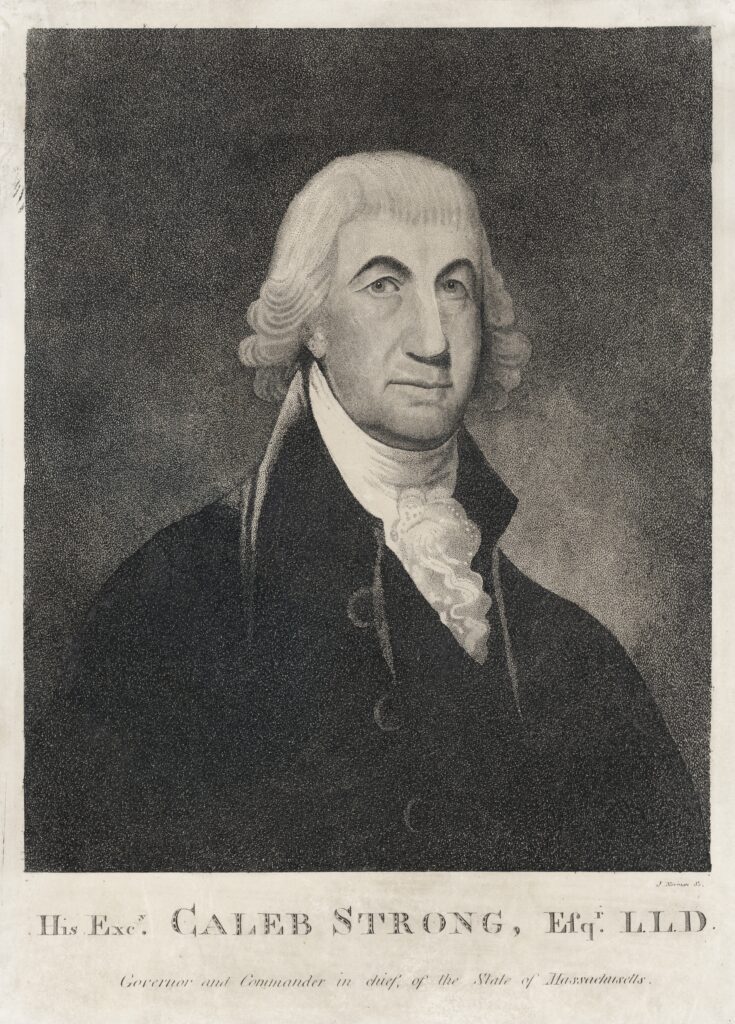
Caleb Strong
Caleb Strong was a contemporary of George Washington but he was not a Freemason, nor was he related to the Bartletts. It is unknown how his hair came to be inside this brooch.
Governor Caleb Strong, ca. 1812, National Portrait Gallery, Smithsonian Institution, acquired through the generosity of Sidney and Barbara Hart
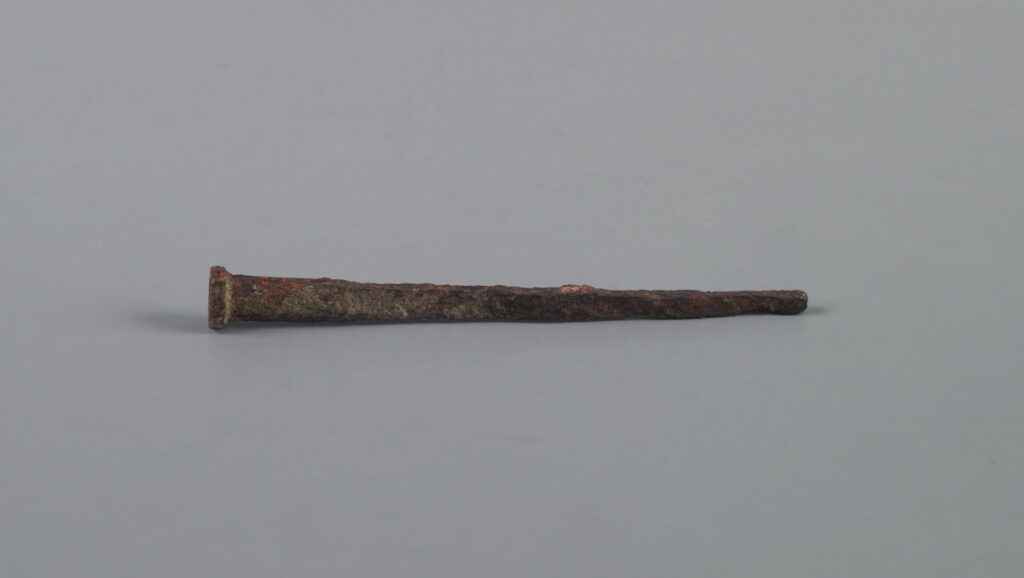
Nail from Old South Meeting House
Boston, 1700s
Iron
Gift of Linda Diver
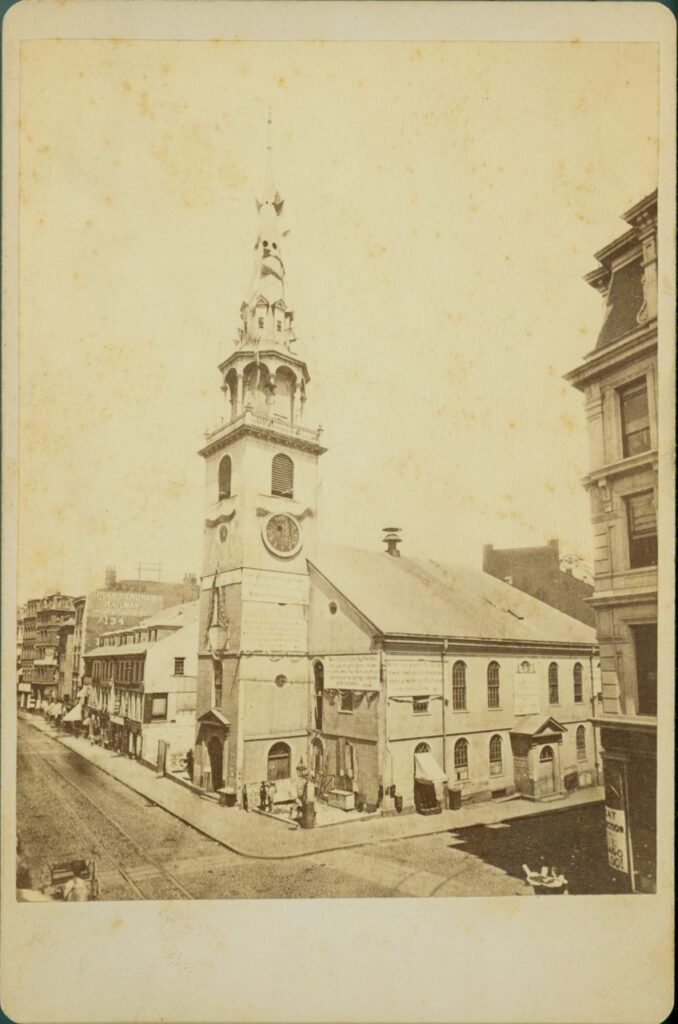
This nail from Old South Meeting House was treated like a relic by the donor’s late mother, an amateur historian from Lynn, Massachusetts, who created dozens of labels for her collection of historic artifacts. Old South played a prominent role during the American Revolution as a site of protest and commemoration: It was from this building that the Sons of Liberty launched the Boston Tea Party in 1773. In 1872, facing threats of demolition, Old South was saved by a group of Boston women who formed the Old South Association. They raised funds to purchase the building by rallying public figures like Ralph Waldo Emerson and Louisa May Alcott to speak up for the preservation effort. Old South Meeting House became a museum in 1877.
Old South Meeting House
Exterior, Old South Meeting House, 1877
Historic New England, Library and Archives
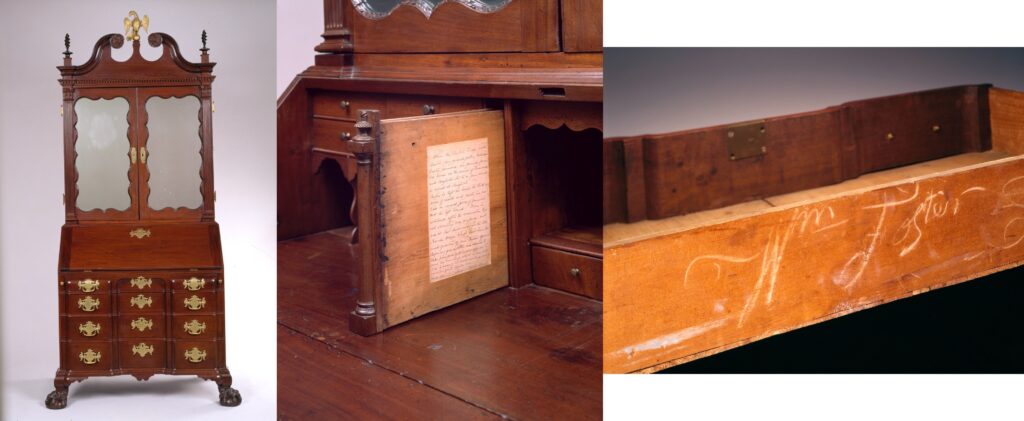
Desk and Bookcase
Desk and Bookcase
Boston, 1765-75
Mahogany, spruce, glass, brass
Gift of Mrs. Charles F. Batchelder, Jr.
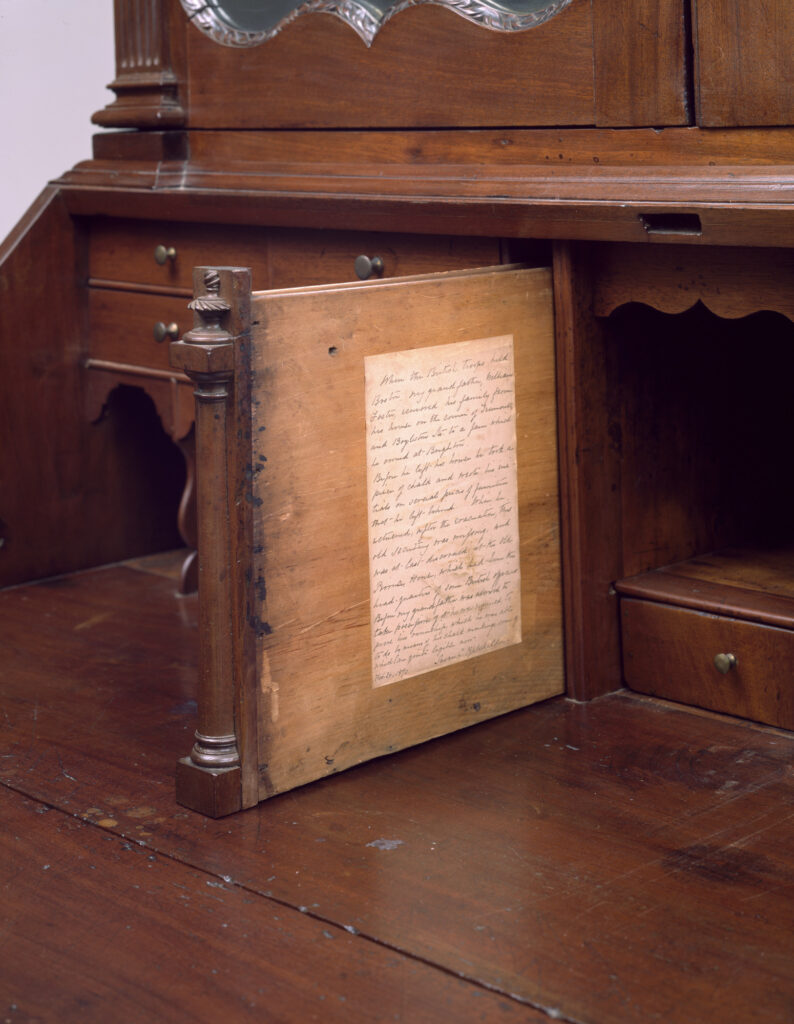
This desk and bookcase belonged to William Foster (1745-1821), a prominent Boston merchant who fled the city with his family during the British occupation. Forced to leave his possessions behind, Foster signed his name on the backs of the drawers for this case. Foster returned home in 1776 to find his desk had been confiscated by British officers and used at their headquarters during the war. Foster used the chalk inscriptions to prove his ownership.
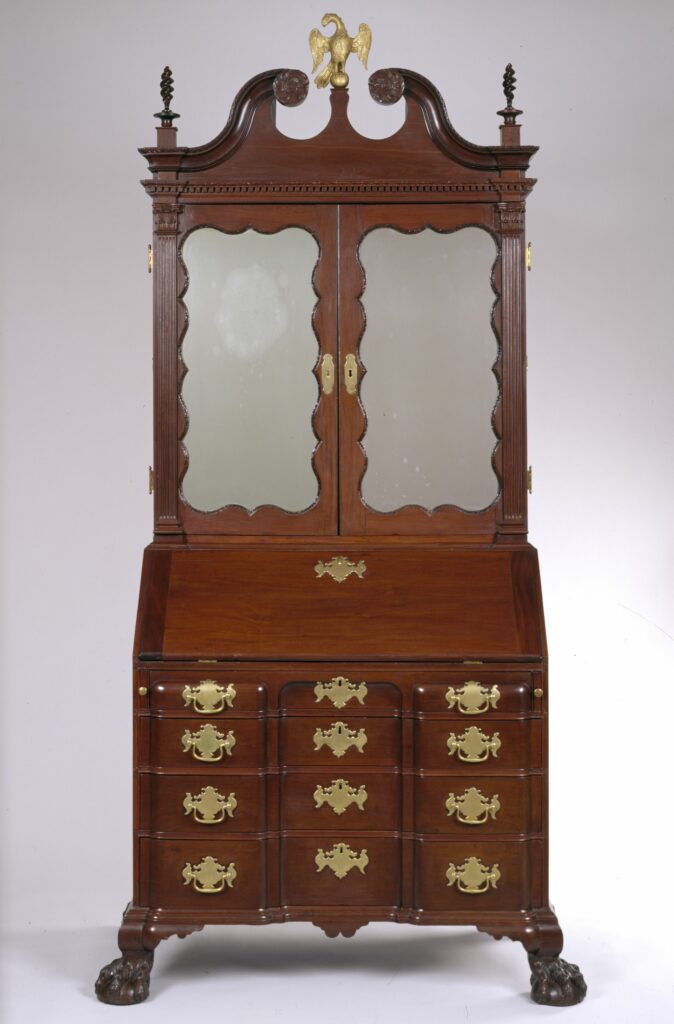
Foster Family History
This story was told repeatedly by Foster’s descendants. Susan Foster Batchelder (1824-1900) shared its history on a note stuck to one of the pilaster draws. The story accompanied “the old mahogany secretary,” as described in her will, as it passed to the next generation.
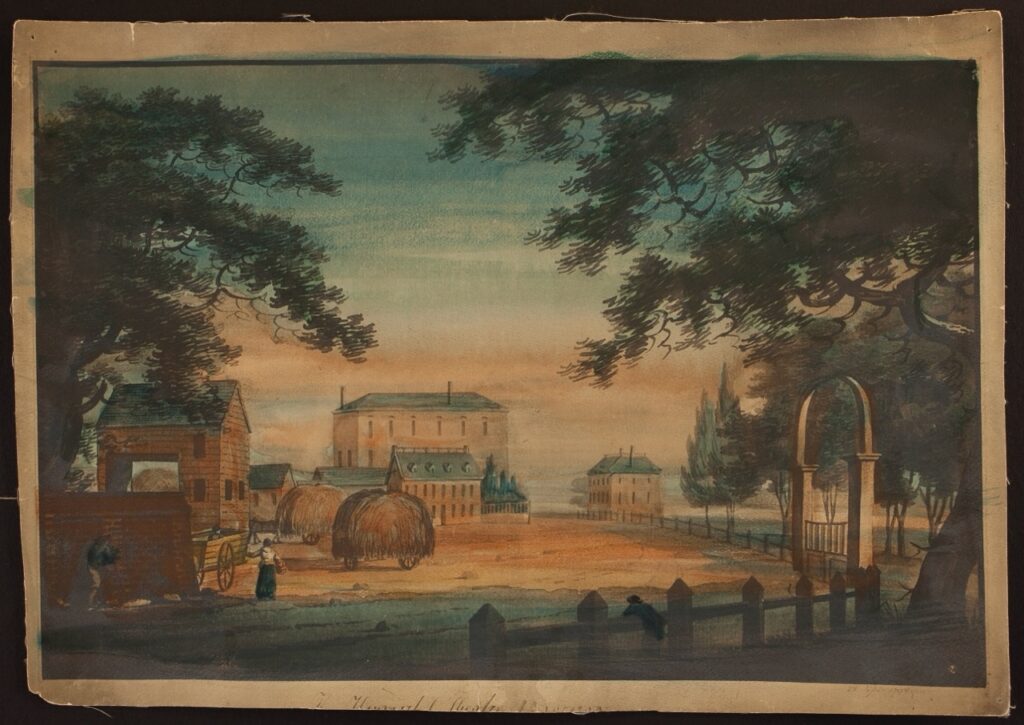
William Foster House
Hatch’s Tavern with the Haymarket Theatre behind it and the William Foster House to the right. The wall of Washington Gardens can be seen and behind it the hay scales. The House is on the southeast corner of the Common. The view is the site of Colonnade Row in (1800), Tremont Street and the Mall, looking south from West Street