 Eustis Estate
Myth and Memory: Stories of the American Revolution
Friday, May 15, 2026 – Sunday, November 15, 2026Myth and Memory explores the rich and complex history of the American Revolution as it played out in New England. Drawn from the museum and archival collections of Historic New England, the objects in this exhibition tell the stories of people – men and women, rebels and loyalists, enslaved and free – whose lives were linked by the shared experience of revolution.
These objects came into the collection accompanied by stories from their donors. Many of the stories are well-documented in the archives, connecting objects to notable people, places, and events related to the American Revolution. Other stories are based on the memories of ancestors, recorded and preserved as family lore. Nearly all these stories contain embellishments formed over time as these objects circulated between private and public realms, passed down from one generation to another and into the hands of collectors, antiquarians, and museum curators. Myth and Memory revisits these stories to untangle fact from fiction, find truth in their mythologies, and add new perspectives to familiar histories.
Through the themes of Resistance, Loyalty, Liberty, and Memory, Myth and Memory draws attention to how we remember the American Revolution and reckon with its legacy.
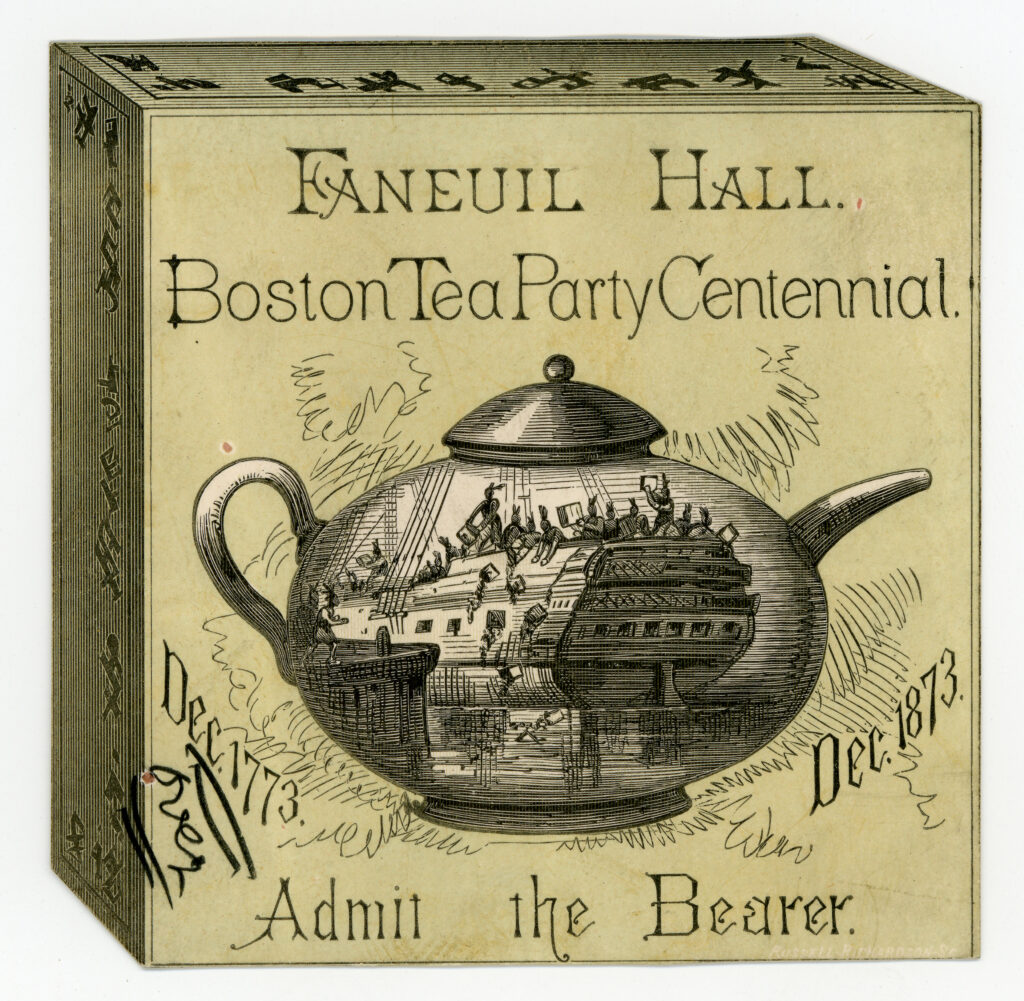
This Boston Tea Party Centennial celebration was attended by descendants of the original Tea Party members who dressed in colonial garments owned by their ancestors.
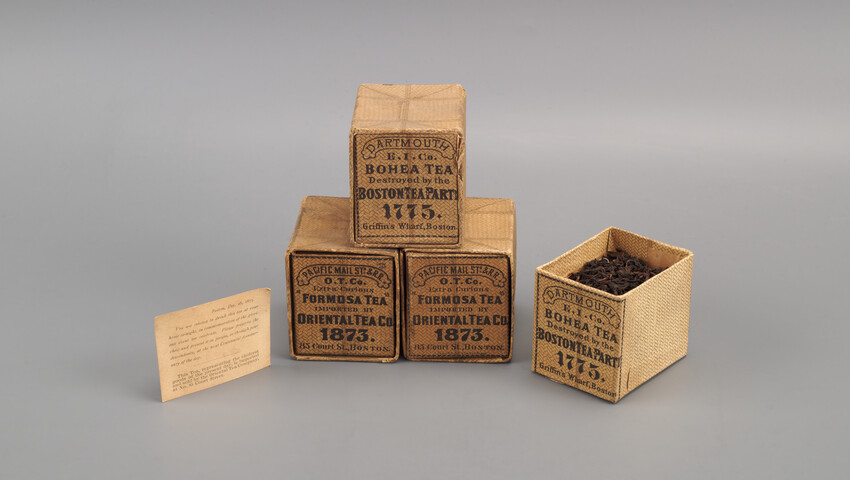
TEST Tea Boxes
Tea Boxes
Boston, 1873
Paper, tea
Gift of Miss Anne F. Caryl
Estate of Miss Frances Greely Stevenson
Gift of Miss Mary Eustis
At the centennial celebration of the Boston Tea Party in 1873, Boston’s Oriental Tea Company sold souvenir boxes of tea. The company urged purchasers to preserve the box “and present it in person, or through your descendants, at the next Centennial Anniversary of the day.” Historic New England received multiple donations of these boxes over the next several decades.
TEST Map of New England with Cicero’s Stops
Recovering Cicero’s Story
Cicero’s life is partially reconstructed through account books, letters, and bills for labor – documents written and received by his enslavers. The most revealing source comes from Reuben Colburn, who billed Jonathan Bowman for travel and expenses associated with retrieving Cicero after his bid for freedom, such as an enlistment bounty, wages paid, and/or military equipment.
1775, Nov. 1 Cicero left Jonathan Bowman and traveled south from Pownalborough
1775, Nov. 5 “Cicero Negro” appeared on the muster list for Captain Robert Follet’s artillery company garrisoned near Kittery, Maine
1775, Nov. 6 Jonathan Bowman published a Runaway/Deserter Advertisement in several local newspapers.
1775, November – December Cicero leaves Follet’s Company and enlists with Captain Caleb Low of the 3rd Company, 8th Essex Milita Regiment in Newburyport, Massachusetts. When Reuben Colburn apprehended Cicero, he “paid Mr. Caleb Low for Sisrow Expenses Down from Newbury 5:5:0” presumably to Cambridge.
At some point, Cicero transferred to another militia company under the command of Captain Moses Nowell once at Cambridge. Colburn “paid for Sisrow to Cap Nowel at Cambridge 1:15:8”
1775, Dec 25 Reuben Colburn left Gardinerstown, Maine (now Gardiner) to apprehend Cicero
1775, Dec 30 Colburn arrived in Cambridge and lodged at Deacon Jonses’ home. Colburn may have apprehended Ciscero the same day, it is possible Cicero was already in custody when Colburn arrived. “Pd for 2 Boles of Tody At the taiking of Sisrow 0:10:0”
1776, Jan. 10 Cicero was likely returned to Jonathan Bowman by Colburn. Colburn was paid a reward of 22:10:0.
Cicero’s documentary trail ends with Colburn’s bill to Bowman, with no additional details identified in Bowman family papers, Pownalborough Courthouse records, or military service records. The rest of his story remains unknown – at least, for now.
Background image: Mitchell, John, Thomas Kitchin, and Andrew Millar. A map of the British and French dominions in North America, with the roads, distances, limits, and extent of the settlements, humbly inscribed to the Right Honourable the Earl of Halifax, and the other Right Honourable the Lords Commissioners for Trade & Plantations. [London; Sold by And: Millar i.e. 1757, 1757] Map. https://www.loc.gov/item/74693175/.
Cicero escaped from Bowman House in Dresden, Maine (on the eastern bank of the Kennebec River) on November 1, 1775.
"Cicero Negro" appeared on the muster list for Captain Robert Follet’s artillery company garrisoned near Kittery, Maine on November 5, 1775.
Cicero leaves Follet’s Company and enlists with Captain Caleb Low of the 3rd Company, 8th Essex Milita Regiment in Newburyport, Massachusetts in November - December 1775. At some point, Cicero transferred to another militia company under the command of Captain Moses Nowell once at Cambridge.
Reuben Colburn arrived in Cambridge and lodged at Deacon Jonses’ home on December 30, 1775. Colburn may have apprehended Cicero the same day, it is possible Cicero was already in custody when Colburn arrived. Cicero was likely returned to Jonathan Bowman by Colburn.
to learn more
The Bigelow Letters
Colonel Timothy Bigelow wrote multiple letters to his wife, Anna Bigelow, during his time stationed away from his family. Bigelow’s letters provide a glimpse into how colonial women managed their families and households during wartime.
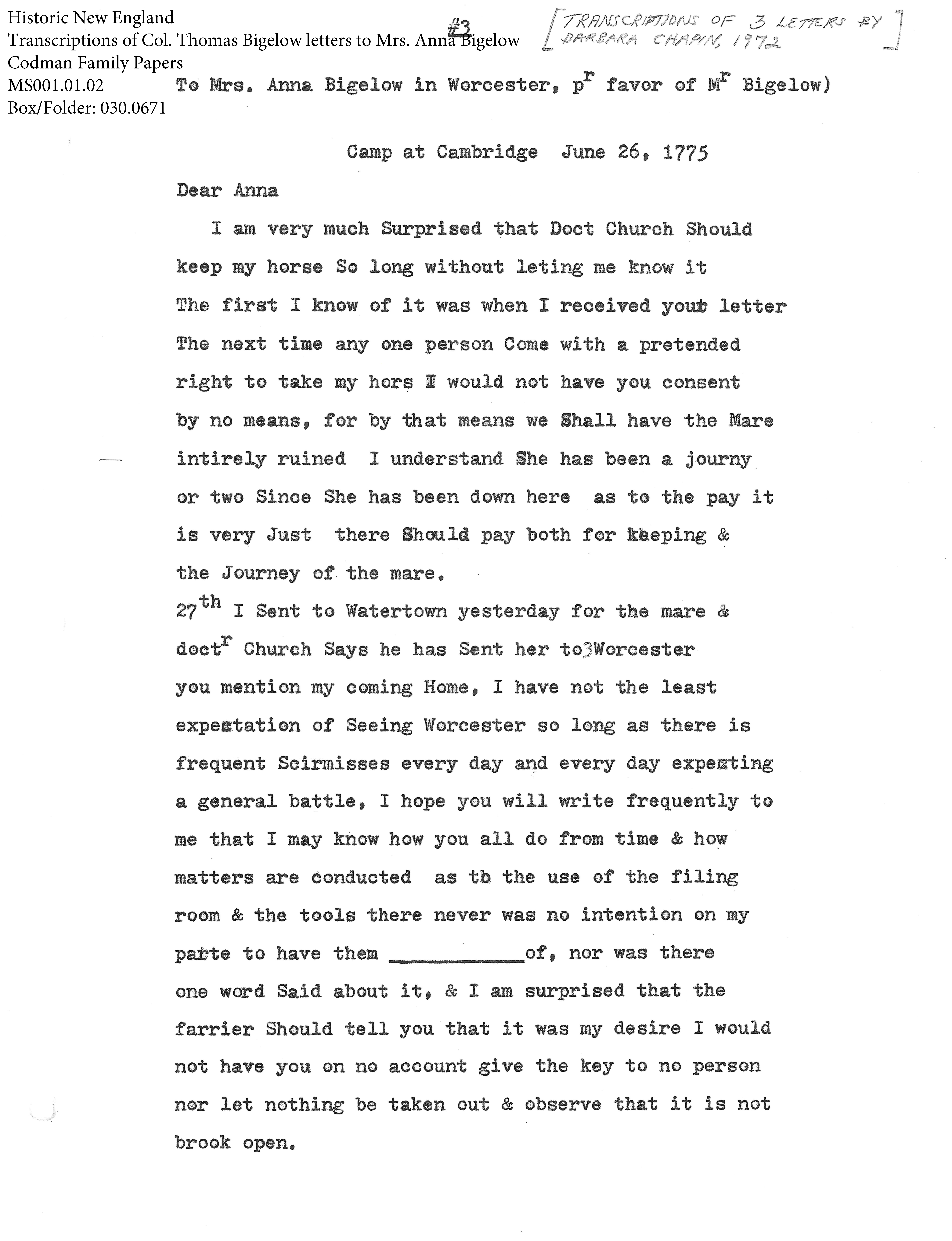
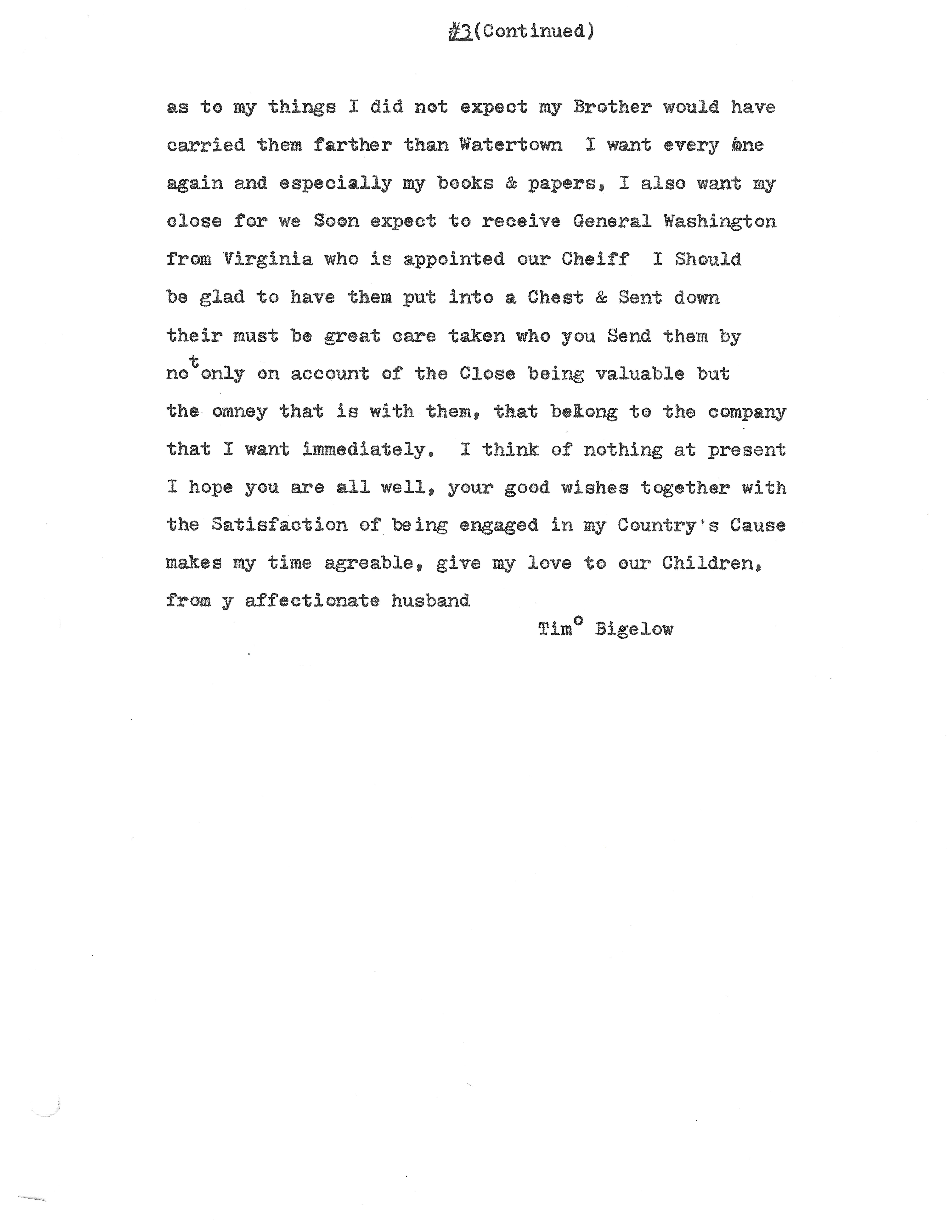
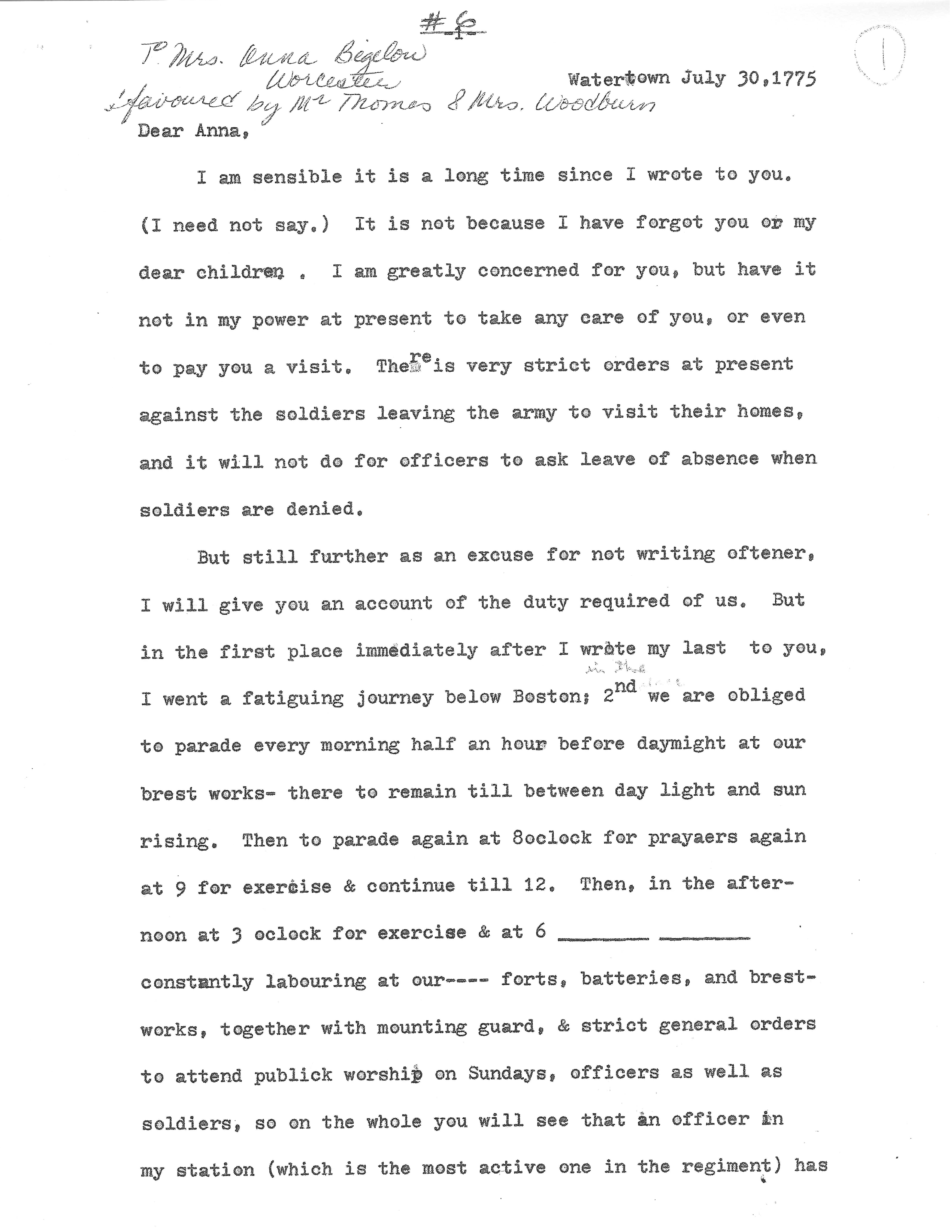
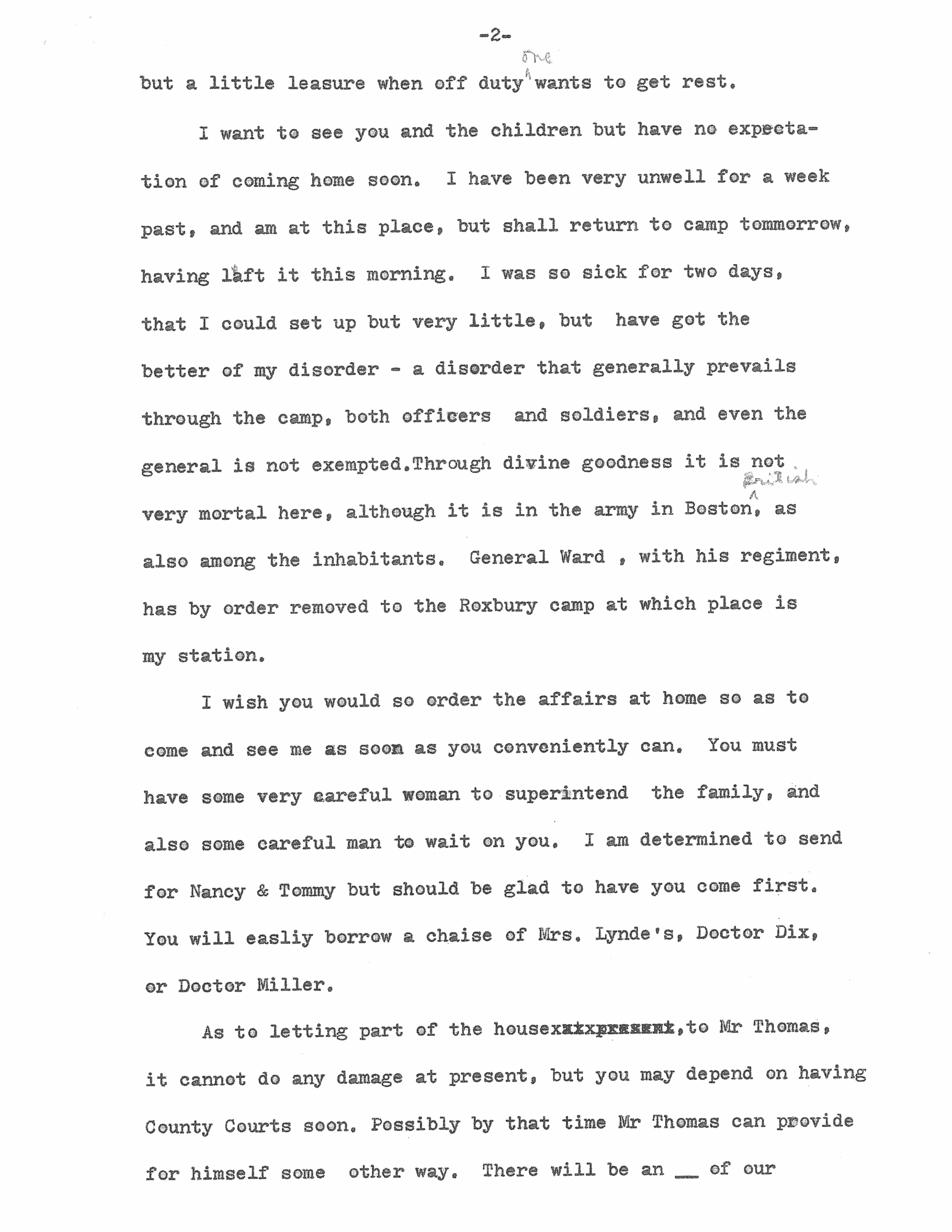
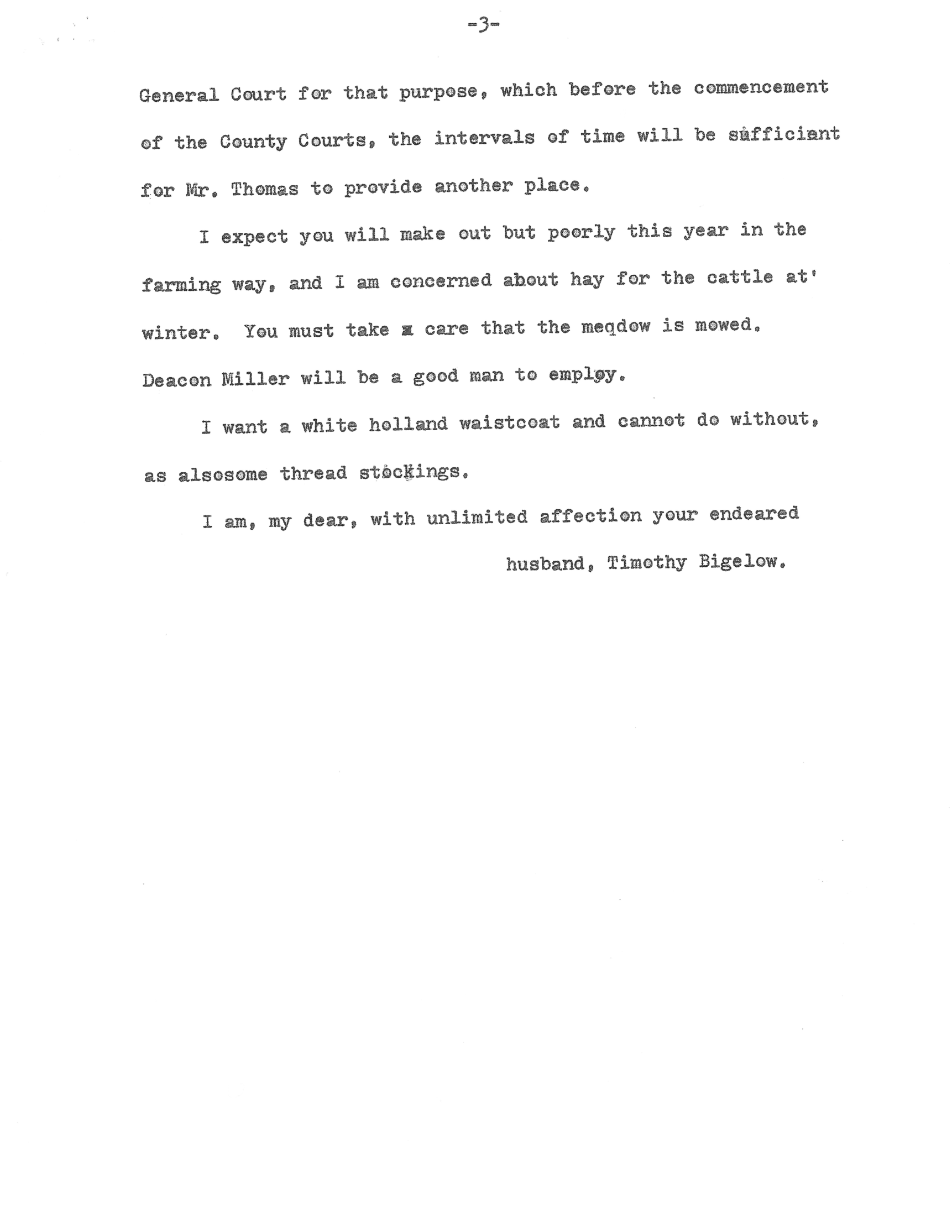
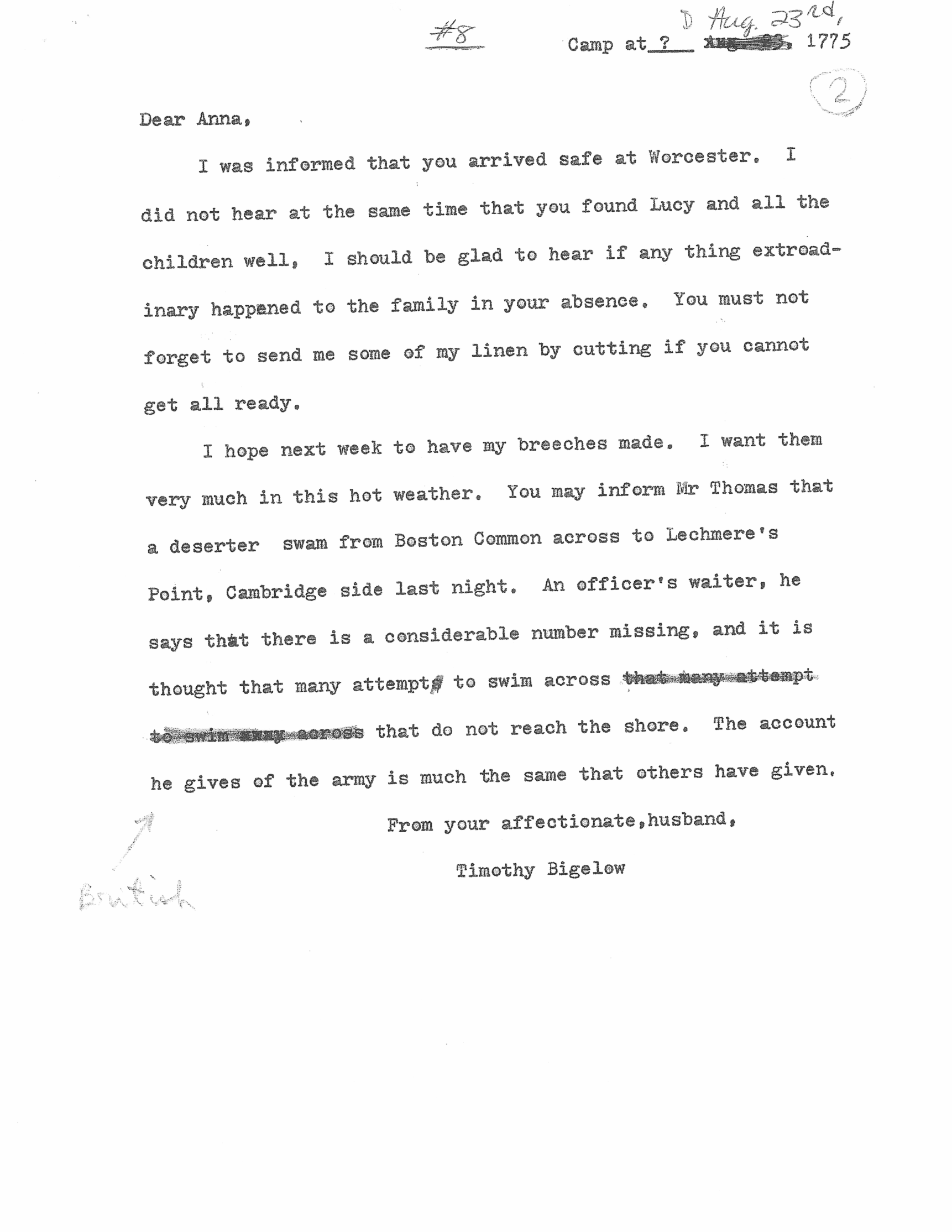
Colonel Timothy Bigelow's Letters
Colonel Timothy Bigelow wrote multiple letters to his wife, Anna Bigelow, during his time stationed away from his family. Bigelow’s letters provide a glimpse into how colonial women managed their families and households during wartime. The original letters are shown at the left, with the modern transcriptions shown at the right.
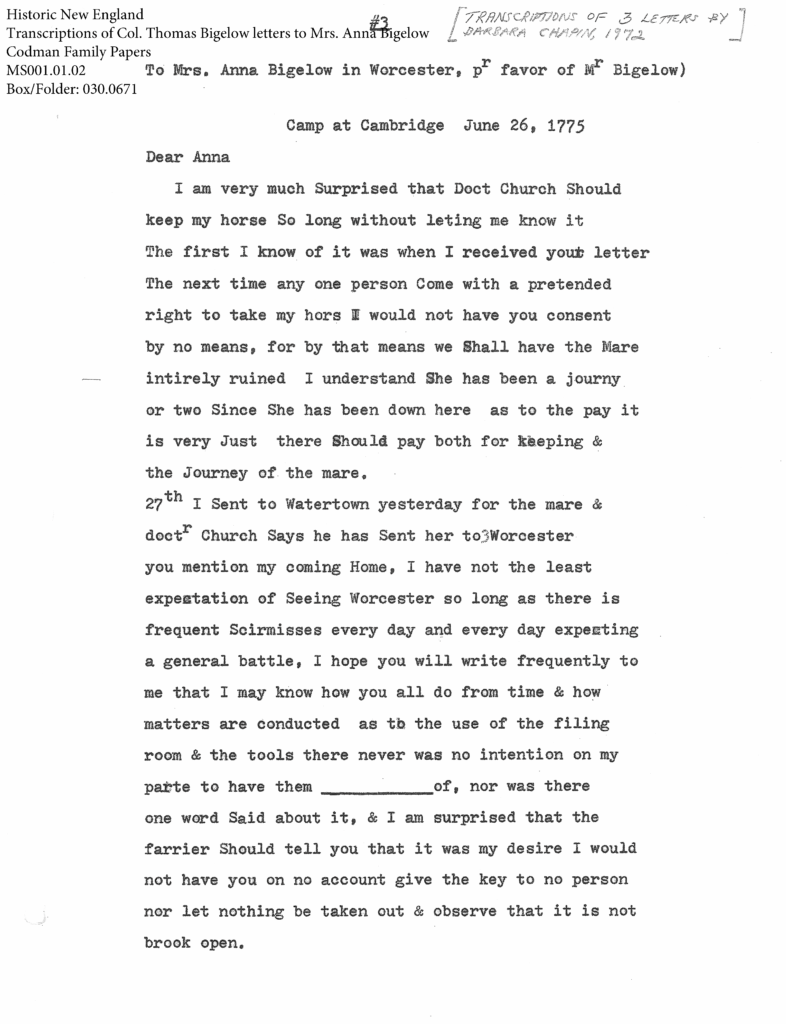
June 26, 1775. To Mrs. Anna Bigelow in Worcester, per favor of Mr. Bigelow. Camp at Cambridge, June 26, 1775. Dear Anna, I am very much surprised that Doct Church should keep my horse so long without letting me know it. The first I know of it was when I received your letter. The next time any one person come with a pretended right to take my horse I would not have you consent by no means, for by that means we shall have the mare intirely ruined. I understand she has been a journey or two since she has been down here. As to the pay it is very just. There should pay both for keeping and the journey of the mare.
27th I sent to Watertown yesterday for the mare and doctor Church says he has sent her to Worcester. You mention my coming home. I have not the least expectation of seeing Worcester so long as there is frequent [skirmishes] every day and every day expecting a general battle. I hope you will write frequently to me that I may know how you all do from time and how matters are conducted. As to the use of the filing room and the tools there never was no intention on my part to have them [illegible] of, nor was there one word said about it, and I am surprised that the farrier should tell you that it was my desire. I would not have you on no account give the key to no person nor let nothing be taken out and observe that it is not [broken] open.
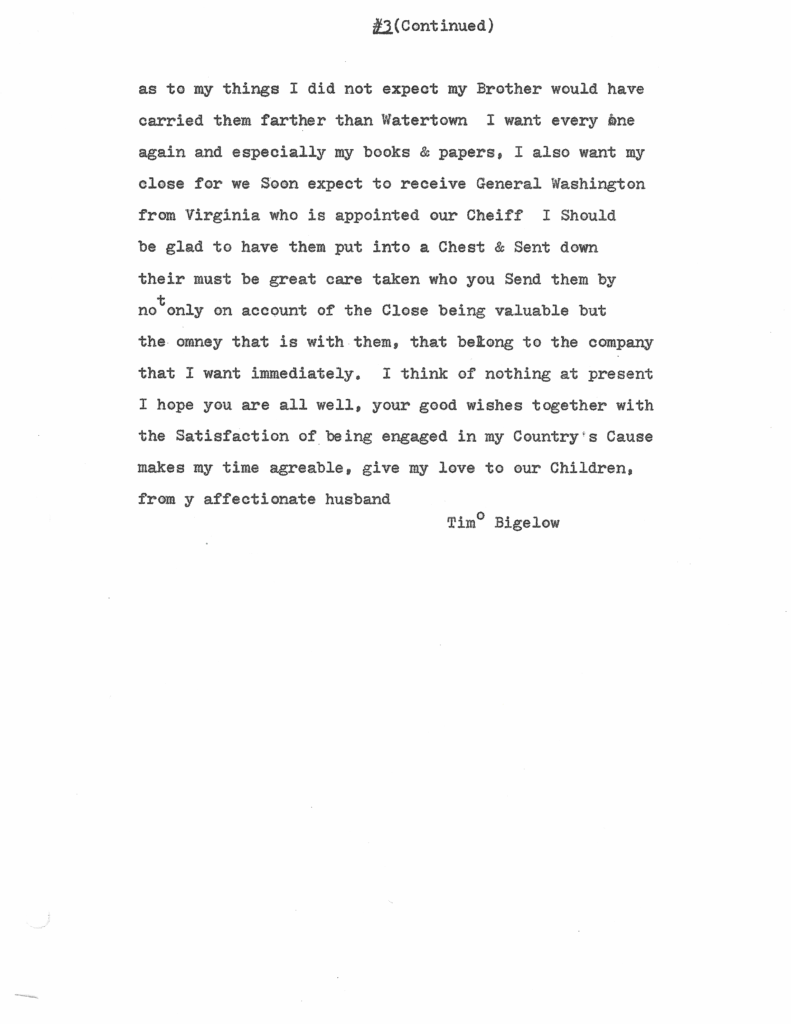
June 26, 1775 (continued). As to my things I did not expect my brother would have carried them farther than Watertown. I want every one again and especially my books and papers. I also want my [clothes] for we soon expect to receive General Washington from Virginia who is appointed our Chief. I should be glad to have them put into a chest and sent down. [There] must be great care taken who you send them by not only on account of the [clothes] being valuable, but the money that is with them, that belong to the company that I want immediately. I think of nothing at present I hope you are all well, your good wishes together with the satisfaction of being engaged in my country’s cause makes my time agreeable, give my love to our children, from your affectionate husband, Timothy Bigelow.