Eustis Estate
“I will call it an error and presumption because I swerved from the accustomed flowry path of female delicacy to walk upon the heroic precipice of feminine perdition” – Deborah Sampson Gannett, 1802
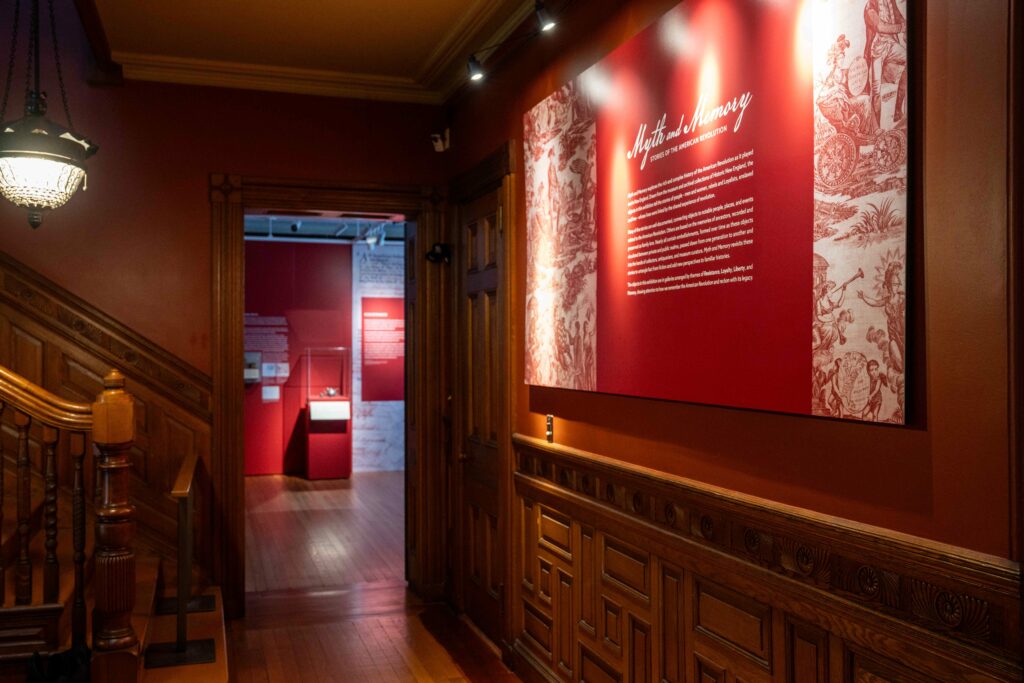
Liberty was both an ideal and a call to action to the New Englanders who fought for independence. Colonists likened their revolutionary actions to freeing themselves from an oppressive tyrant. Battlefields ranged from city streets and harbors to rural fields and farms and involved multiple nations, each with its own political agendas. For those who took part in the conflict, the American Revolution represented far more than a war against Britain. People joined the fight for personal reasons, whether to liberate themselves from slavery or prove their heroism. Some of those individuals recorded their experience of war in letters, journals, and engravings, which became cherished family heirlooms. New Englanders also preserved artifacts associated with historic battles as souvenirs of the revolution, such as the objects in this gallery.
Timeline of Events
July 4, 1776 – Signing of the Declaration of Independence
Congress unanimously votes to separate the 13 North American colonies from Great Britain and its Empire. This document is reputed to have inspired subsequent quests for liberty, most famously the French Revolution
March 17, 1776 – British Evacuate Boston
General William Howe evacuates Boston by ship after General George Washington assumes command of the American forces and seizes Dorchester Heights. The Siege of Boston ends.
June 14, 1777 – The Flag Resolution
The First Flag Resolution confirms the “Stars and Stripes” design as the official flag of the United States. The design is supposed to have originated via Elizabeth Griscom (Betsy Ross), but this claim cannot be verified. It is more likely to have come from Congressman Francis Hopkinson.
February 5, 1778 – France and the US become Allies
France and the US form the Franco-American Alliance which supplies the Colonists with much needed troops and supplies. In return, France is able to destabilize the British Empire and retaliate against their losses in the Seven Years’ War.
September 28 – October 19, 1781 – Siege of Yorktown
British troops are overstretched and demoralized, and parliament is worn thin between continental wars with France and Spain, and the American Revolution. General Charles Lord Cornwallis surrenders after French and American troops outnumber British forces in a three week siege at Yorktown. This battle is the last of the American Revolution.
"He intended to Join the Army"
Cicero's StoryBorn around 1754, Cicero spent his adolescence enslaved by Edward and Mary Emerson of Boston. Edward Emerson died in 1769, and a year later his widow married Jonathan Bowman, a member of the Hancock family. The couple brought Cicero to Pownalborough (Dresden), Maine. They lived on the banks of the Kennebec River in a home now owned by Historic New England.
Jonathan Bowman was a staunch supporter of the revolutionary cause and Cicero was likely affected by his enslaver’s calls for liberty from oppression. On November 1, 1775, Cicero left Bowman
House, effectively emancipating himself, and enlisted with an artillery company garrisoned near Kittery, Maine. Bowman placed a runaway ad in the newspaper and hired Reuben Colburn to capture Cicero. Colburn tracked Cicero to Cambridge, Massachusetts, apprehending him in December and returning him to Bowman House. It is unknown if Bowman punished Cicero, sold him, freed him, or if Cicero self-emancipated once more and reenlisted in the army.
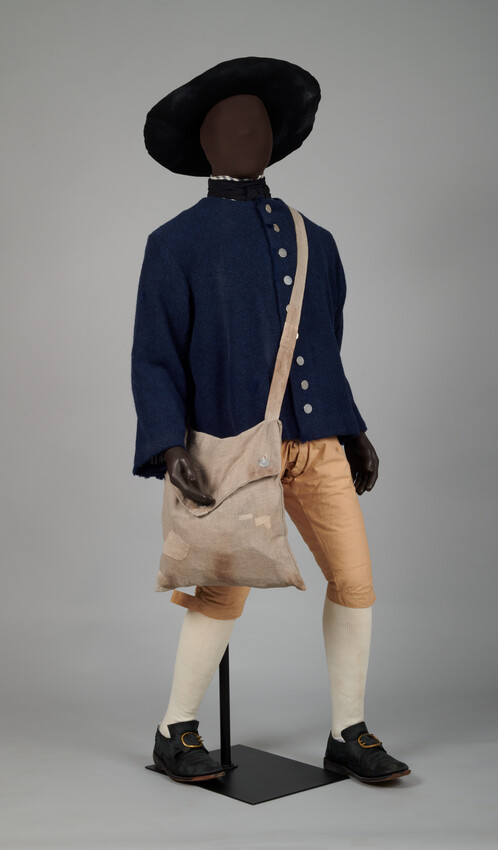
Runaway ads are often the primary means by which historians recover information about enslaved people in New England. The ad for Cicero describes the attire he wore the night he fled Bowman House. Historic New England reimagined this outfit using historic garments and handmade reproductions.
Cicero
Runaway ads are often the primary means by which historians recover information about enslaved people in New England. The ad for Cicero describes the attire he wore the night he fled Bowman House. Historic New England reimagined this outfit using historic garments and handmade reproductions.
Breeches
New England, ca. 1775
Linen, cotton
Estate of Dennison Rogers Slade
Pair of Stockings
New England, ca. 1780
Cotton
Gift of Mrs. Daniel P. Abercrombie
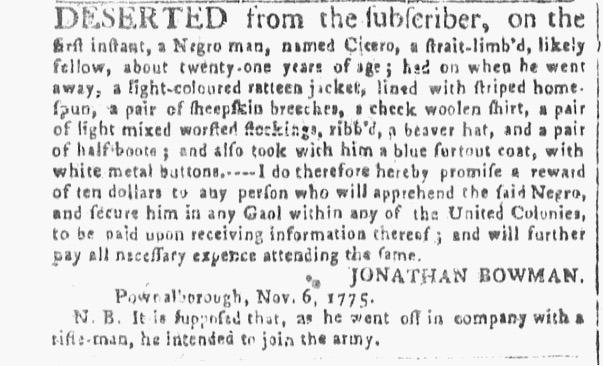
Runaway Advertisement 1775
Advertisement, Essex Gazette, November 16, 1775
“Deserted from the subscriber, on the first instant, a Negro man, named Cicero, a straight-limb’d, likely fellow, about twenty-one years of age; had on when he went away: a light-colored ratteen jacket, lined with striped homespun, a pair of sheepskin breeches, a check woolen shirt, a pair of light mixed worsted stockings, ribb’d, a beaver hat, and a pair of half-boots; and also took with him a blue sortout coat, with white metal buttons…I do therefore hereby promise a reward of ten dollars to any person who will apprehend the said Negro, and secure him in any Gaol within any of the United Colonies, to be paid upon receiving information thereof; and will further pay all necessary expense attending the same.
-Jonathan Bowman. Pownalborough, Nov. 6, 1775
N.B. It is supposed that, as he went off in company with a rifle man, he intended to join the army”
Collection of the Massachusetts Historical Society
Colburn’s Bill
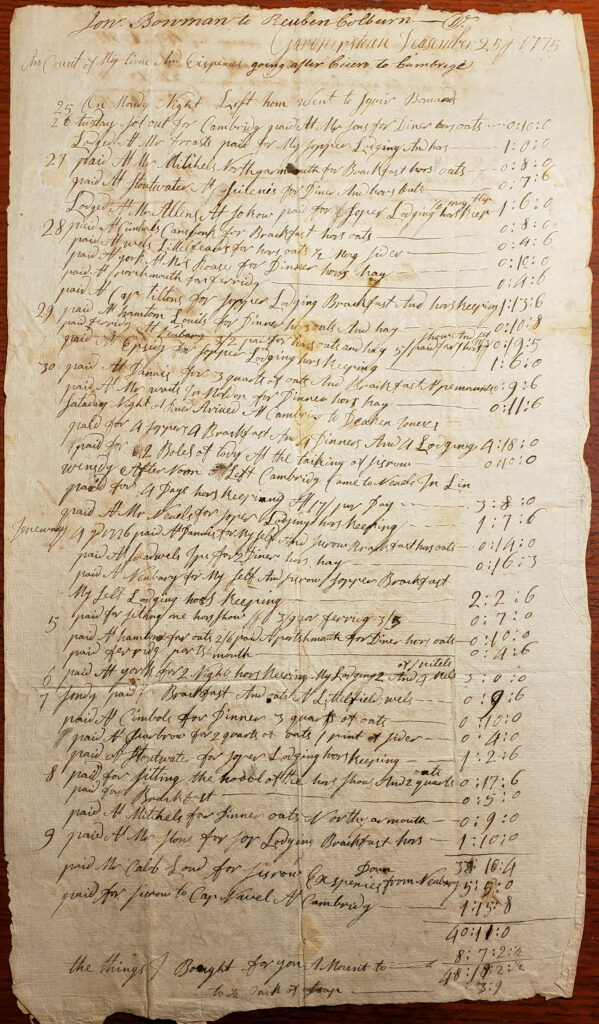
Cicero’s life is partially reconstructed through account books, letters, and bills for labor – documents written and received by his enslavers. The most revealing source comes from Reuben Colburn, who billed Jonathan Bowman for travel and expenses associated with retrieving Cicero after his bid for freedom.
1775, November 1
Cicero left Jonathan Bowman and traveled south from Pownalborough (Dresden), Maine.
1775, November 5
“Cicero Negro” appeared on the muster list for Captain Robert Follet’s artillery company garrisoned near Kittery, Maine.
1775, November 6
Jonathan Bowman published a runaway advertisement in several local newspapers.
1775, November — December
Perhaps alerted to the November 6 runaway ad, Cicero left Follett’s company and moved further south to Newbury, Massachusetts, to join Captain Caleb Low’s 3rd Company, 8th Essex Milita Regiment. Eventually, Cicero was transferred to a militia company in Cambridge, Massachusetts, under the command of Captain Moses Nowell.
1775, December 25
Reuben Colburn left Gardinerstown (Gardiner), Maine, to apprehend Cicero.
1775, December 30
Colburn followed Cicero’s trail to Cambridge. He arrived there on December 30 and apprehended
Cicero the very same day. In his bill to Bowman, Colburn recorded: “Pd for 2 Boles of Tody At the taiking of Sisrow 0:10:0,” noting the drinks he bought himself and Cicero before setting off on their return to Maine.
Colburn later compensated Captain Low and Captain Nowell for expenses related to Cicero, including enlistment fees, wages paid, and military equipment.
“paid Mr. Caleb Low for Sisrow Expenses Down from Newbury 5:5:0”
“paid for Sisrow to Cap Nowel at Cambridge 1:15:8”
1776, January 10
By January 10, 1776, Cicero was back at Bowman House. Bowman paid Colburn a reward of over 22 pounds.
Map of Cicero’s Movements
CLICK THE HOT SPOTS ON THE MAP TO LEARN MORE.
Cicero’s documentary trail ends with Colburn’s bill to Bowman, with no additional details identified in Bowman family papers, Pownalborough Courthouse records, or military service records. The rest of his story remains unknown – at least, for now.
Image courtesy of John Mitchell, Thomas Kitchin, and Andrew Millar.
A map of the British and French dominions in North America, with the roads, distances, limits, and extent of the settlements, humbly inscribed to the Right Honourable the Earl of Halifax, and the other Right Honourable the Lords Commissioners for Trade & Plantations. [London; Sold by And: Millar i.e. 1757, 1757] Map. https://www.loc.gov/item/74693175/.
Cicero escaped from Bowman House in Dresden, Maine (on the eastern bank of the Kennebec River) on November 1, 1775.
"Cicero Negro" appeared on the muster list for Captain Robert Follet’s artillery company garrisoned near Kittery, Maine on November 5, 1775.
Cicero leaves Follet’s Company and enlists with Captain Caleb Low of the 3rd Company, 8th Essex Milita Regiment in Newburyport, Massachusetts in November - December 1775. At some point, Cicero transferred to another militia company under the command of Captain Moses Nowell once at Cambridge.
Reuben Colburn arrived in Cambridge and lodged at Deacon Jonses’ home on December 30, 1775. Colburn may have apprehended Cicero the same day, it is possible Cicero was already in custody when Colburn arrived. Cicero was likely returned to Jonathan Bowman by Colburn.
to learn more
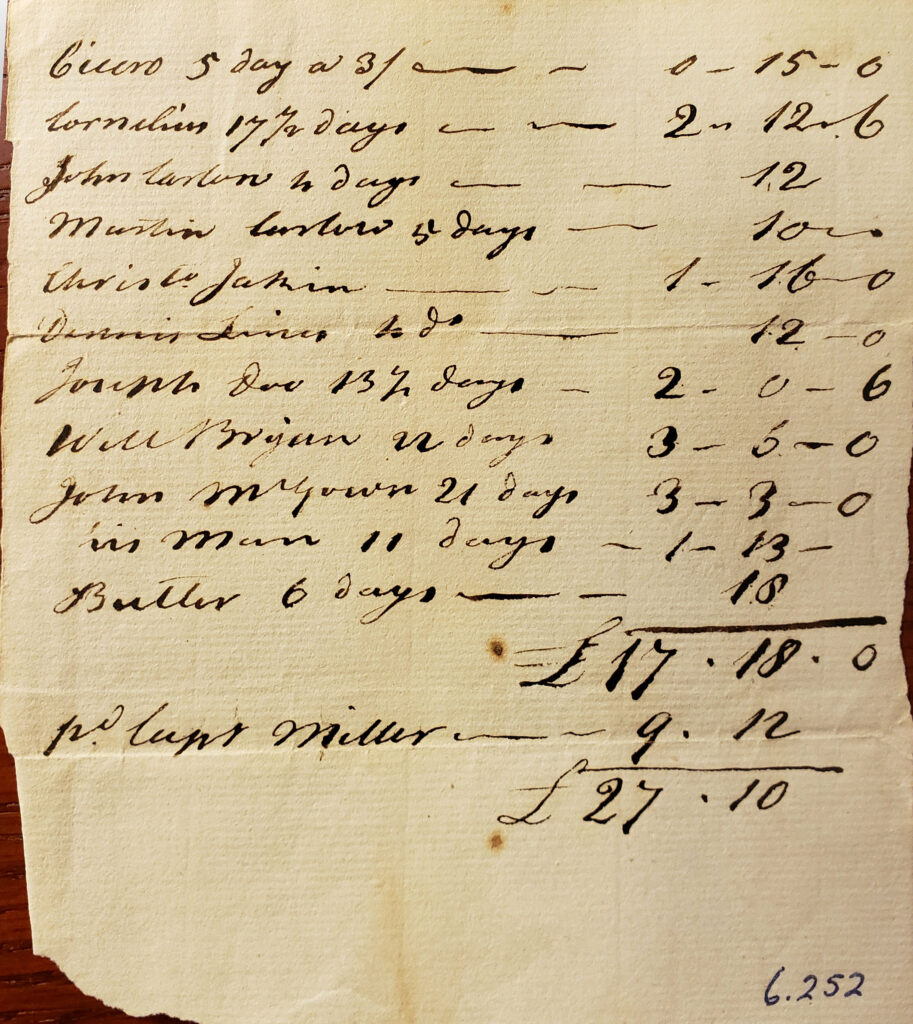
Labor Bill
This bill from 1774 shows Cicero’s and Cornelius’s work time on Jonathan Bowman’s brig Minerva, paid by Capt. Samuel Miller.
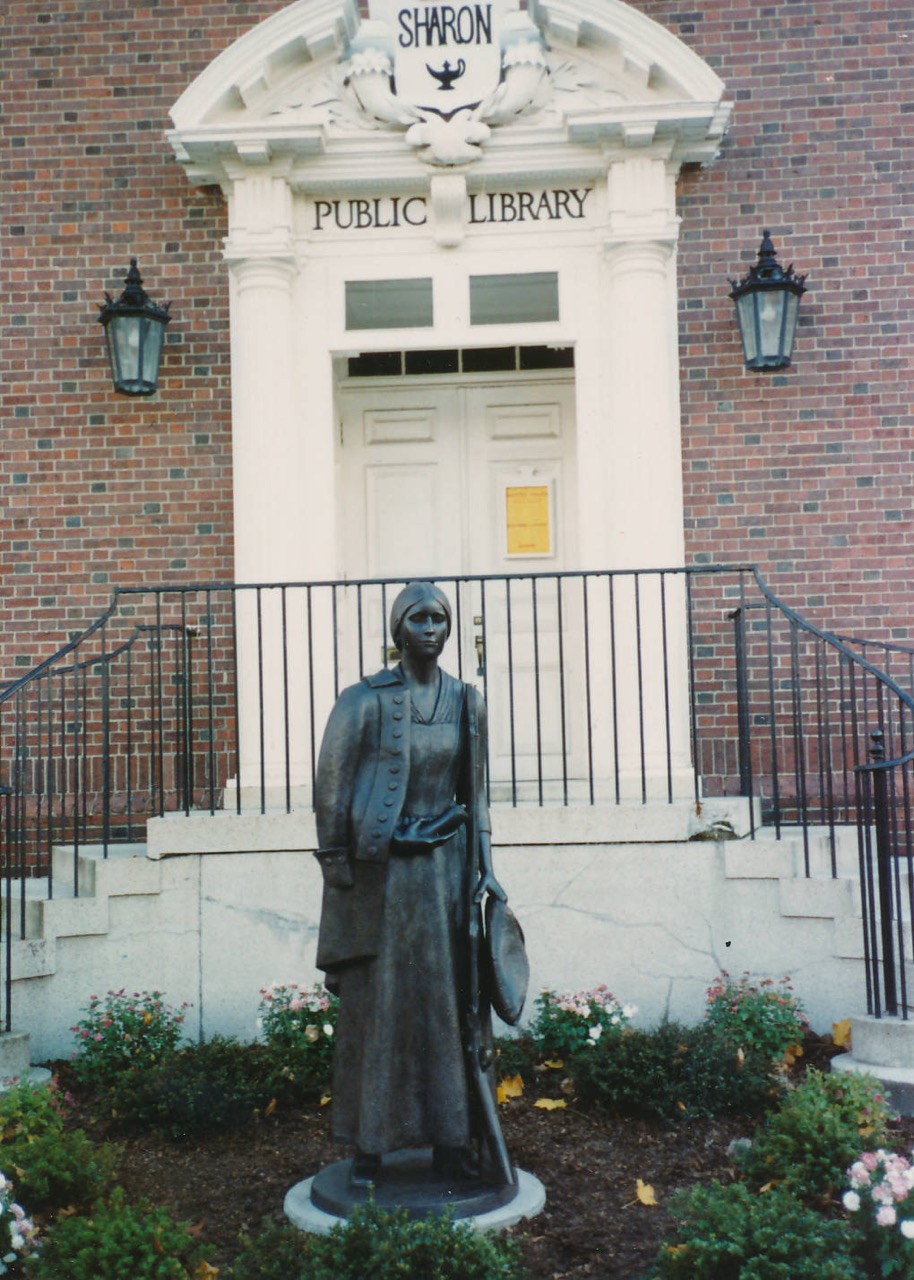
Deborah Sampson
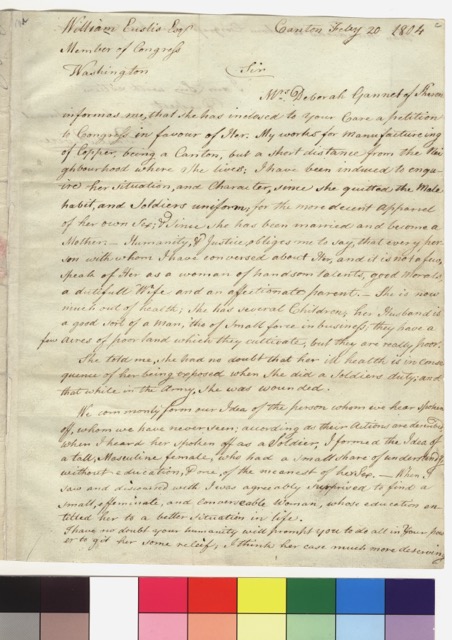
In 1782, Deborah Sampson (1760-1827) disguised herself as a man and enlisted in the 4th Massachusetts Regiment of the Continental Army as Robert Shurtleff. Sampson served for eighteen months before contracting yellow fever. Identity discovered, she received an honorable discharge in 1783.
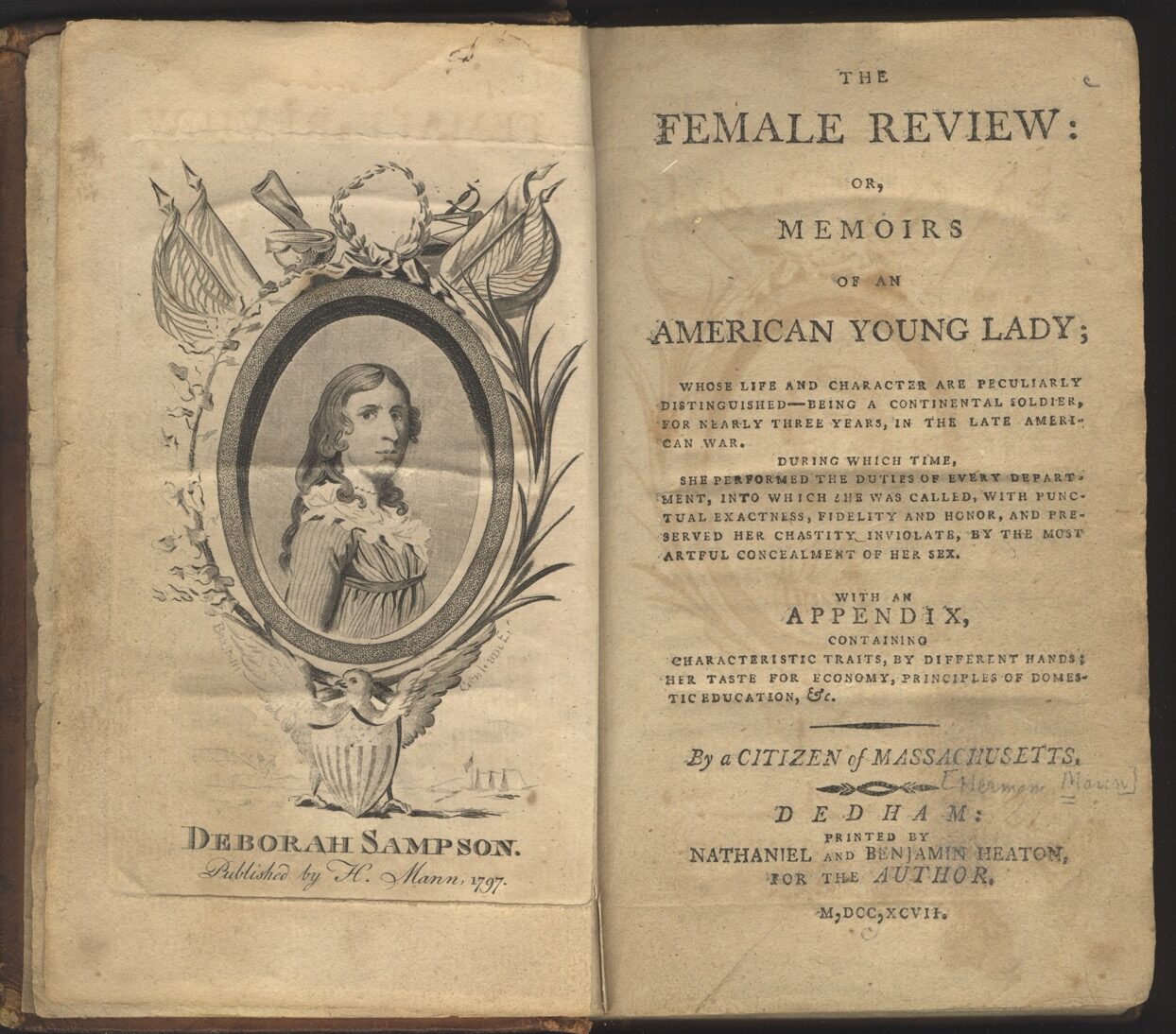
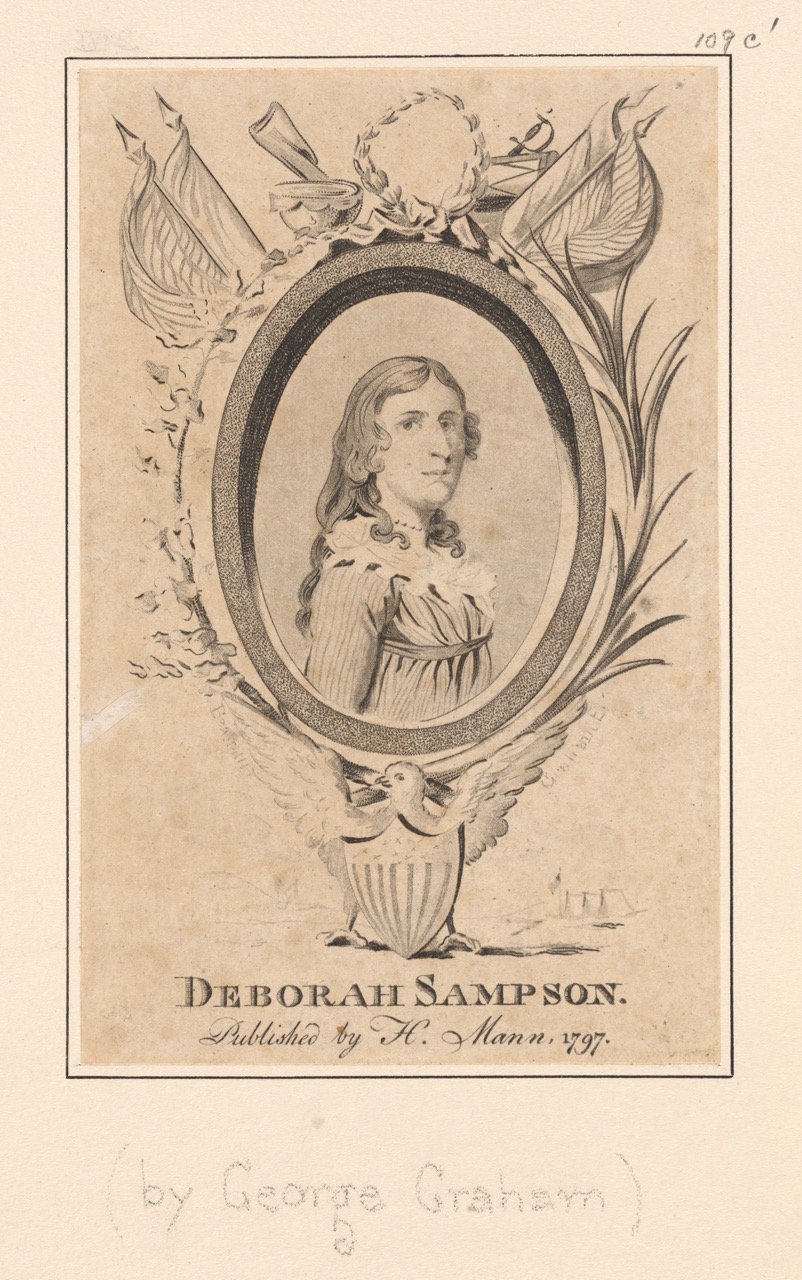
Sampson told her story to Herman Mann, who published The Female Review: or, Memoirs of an American Young Lady in 1797. Sampson later embarked on a lecture tour around the country, appearing on stage dressed in full military regalia. With support from Paul Revere, she became the first woman to receive a Federal military pension.
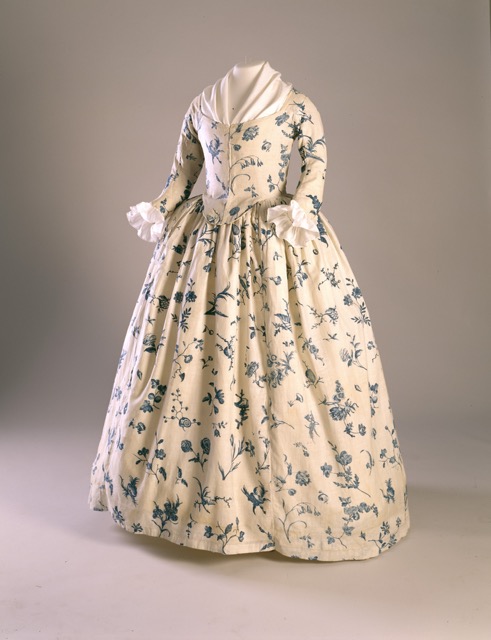
Deborah Sampson’s only surviving garment is the dress worn for her marriage to Benjamin Gannett in 1785.
“I will call it an error and presumption
because I swerved from the accustomed
flowry path of female delicacy
to walk upon the heroic precipice of
feminine perdition”
– Deborah Sampson Gannett, 1802
Deborah Sampson’s Dress
Dress
England and France, 1770-85
Linen
Gift of Ann B. Gilbert, Carol Bostock Kraner, Susan Goldstone and Louise Bostock Lehman Sonneborn in memory of Beatrice Weeks Bostock
Behind the Exhibition
No Longer in DisguiseWritten by Erica Lome and Mackenzie Landsittel
Historic New England’s collection includes the wedding dress Deborah Sampson wore when she married Benjamin Gannett in 1785. The dress was passed down in the Gannett family before arriving at Historic New England in 1998. Originally designed as an open robe, revealing the petticoat underneath, in the late eighteenth century the gown was altered into a round gown, with a skirt that closed across the front. It is interesting as a rare surviving example of a wedding dress from eighteenth-century New England, but it is also a tool with which to tell Sampson’s story. While it would have been powerful to display textiles representing Sampson as both a soldier and a wife and mother, her military uniform has been lost to history. When understood in the context of the supporting texts left by Sampson and others about her life and role in the American Revolution, her wedding dress prompts us to reconsider how she was remembered by the public and portrayed by historians in her own time and today.
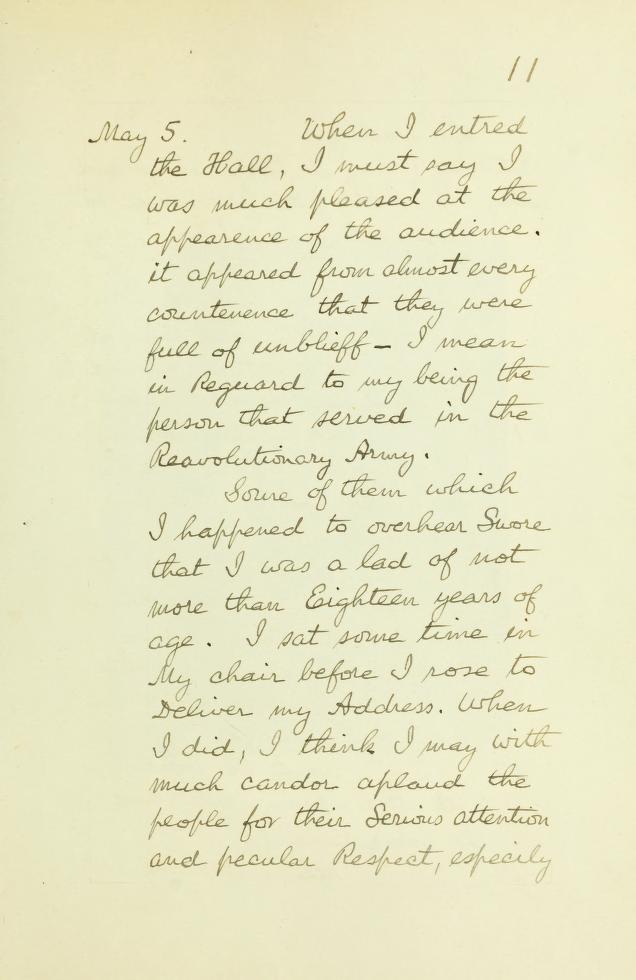
Sampson walked a fine line between traditional womanhood as a mother and wife and the more masculine roles of war veteran and public lecturer. In the speech she gave across the country, likely written by her biographer Herman Mann, Sampson apologized for breaking from gender norms to disguise herself as a man to fight in the war. She also revealed herself to be a proponent of a set of beliefs that, in same year the United States celebrated its bicentennial, historian Linda Kerber labelled “Republican Motherhood”: The idea that women were responsible for cultivating morality and patriotic ideals in the next generation of American leaders, which afforded them political influence even without formal political power. “The rank you hold in the scales of beings is, in many respects, superior to that of man,” Sampson declared in her stump speech. “Nurses of his growth, and invariable models of his habits, he becomes a suppliant at your shrine, emulous to please, assiduous to cherish and support, to live and to die for you.”
A Female Review
Deborah Sampson’s story had multiple authors. In The Female Review, newspaper publisher Herman Mann cast her as a folk hero: “Though destitute of many advantages of education, she happened to fix on many genuine principles.” Mann’s biography also contained embellishments. In one account, he claimed her ears were “deadened from the thundering of the invasion of Yorktown,” yet the Siege of Yorktown took place one year before Sampson enlisted in 1782. Sampson used public speeches, largely drafted by Mann, to address her unconventional actions.
Timothy Bigelow
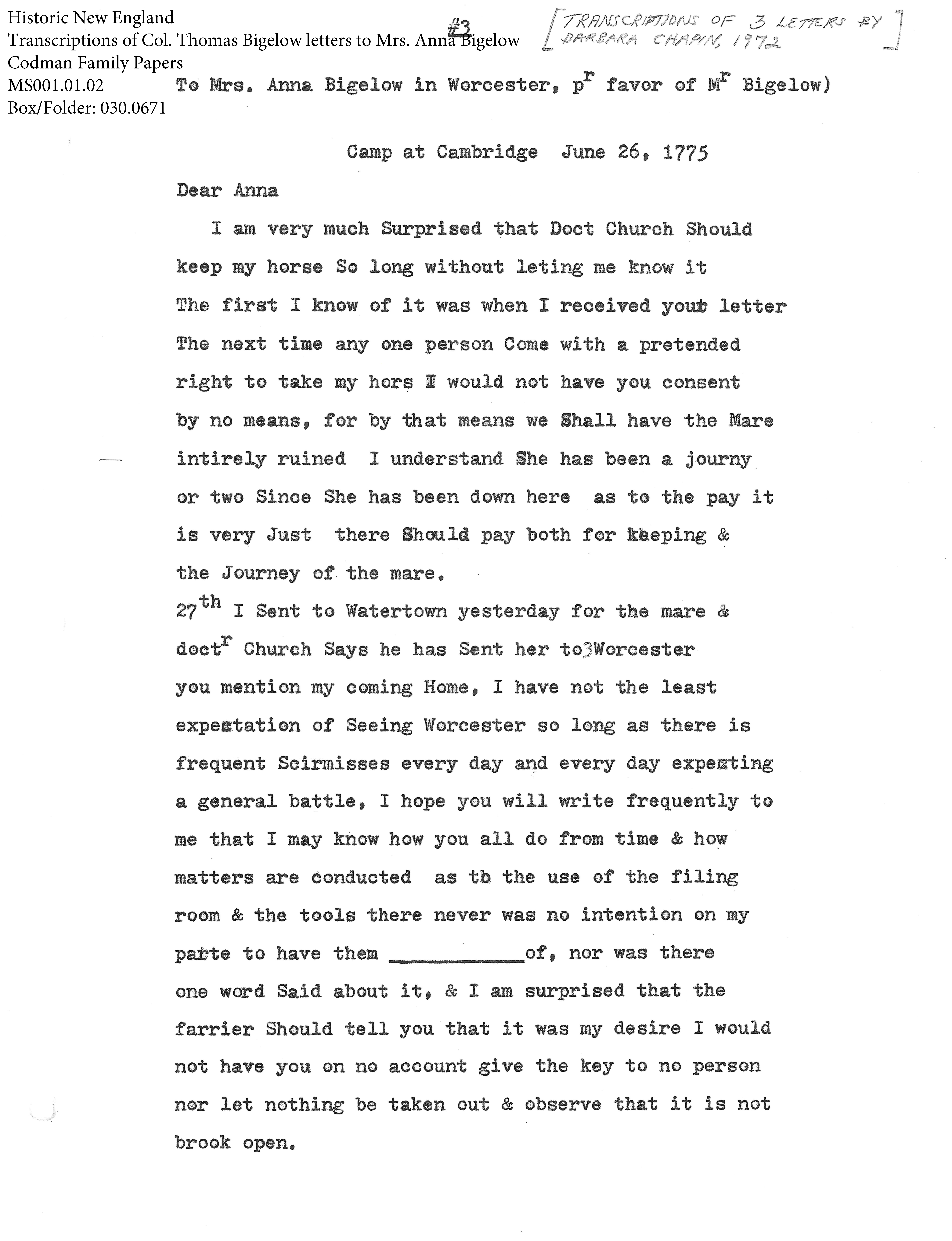
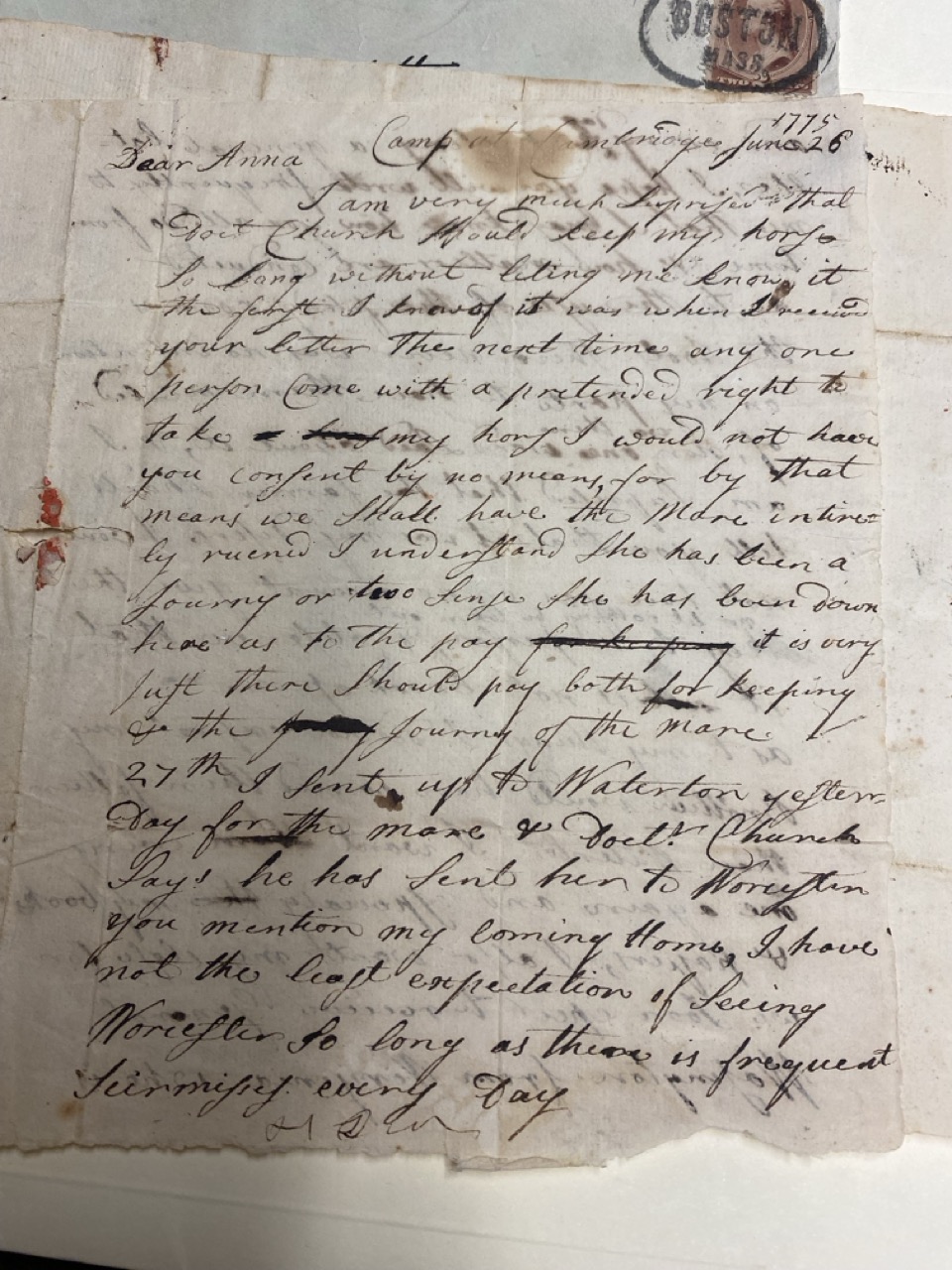
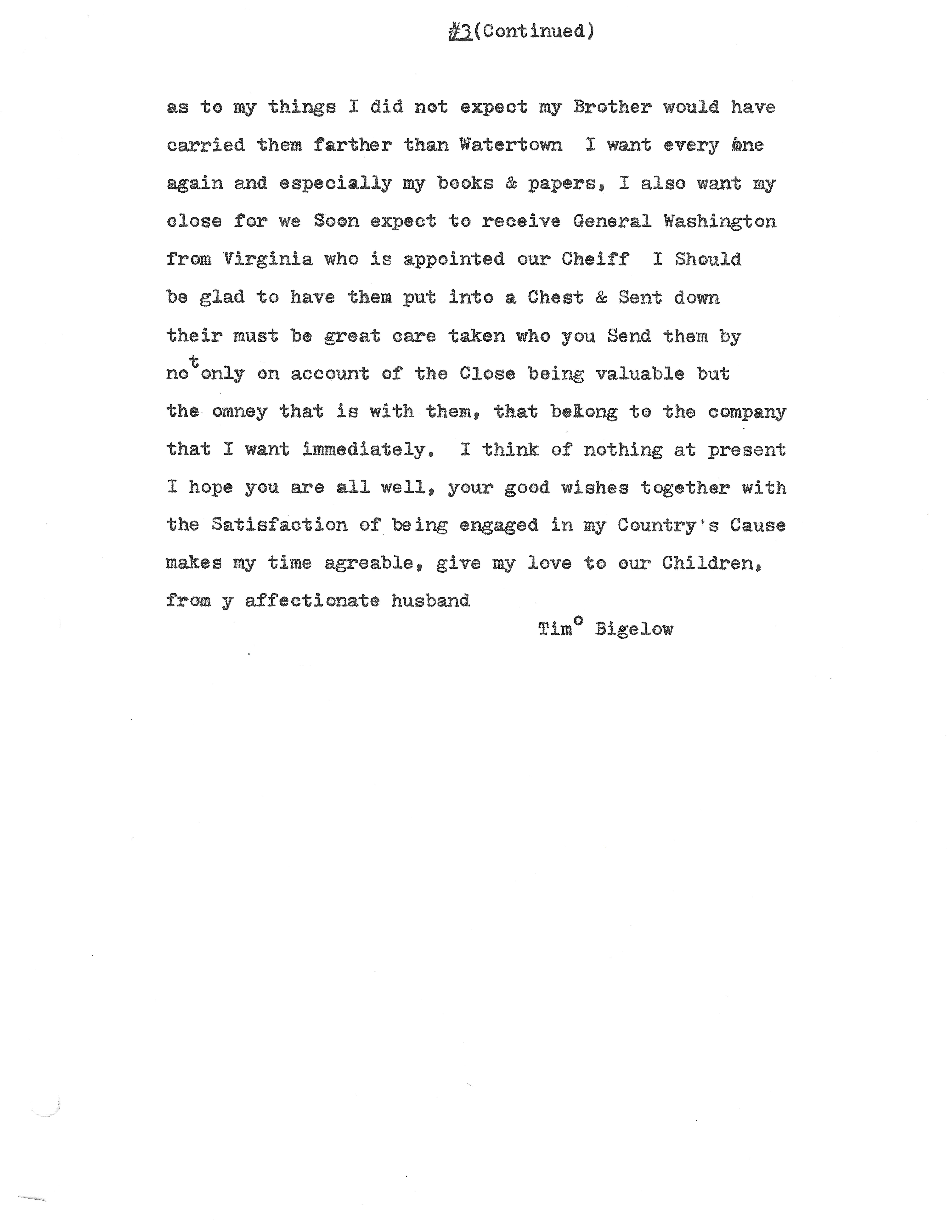
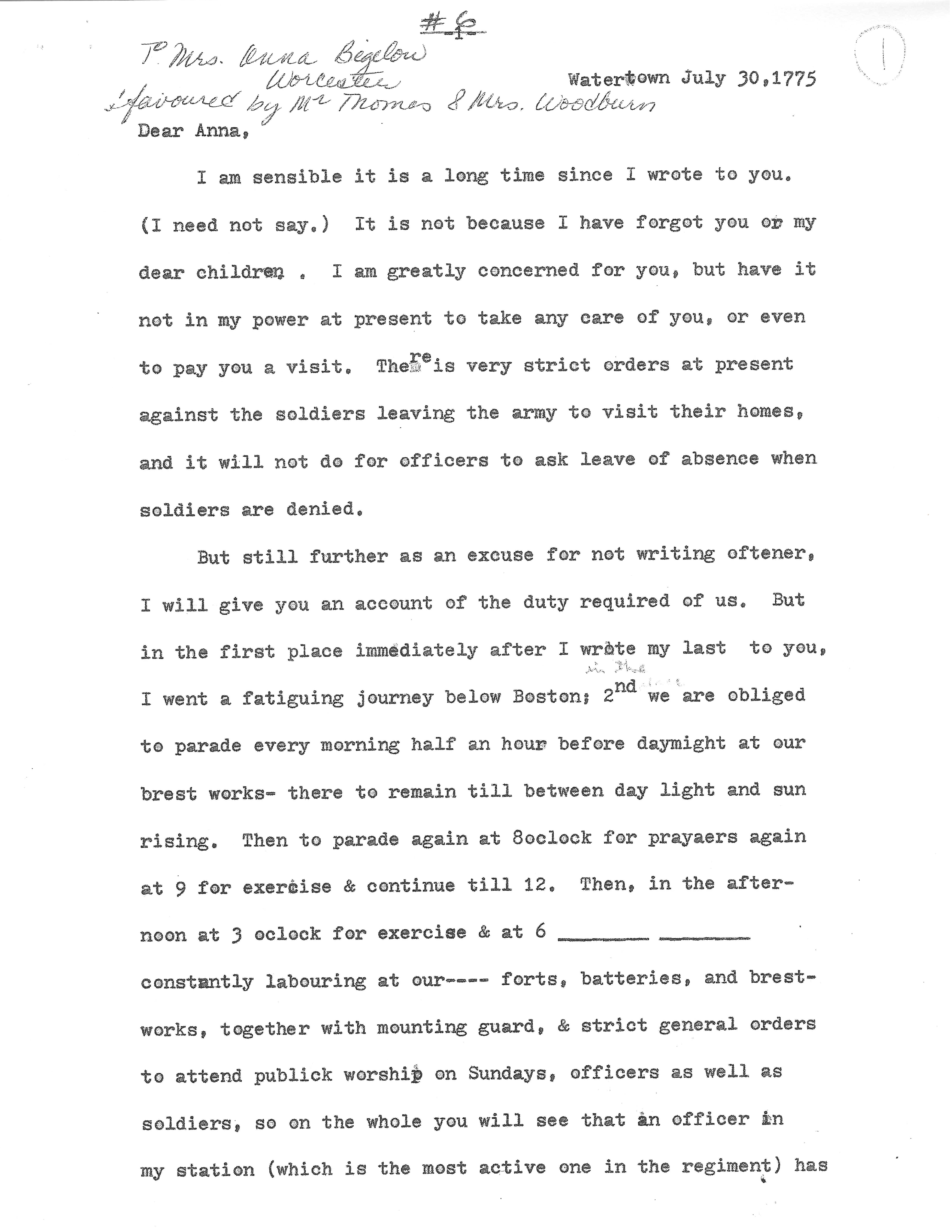
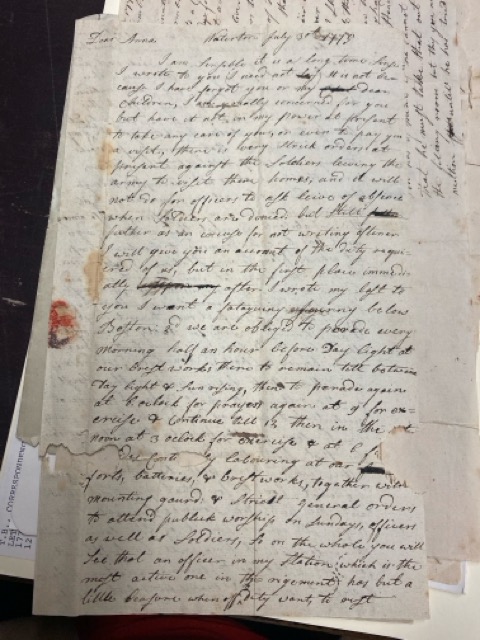
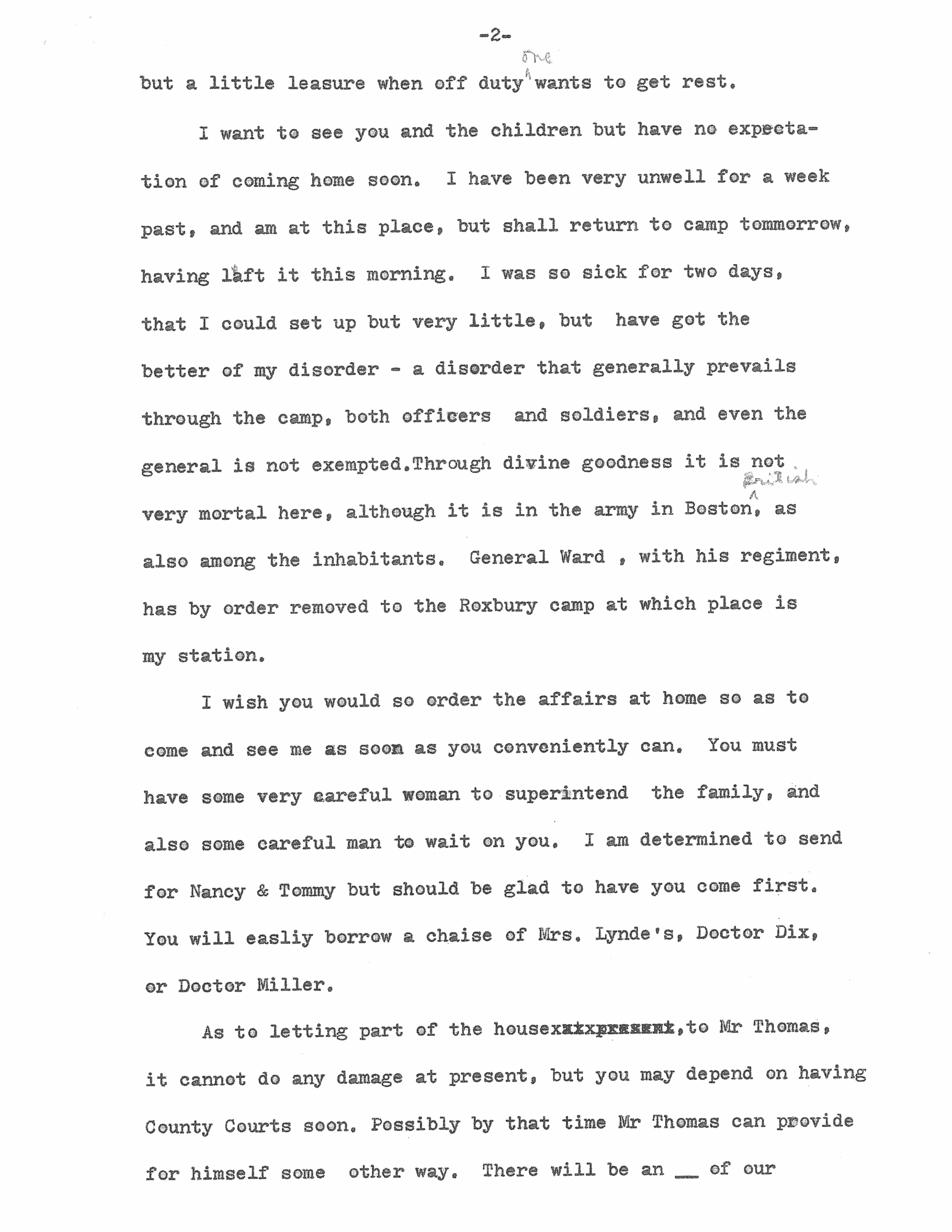
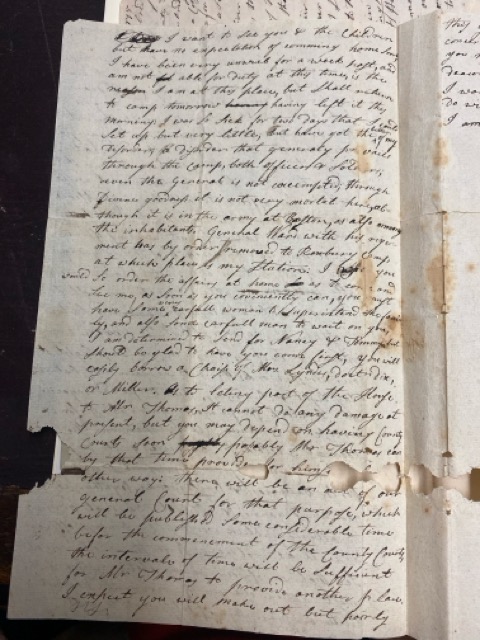
“I am sensible it is a long time since I wrote to you. (I need not say.) It is not because I have forgot you or my dear children. I am greatly concerned for you, but have it not in my power at present to take any care of you, or even pay you a visit. There is very strict orders at present against the soldiers leaving the army to visit their home, and it will not do for officers to ask leave of absence when soldiers are denied.”
– Timothy Bigelow to Anna Bigelow, July 30, 1775
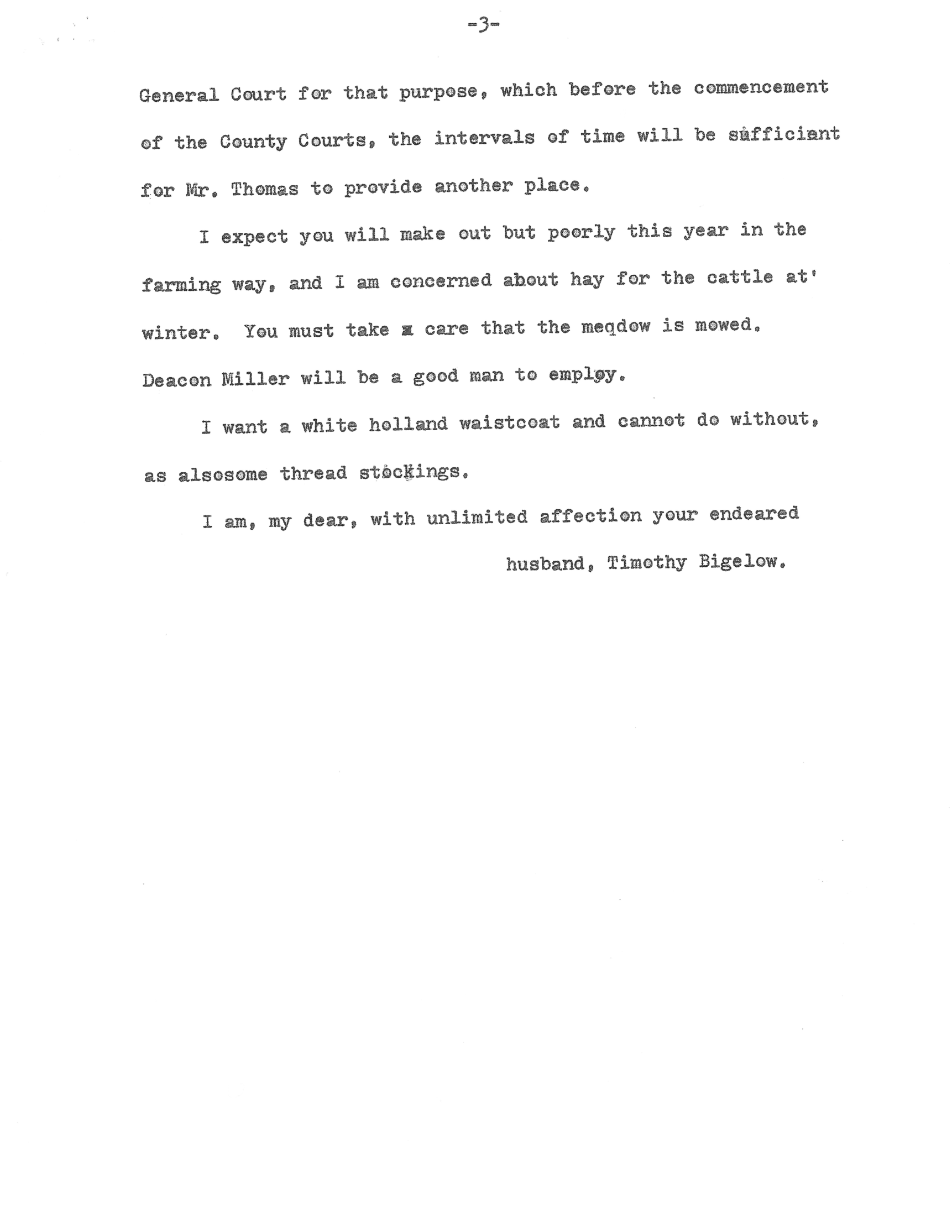
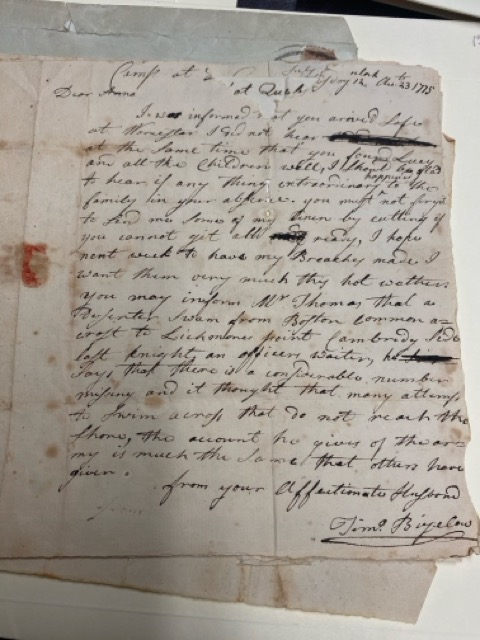
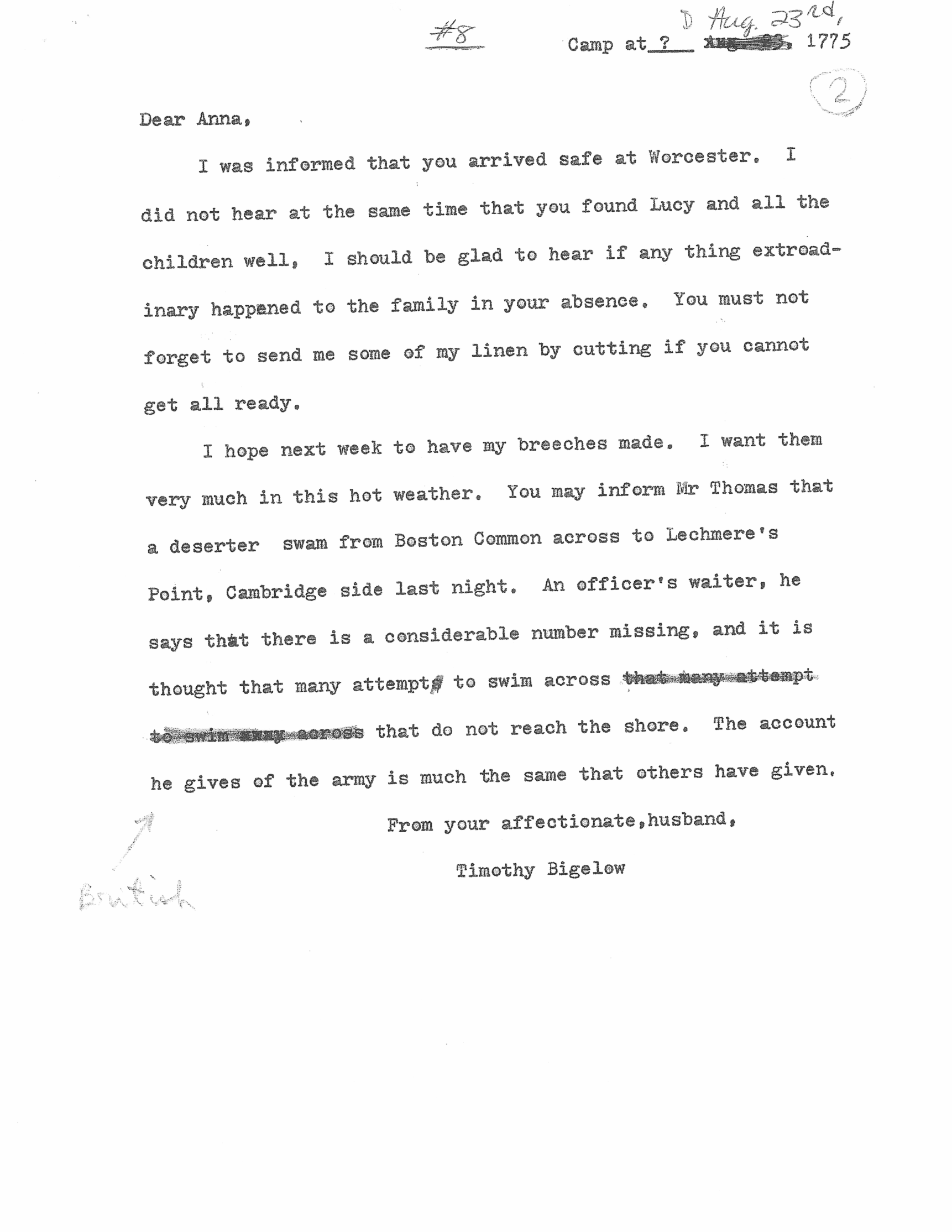
Timothy Bigelow’s letters to his wife, Anna, describe the regimental life of Continental Army officers, from daily drills and exercise to building fortifications and mandatory public worship. He also relayed news of men deserting their posts and disease making its way through the camp. Despite these challenges, Bigelow assured his wife that the “Satisfaction of being engaged in my Country’s Cause” made his time in service “agreeable.”
Bigelow’s letters also provide a glimpse into how colonial women managed their families and households during wartime. Anna Bigelow not only took in tenants while her husband was away but ran the farm in Worcester, Massachusetts, and conducted business with neighbors. In addition, she occupied her time making and sending clothing to her husband, whose letters include requests for garments such as linen breeches for the hot weather and something fine to wear for General Washington’s visit. He even requested that their son Andrew be “fitted out in as respectable a manner as other children in the neighborhood,” signaling his desire to maintain the family’s good reputation while he was away.
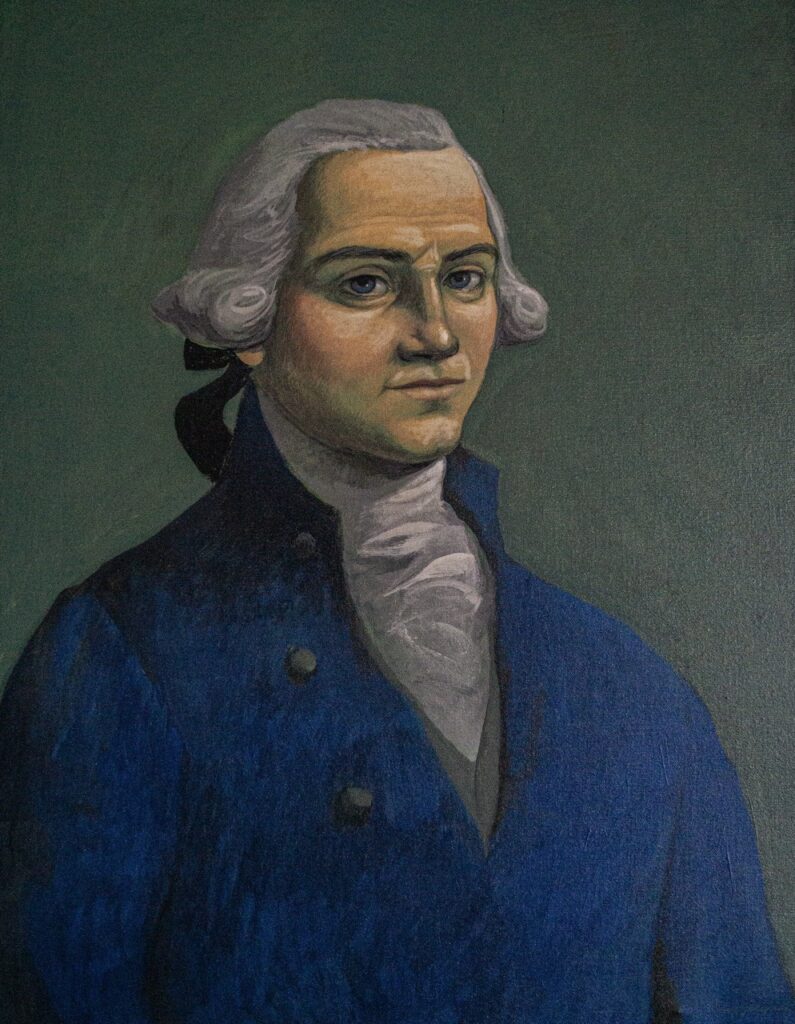
Portrait of Timothy Bigelow
This portrait of Timothy Bigelow was produced by Sante Graziani in the 1970s for the Colonel Timothy Bigelow Chapter of the Daughters of the American Revolution.
There is no surviving period portrait of Bigelow.
The Bigelow Letters
Colonel Timothy Bigelow wrote multiple letters to his wife, Anna Bigelow, during his time stationed away from his family. Bigelow’s letters provide a glimpse into how colonial women managed their families and households during wartime.
Powder Horns
In the eighteenth century, colonists used hollowed-out vessels made from ox or cattle horns to carry their gunpowder for a flintlock musket. Fitted with a plug at the base and a stopper in the spout, the curved form of the powder horn fit around the waist of its user comfortably when worn with a long strap over the shoulder.
Powder horns were often personalized, inscribed with the names of their owners along with designs ranging from geographic and military landmarks to whimsical creatures. Artisans working in military camps did much of the engraving, a decorative tradition beginning in the 1740s which lasted until the Continental Army began equipping soldiers with cartridge boxes for their gunpowder soon after the Siege of Boston began in 1775.
After the American Revolution, veterans and their families preserved powder horns as souvenirs of military service.
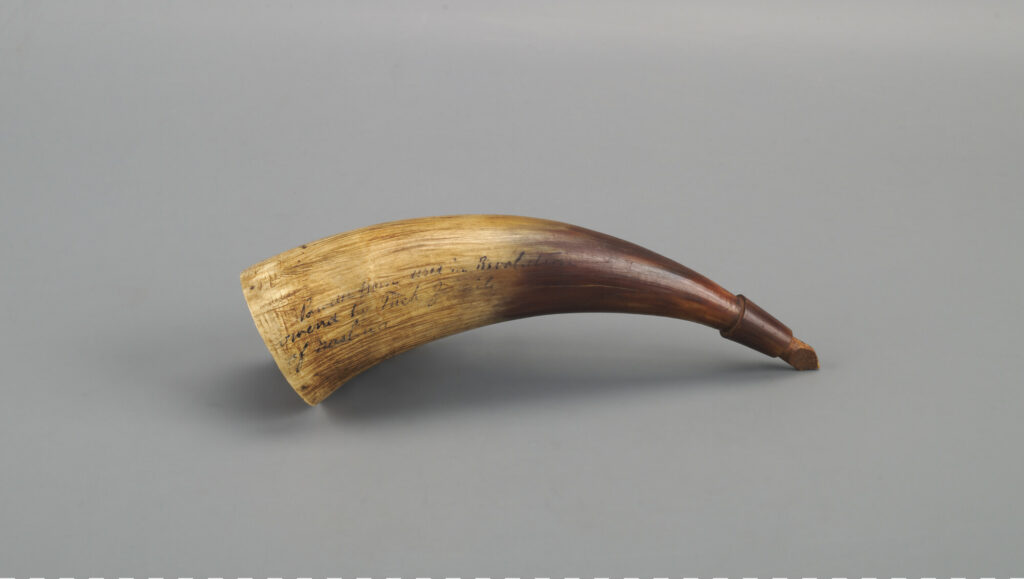
Powder Horn, 1770
Powder Horn
New Hampshire, 1770-80
Horn, wood
Gift of Mr. Stephen T. Moore
According to its inscription, this unadorned powder horn, “used in Revolution,” belonged to a member of the Tuck family of Nashua, New Hampshire. However, the horn’s original owner cannot be identified and its small size suggests it was not used in the military. The handwritten note was probably reason enough for its acquisition by donor Stephen T. Moore in the early twentieth century.
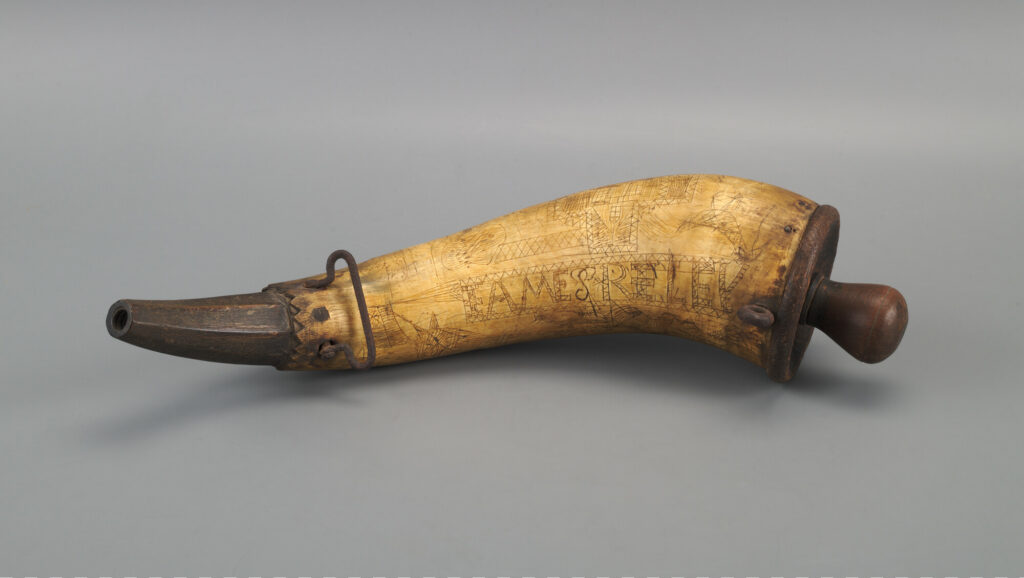
Powder Horn, 1775
Powder Horn
New England, 1775-77
Horn, wood
Gift of Miss Margaret Wyman
James Reiley likely used this artillery priming horn while serving in Colonel John Crane’s Continental Artillery Regiment. Reiley participated in military campaigns in New England, New York, and New Jersey. The presence of carved decoration, including Reiley’s name, helps date this horn to the Siege of Boston.
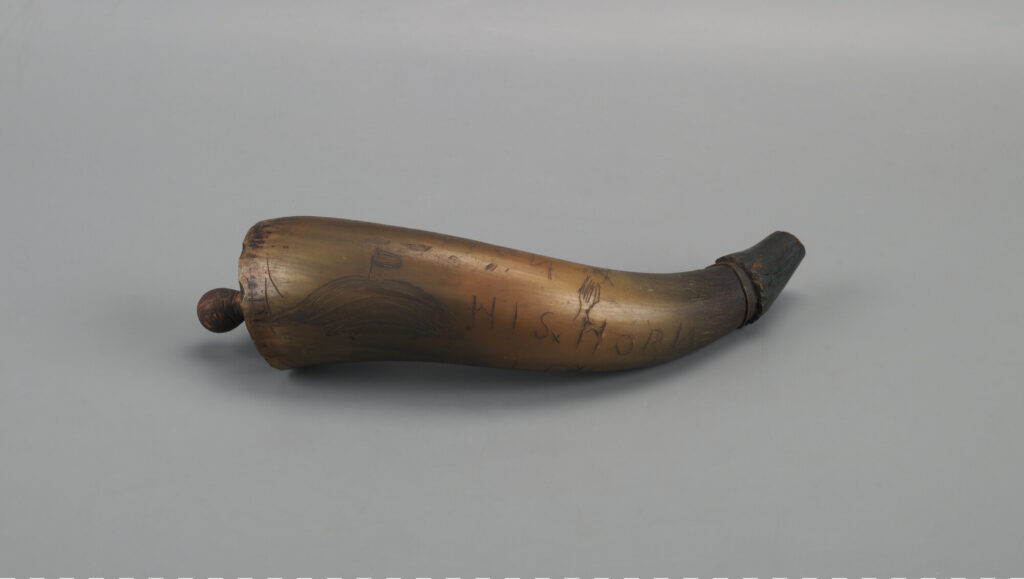
Powder Horn, 1900
Powder Horn
Unknown location, 1900-34
Horn, wood
Gift of Wickliffe Draper
“JUNE 17, 1775/ W. WILAND/
LEXINGTON/ HIS HORN/
CHARLESTOWN”
The engraving on the body of this powder horn claims its use during the American Revolution, but in reality, this is a horn with later carvings, designed to attract a collector. Aside from the crude carving, there is no record of a W. Wiland from Lexington ever serving in the Massachusetts Army.
Behind the Exhibition
A Case Study of Three Powder HornsIn the eighteenth century, colonists used hollowed-out vessels made from ox or cattle horns to carry their gunpowder for a flintlock musket. Fitted with a plug at the base and a stopper in the spout, the curved form of the powder horn fit around the waist of its user comfortably when worn with a long strap over the shoulder.
Powder horns were also works of art, engraved with ornate designs and inscriptions made by their owners or professional artisans working in military camps as early as the 1740s. On the most basic level, decorated powder horns were a means of personal identification for soldiers. They also served as canvases for soldiers to document the world around them. Popular decorations ranged from geographic maps and military forts to animals and whimsical creatures. Horns carved during the Siege of Boston (1775-1777) depicted fortifications, city views, and encampments in Roxbury, Charlestown, and Cambridge; soldiers marching and engaged in battle; and plenty of patriotic imagery. This decorative tradition lasted until the Continental Army, led by George Washington, began equipping troops with cartridge boxes for loading gunpowder, diminishing the need to carry a horn.
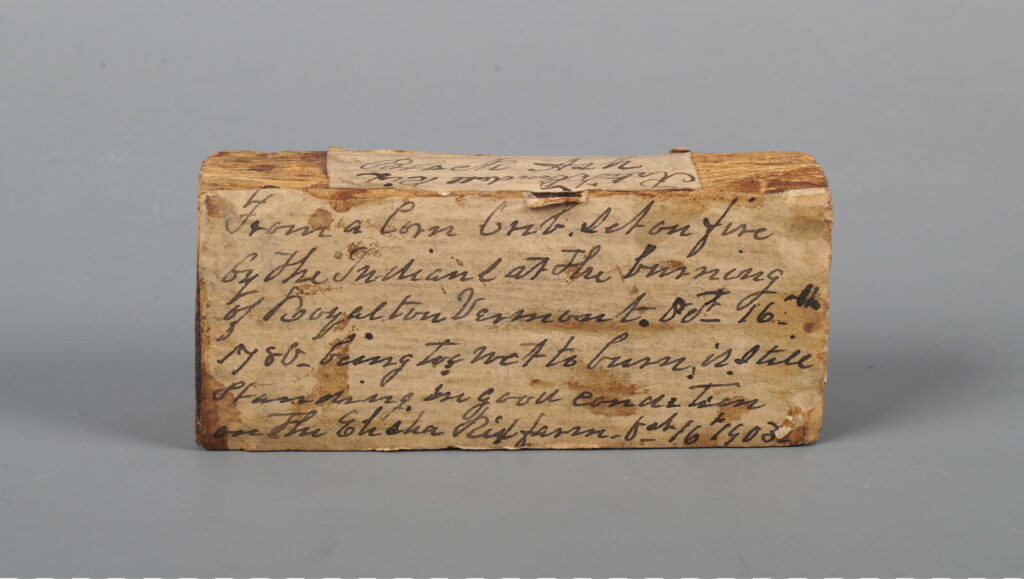
Corn Crib
Fragment of Corn Crib
Royalton, Vermont, ca. 1780
Black ash
Gift of Miss Mary Johnson
“Black ash. From a corn crib set on fire by the Indians at the burning of Royalton, Vermont Oct. 16th, 1780, being too wet to burn is still standing in good condition on the Elisha Rix farm Feb. 16, 1903.”
When Mary Johnson donated this fragment of a corn crib to Historic New England in 1920, she called it a “relic,” believing its association with the infamous Royalton Raid of 1780 made it valuable to a museum collection. The neatly squared angles on this block of wood imply the original corn crib was torn down and divided up for interested parties.
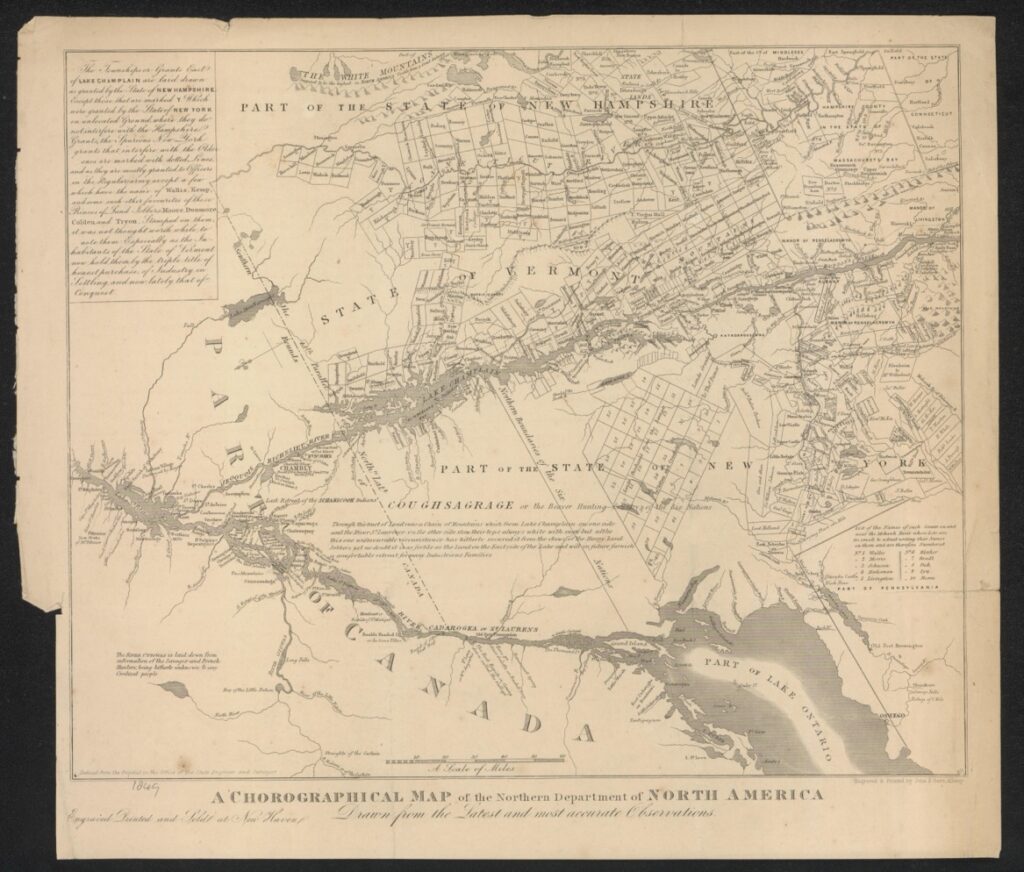
Map of Northern New England
“A Chorographical Map of the Northern Department of North America”
University of Michigan Digital Collections
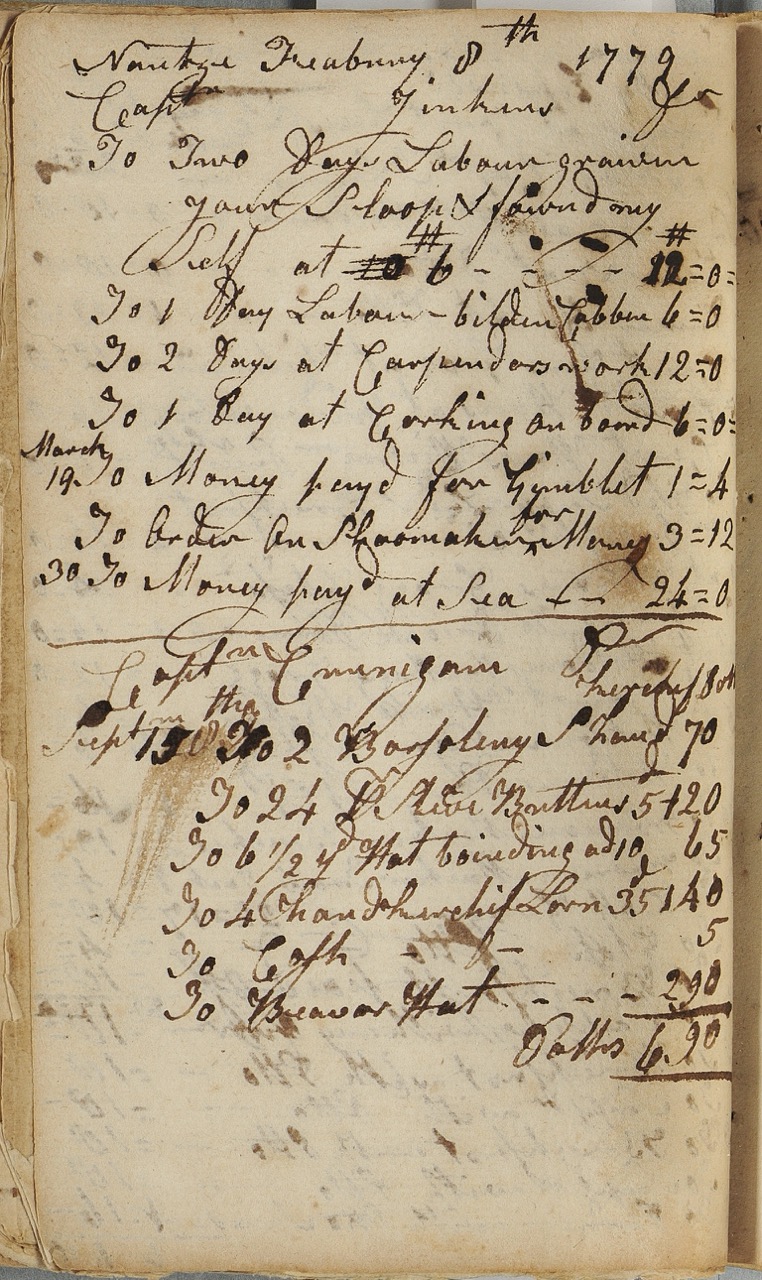
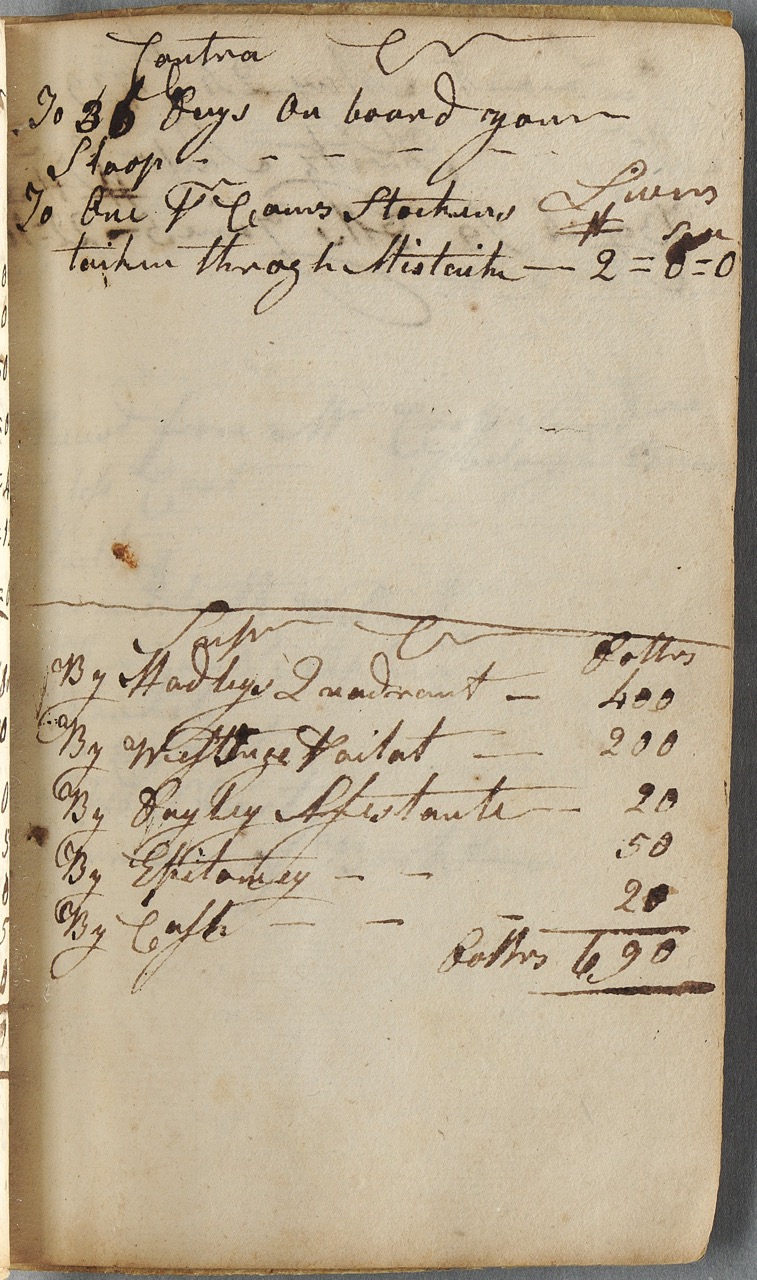
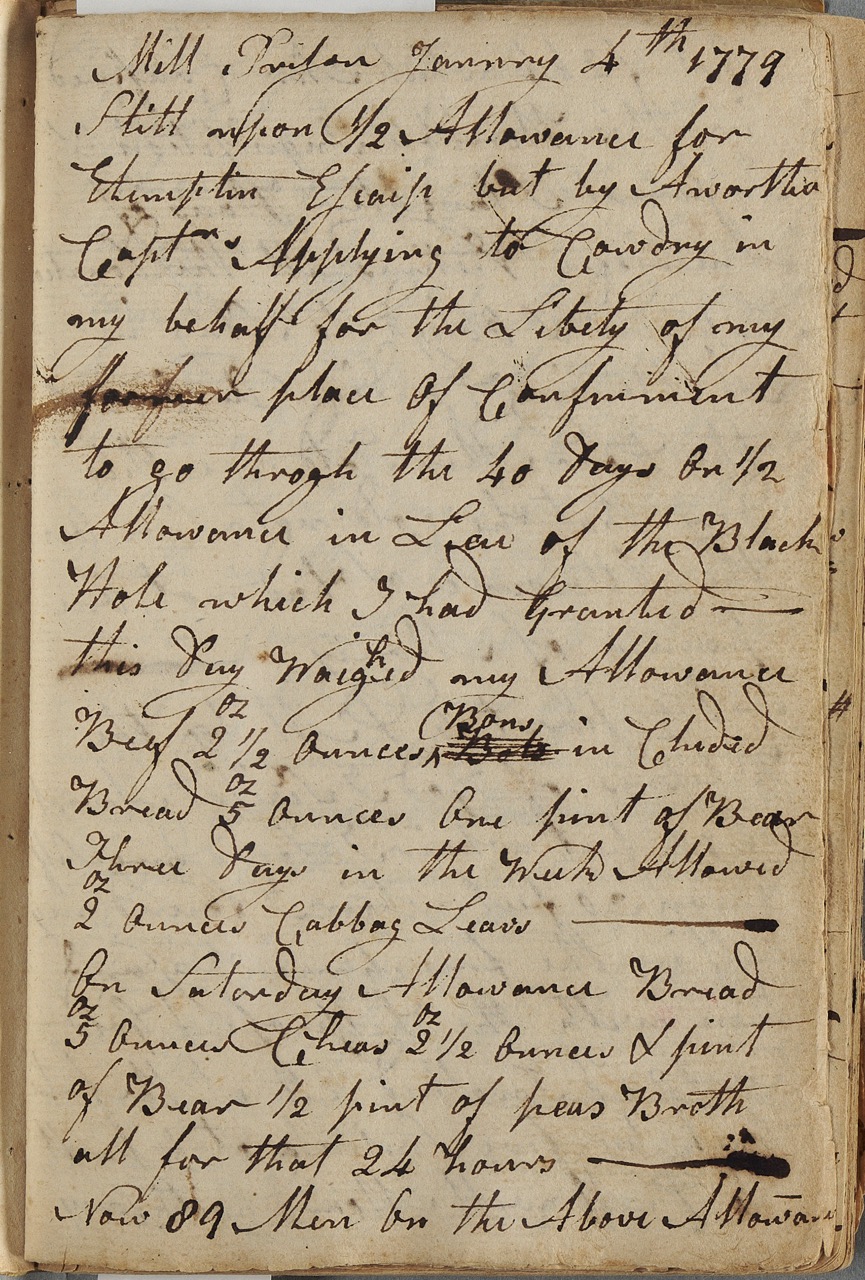
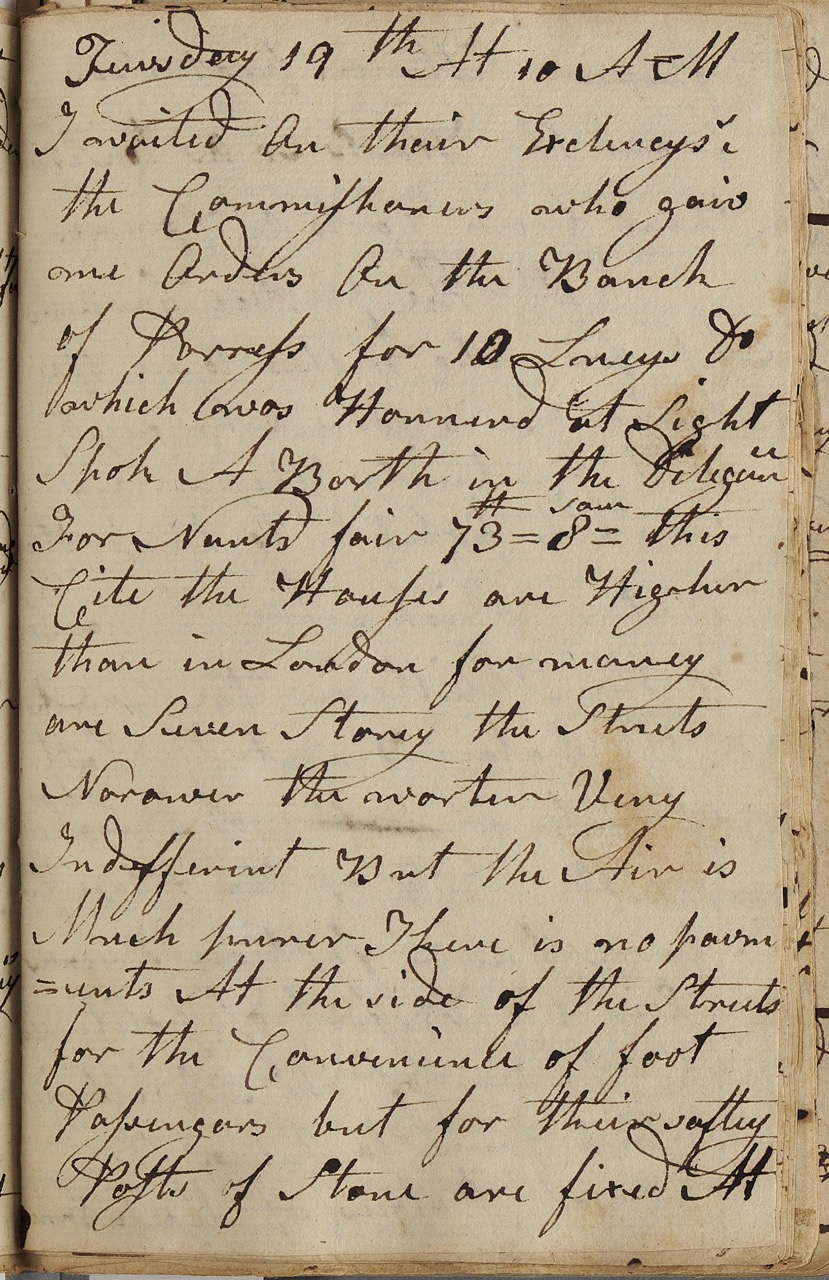
Offin Boardman
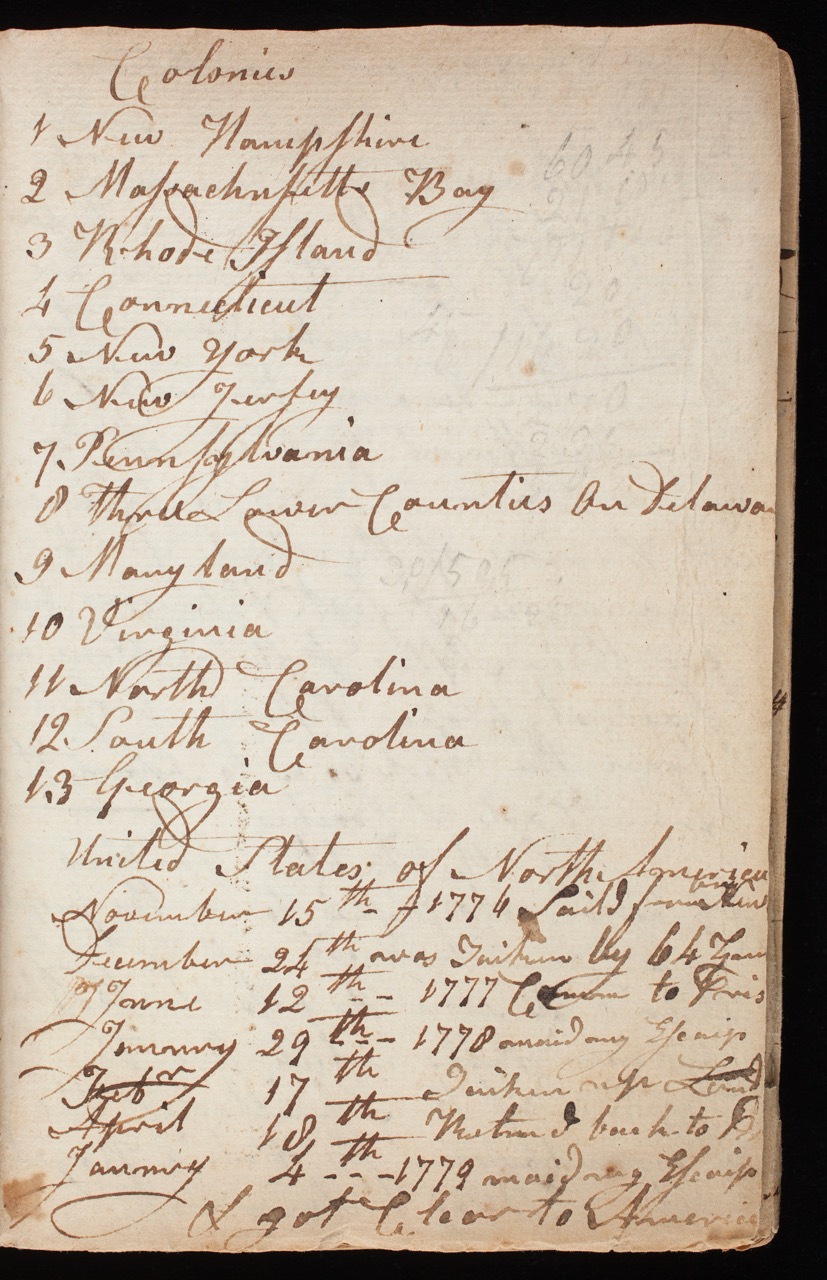
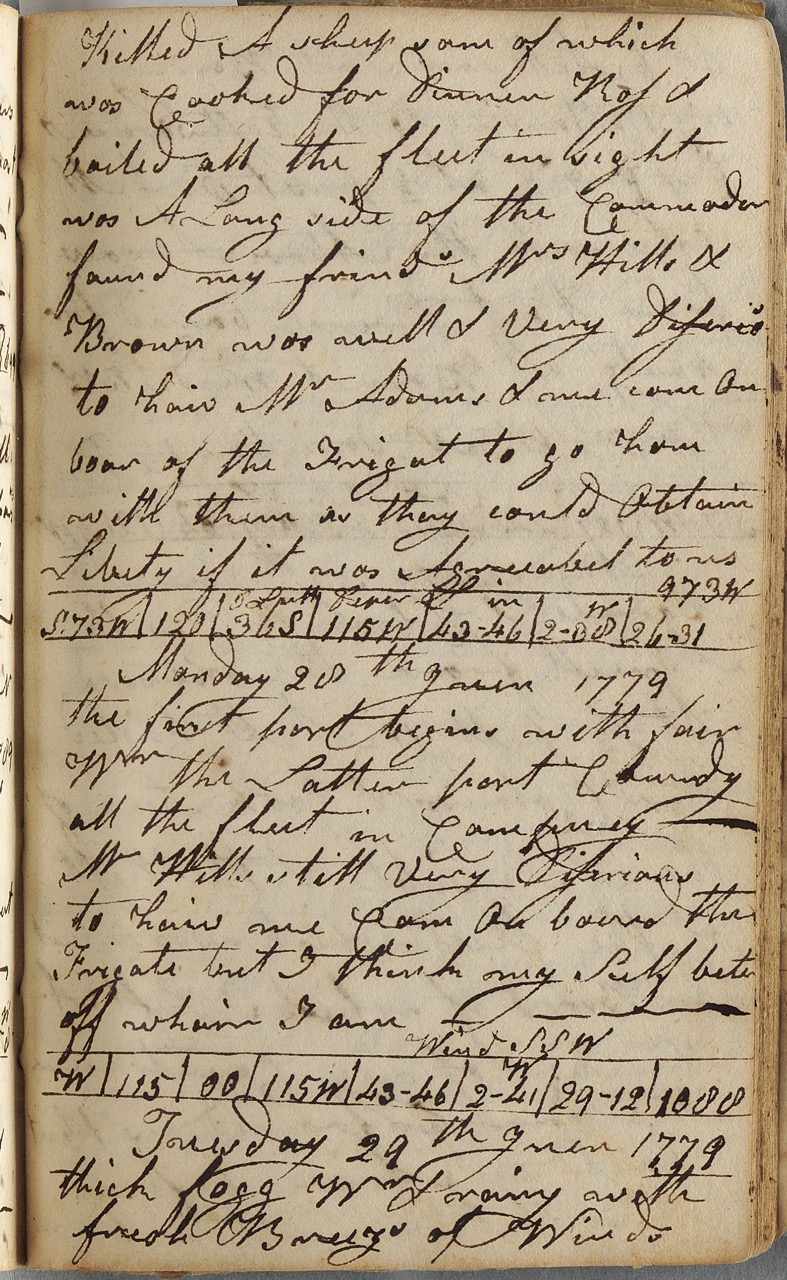
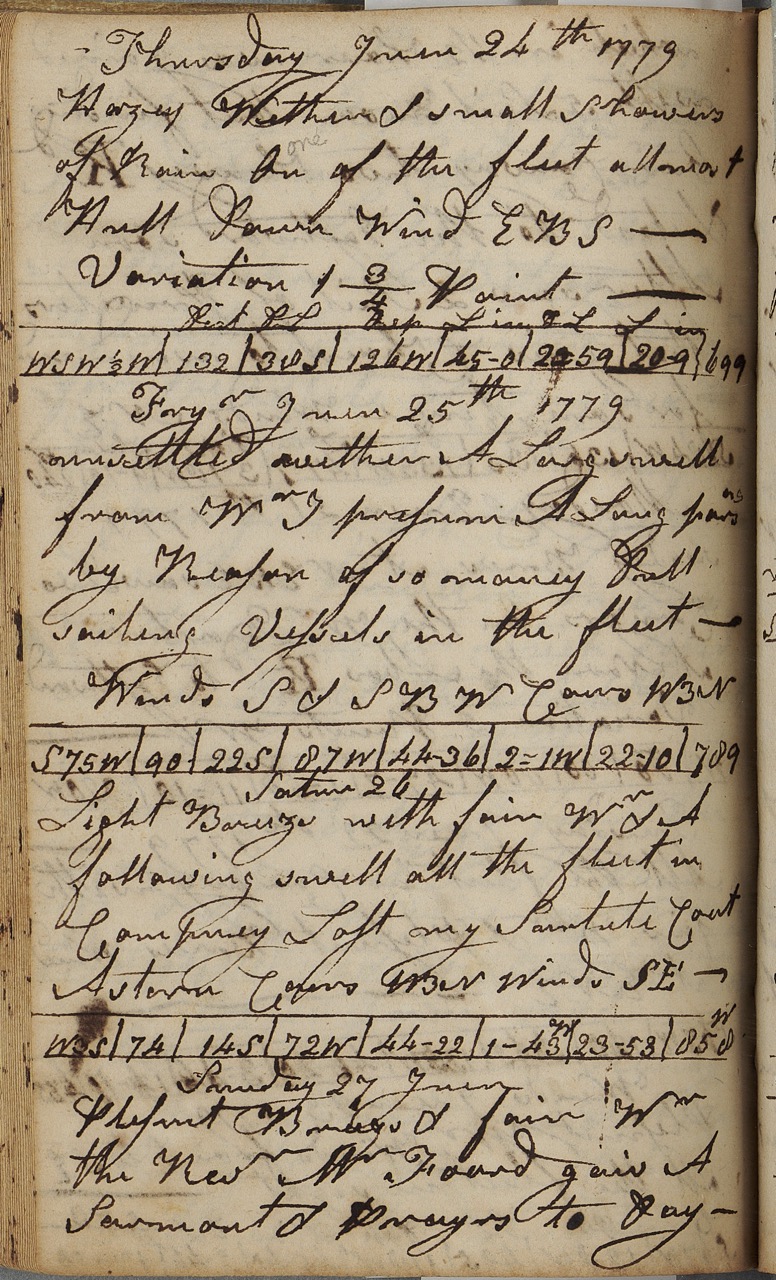
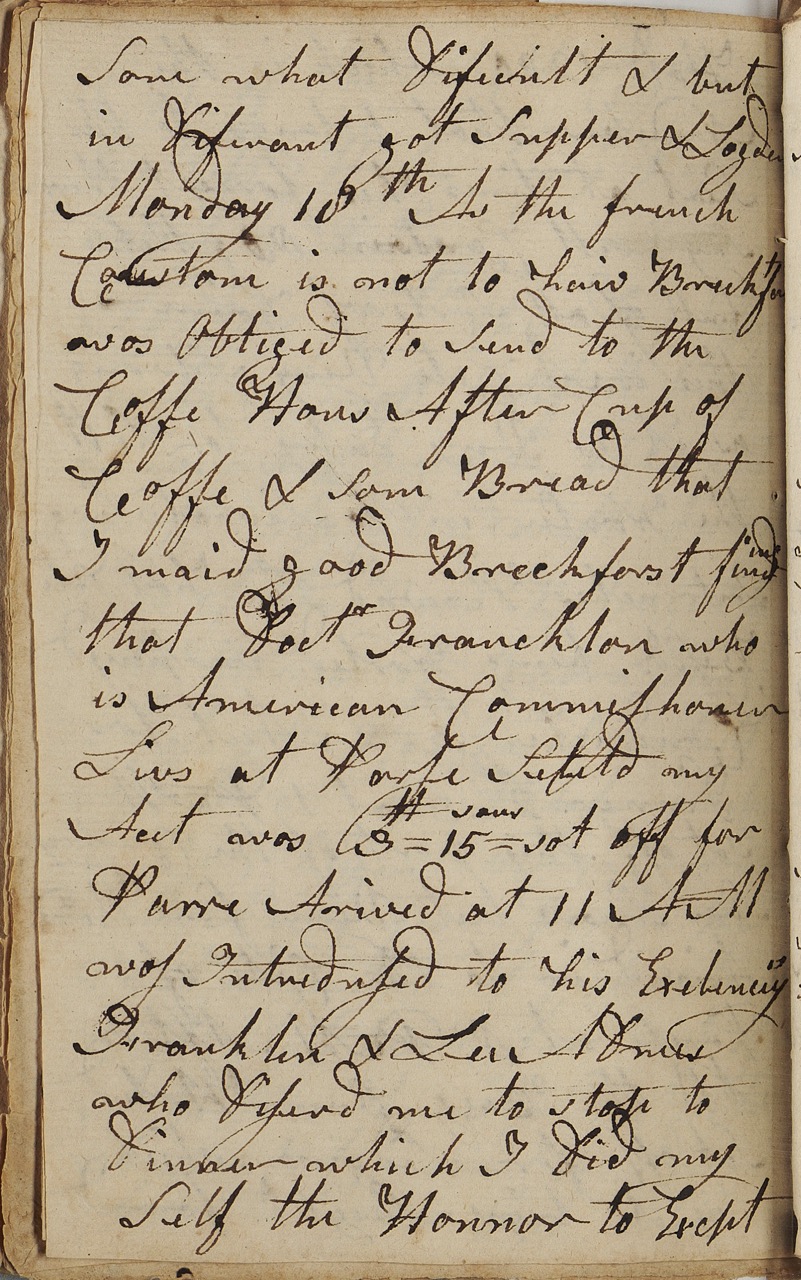
During the American Revolution, Offin Boardman (1747-1811) of Newburyport, Massachusetts, amassed a fortune as a privateer. Captured and held by the British in 1777, Boardman escaped “that dismal hole, Mill Prison” in 1779 and made his way from England to France, where his connections secured him passage to America. In his diary, Boardman recalled meetings with “His Excellencies Franklin and Adams” while Paris. Other entries describe daily life aboard commercial ship and notes to his wife. Boardman eventually returned to Newburyport and lived at Historic New England’s Spencer-Peirce-Little Farm until his death in 1811. Diary of Offin Boardman. England, France, Virginia, 1779-80. Paper, leather, ink. Gift of Margaret Bradbury Gigon.
Offin Boardman's Diary
Flip through Offin Boardman’s Diary
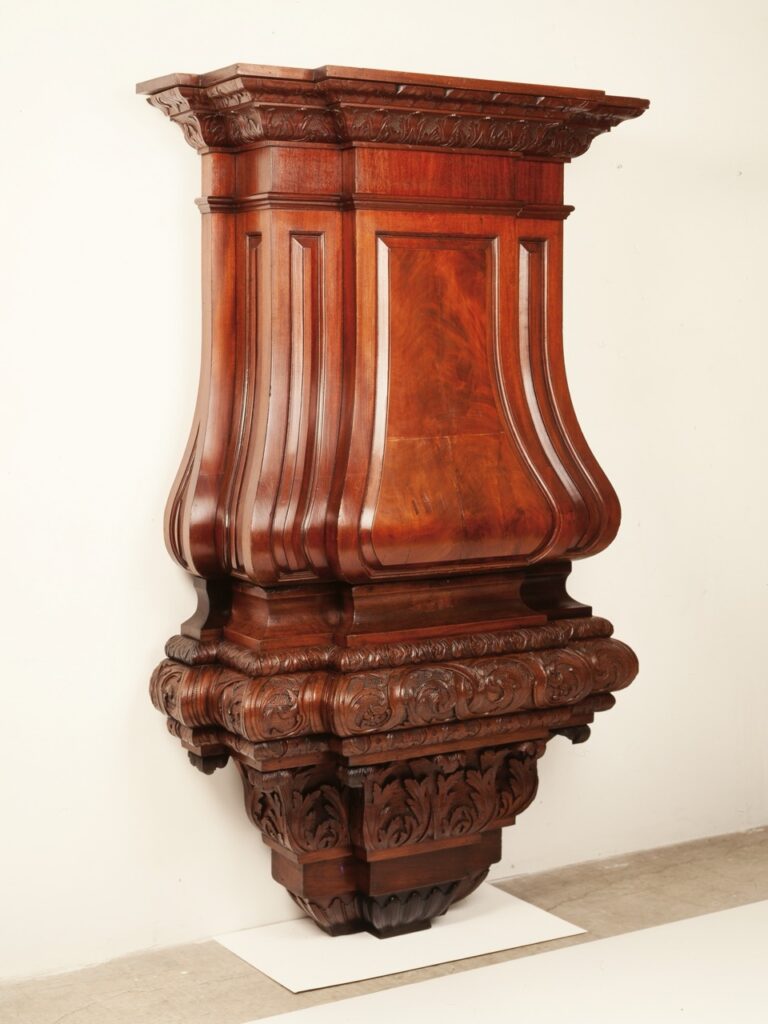
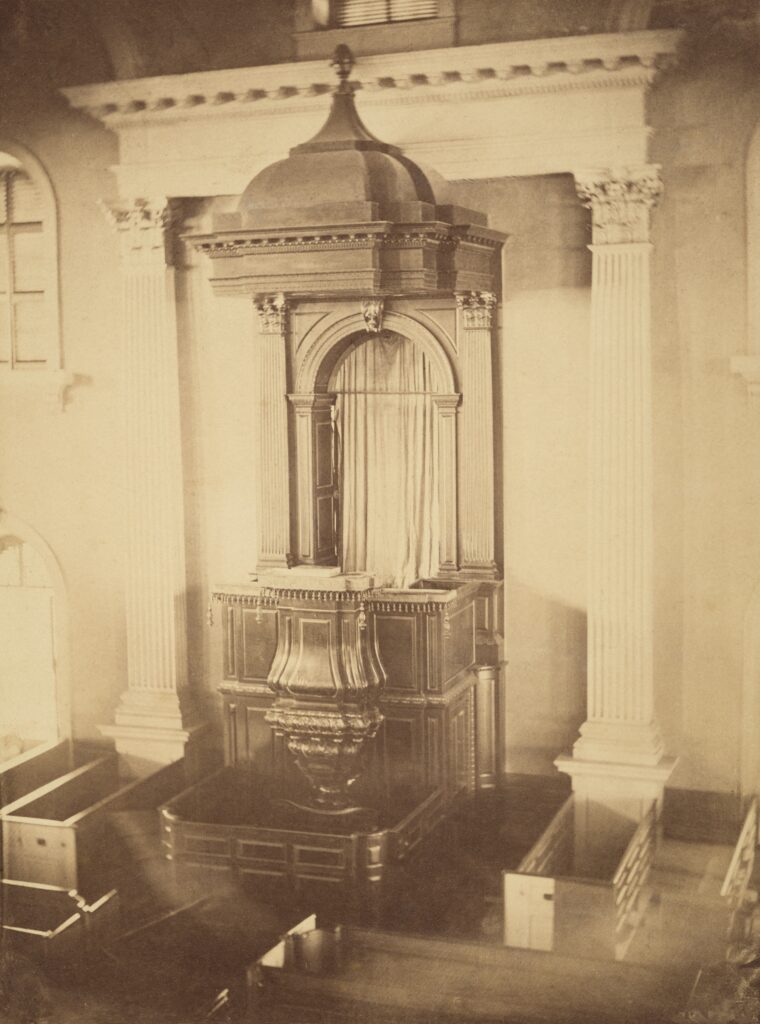
Pulpit
Pulpit
Attributed to William Crafts (1736-1800) and William Burbeck (1716-1785)
Boston, 1772-73
Mahogany, pine
Gift of the Massachusetts Historical Society
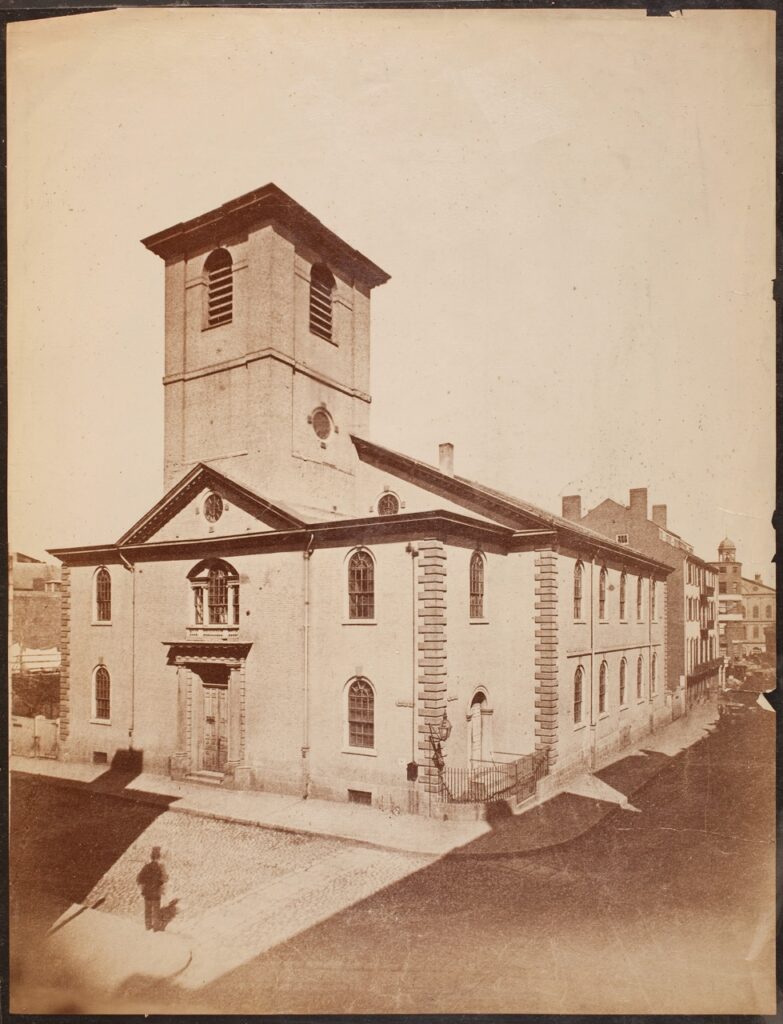
Brattle Street Church was a site of worship for Boston’s elite families, counting John Hancock, Joseph Warren, and John and Abigail Adams among its parishioners.
From this handsomely carved pulpit, Reverend Samuel Cooper (1725-1783) infused his sermons with revolutionary sentiments. After British soldiers occupied Boston in 1768, Cooper preached: “I pray that our Brethren separated from us by the ocean would cherish a fellow feeling for us; and allow us to enjoy those rights, of which they justly boast. . . . Rights, which are not constituted by human compact, but by the immutable Rule of Equity, and the eternal laws of the God of Nature.”
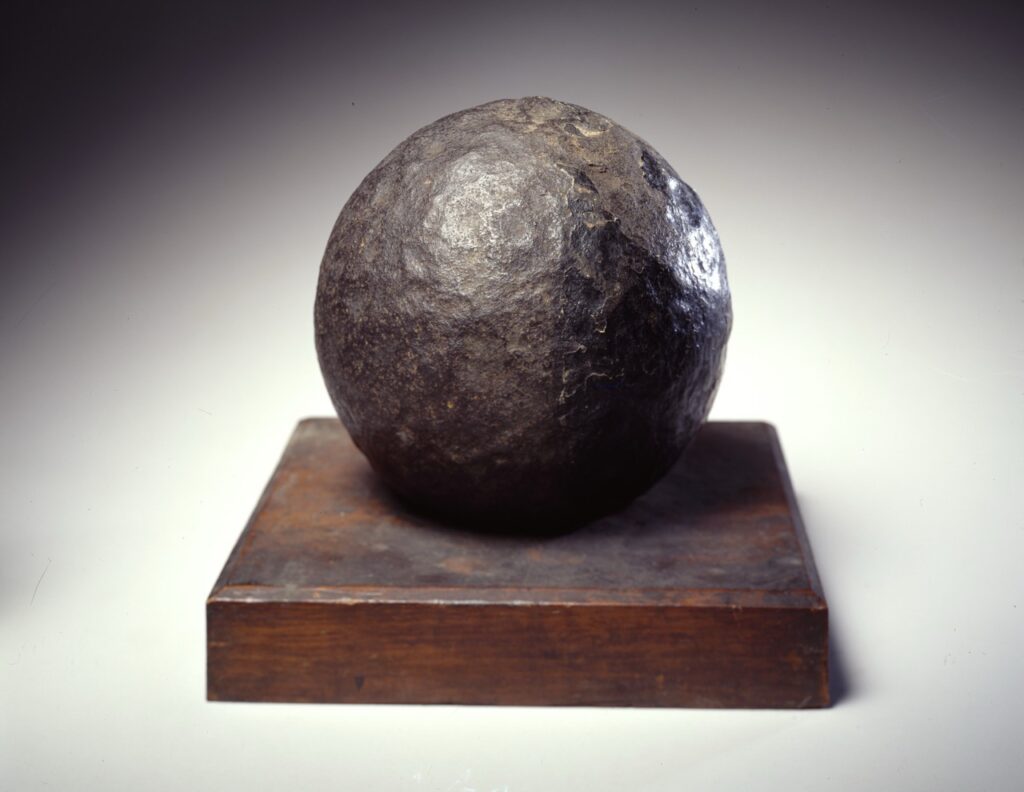
Cannonball
Cannonball
Boston, 1770s
Gift of the Massachusetts Historical Society
During the Siege of Boston, British soldiers used Brattle Street Church as barracks. In 1776, the American army fired cannons at the church, and this cannonball hit the facade.
After the British evacuated Boston, Samuel Cooper returned to find his church damaged but still standing. He continued to deliver sermons and wartime updates from the pulpit, including news of General Burgoyne’s surrender in 1777 and France’s alliance with America in 1778. The cannonball remained lodged in place until the church was demolished in 1871.
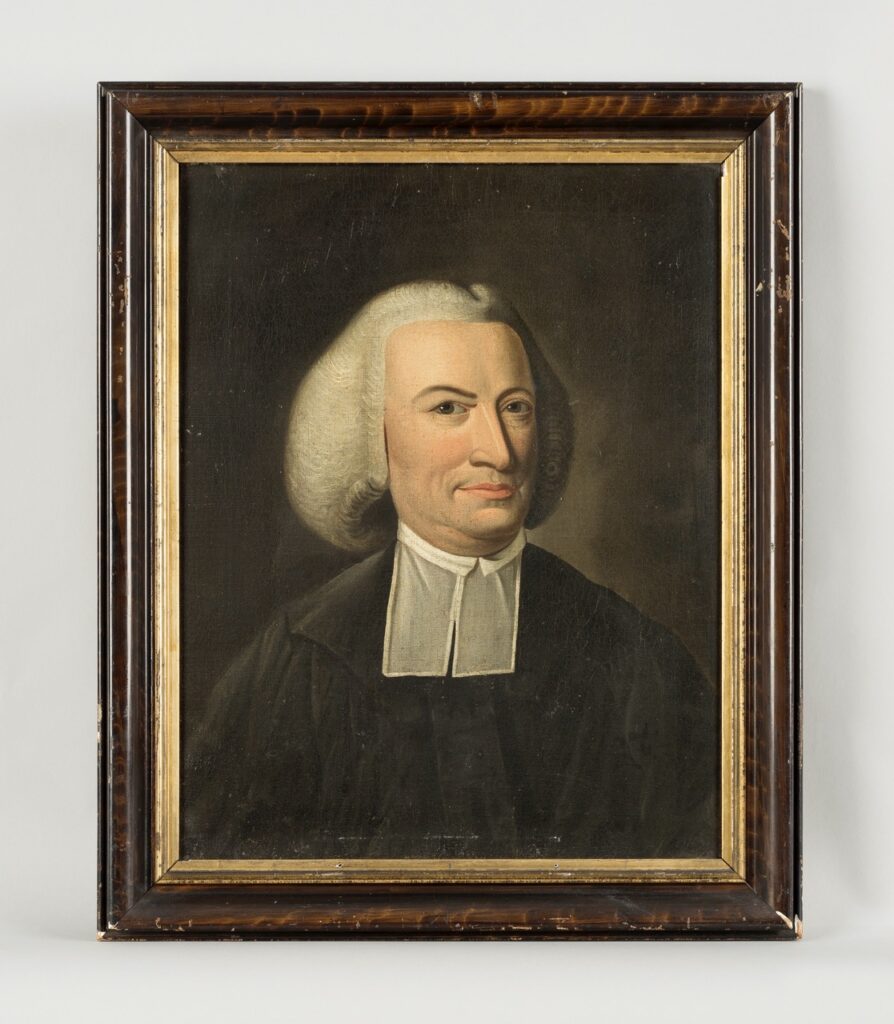
Reverend Samuel Cooper
Reverend Samuel Cooper
Attributed to John Singleton Copley
(1738-1815)
Boston, 1780s
Collection of the Massachusetts Historical Society
Brattle Street Church Exterior
Exterior of Brattle Street Church showing the cannonball lodged in the building above the door.
Measured drawings of Brattle Street Church by Gridley James Fox Bryant.
Historic New England, Library and Archives
Brattle Street Church Interior
Interior, Brattle Street Church, ca. 1860.
Historic New England, Library and Archives
Explore More
The next page is Gallery 4.